The Durable Performance Brief · Edition 27 · September 23, 2026
Most leaders know what they want their organization to value.
Quality.
Accountability.
Judgment.
Candor.
Ownership.
Collaboration.
Long-term thinking.
They talk about those things because they genuinely believe in them.
Then the organization behaves differently.
Quality gives way to speed. Candor gets replaced by careful messaging. Ownership turns into escalation. Collaboration becomes political coordination. Long-term priorities lose to whatever the quarter rewards most visibly.
Leadership often responds by repeating the message.
That usually misses the problem.
When behavior consistently contradicts intent, the first question should not be whether people understood what leadership said.
It should be whether the system is teaching something else.
The Core Thesis
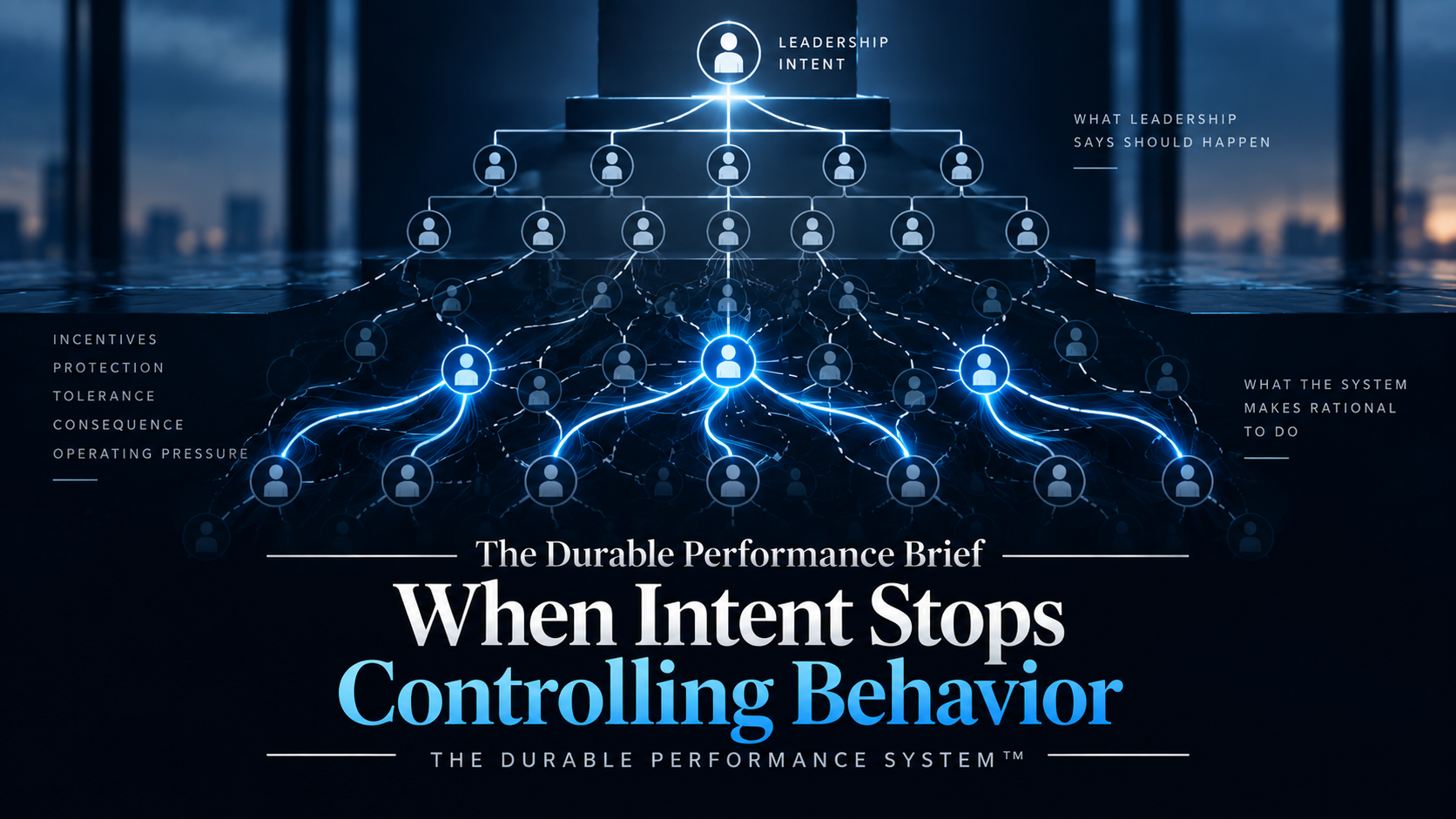
Intent can influence behavior.
It cannot govern behavior indefinitely when the operating system contradicts it.
People learn what matters through experience. They notice what gets rewarded, what gets protected, what creates career risk, what receives consequence, and what leadership abandons when pressure rises.
Those signals eventually become stronger than stated values.
An organization can say quality comes first. If the people who hit aggressive delivery targets advance faster than the people who slow work to protect quality, the system has provided a more precise instruction.
It can say, “Tell us bad news early.” If early bad news produces scrutiny while polished late explanations preserve credibility, people learn when truth is actually safe.
It can say managers own decisions. If senior leaders routinely reopen those decisions, managers learn where authority really lives.
None of this requires cynicism.
People are adapting rationally to the environment they experience.
That is why leadership intent and organizational behavior can gradually separate even when the intent itself remains sincere.
The Organization Has Revealed Rules
Every organization has two sets of rules.
The first is stated.
It appears in values, leadership principles, strategy documents, performance expectations, and executive communication.
The second is revealed.
It appears in who gets promoted.
Who gets protected.
Which deadlines can move.
Which standards cannot.
What happens when someone challenges a powerful person.
Whether bad news is safer early or late.
Whether acting independently is rewarded or second-guessed.
Whether results excuse behavior that would be corrected in someone else.
The revealed rules usually win.
Not because people reject the stated rules, but because the revealed rules contain consequences.
They tell people what the system will actually do.
This is the heart of Incentive Architecture. Incentives are larger than compensation. Recognition, promotion, protection, tolerance, access, workload, status, and consequence all teach people which behavior the organization truly values.
The system is always instructing.
The question is whether its instruction matches leadership’s intent.
Why More Communication Often Fails
When leaders see a gap between intention and behavior, communication is an attractive response.
Restate the expectation.
Hold another town hall.
Rewrite the values.
Add training.
Ask managers to reinforce the message.
Launch a campaign.
Sometimes clarity really is the problem.
But if people already understand the expectation and are behaving differently because the system rewards something else, more communication adds volume without changing the instruction.
Imagine a company that repeatedly tells employees to raise risks early.
Everyone understands.
But the employee who raises a problem before having a solution is questioned aggressively. The manager who waits, packages the issue, builds a recovery plan, and presents the problem with reassuring context is perceived as composed.
Leadership never says:
Bring us bad news late.
It does not have to.
The organization learns from the response.
Soon risks travel upward later and more carefully. Leadership eventually notices and concludes that the culture needs more candor.
The people were not confused about candor.
They learned the cost of practicing it.
That is a Signal Integrity problem before it is a communication problem.
Pressure Reveals Which Rule Is Real
It is easy for stated intent and actual behavior to remain aligned when there is little cost.
The useful test comes under pressure.
A company can say quality matters when the schedule is comfortable.
What happens when protecting quality means missing the quarter?
Leadership can say ownership matters when local decisions produce the expected answer.
What happens when a manager makes a legitimate decision senior leadership would have made differently?
An organization can say standards apply equally.
What happens when enforcing one threatens the departure of a top performer?
Leaders can say they want unfiltered truth.
What happens when that truth contradicts a strategy they publicly supported?
Pressure exposes hierarchy among values.
It reveals which principles govern and which principles become negotiable.
People notice those moments because they contain information that ordinary communication does not.
One difficult decision can teach more about the real operating system than a year of leadership messaging.
Culture Records the Pattern
Culture is often asked to solve this gap.
Leadership sees behavior it dislikes and concludes that the organization needs a stronger accountability culture, ownership culture, performance culture, or speak-up culture.
But culture cannot reliably carry an expectation the operating system keeps contradicting.
If high performers receive exemptions, people learn that performance changes the standard.
If managers are accountable without sufficient authority, people learn that ownership has limits.
If bad news is punished socially, people learn to manage the signal.
If visible activity earns more recognition than quiet structural improvement, people learn to produce activity.
Repeat those experiences long enough and they become cultural.
Culture did not cause the contradiction.
Culture recorded it.
This is why Accountability Design matters. Expectations become credible when ownership, authority, standards, evidence, correction, and consequence reinforce one another.
Without that reinforcement, leadership intent remains vulnerable to whatever the system rewards more consistently.
The Leadership Trap
This is difficult for capable leaders because they experience their own intentions directly.
They know they care about quality.
They know they want people to speak honestly.
They know they believe managers should have ownership.
They remember the times they defended those principles.
From inside the leader’s perspective, the commitment feels obvious.
Employees do not experience leadership from inside the leader’s perspective.
They experience decisions.
They experience what happens after the meeting.
They experience who gets promoted.
They experience which exceptions survive.
They experience whether leadership backs the manager when enforcement becomes inconvenient.
They experience what happens when stated principles collide with pressure.
That is the operating version of leadership.
Intent still matters. It tells you what you are trying to build.
But the system tells you what you are actually building.
One Practical Diagnostic
Take one value or expectation leadership talks about frequently.
Then ask:
What does someone have to do to succeed here when this stated expectation becomes inconvenient?
If the answer reinforces the expectation, the system is probably aligned.
If the answer requires people to work around it, you have found the gap.
Then examine four things:
What behavior receives the strongest reward?
What behavior receives protection despite contradicting the expectation?
What creates the greatest personal or career risk?
What happens when pressure forces a tradeoff?
Do not ask what leadership believes.
Ask what a rational person observing the system would conclude.
That answer is closer to the organization’s real operating rule.
If You Change One Thing This Week
Choose one leadership message your organization repeats often.
Maybe:
Quality comes first.
We want people to take ownership.
Bring us bad news early.
We value collaboration.
Accountability applies to everyone.
Now stop improving the language.
Trace the reinforcement.
Find one place where the organization rewards, protects, tolerates, or penalizes behavior in a way that contradicts the message.
Then change that condition.
Change the metric.
Protect the person who surfaced the problem early.
Back the manager who made the legitimate decision.
Remove the exemption.
Correct the behavior you have been contextualizing.
Change what gets recognized.
The correction does not need to be dramatic.
It needs to make the stated expectation more rational to follow.
For the broader mechanism, see more on Organizational Drift. Drift strengthens when repeated accommodations teach the system something different from what leadership continues to say.
Go Deeper
This issue builds on ideas from Why Organizations Drift, part of The Durable Performance System™ series.
Related read:
Why Organizations Drift examines why capable organizations gradually behave differently from what their leaders intend. Standards soften, exceptions accumulate, incentives shift, and enforcement becomes less predictable—not necessarily because leaders stop caring, but because systems adapt to what is consistently reinforced.
Closing Thought
Leadership intent is important.
But intent is a design requirement, not a control mechanism.
You can want accountability.
You can value truth.
You can believe in ownership.
You can care deeply about quality.
The organization still has to experience those things as rational behaviors.
That requires more than belief.
It requires reinforcement.
Because people eventually stop organizing themselves around what leadership says should matter.
They organize around what the system proves does.
Question for readers: What does your organization say it values that its operating system quietly teaches people to treat differently?
Next Wednesday: The compounding cost of tolerance.
Part of The Durable Performance System™
Books, field guides, and frameworks on power, incentives, authority, accountability, and execution.
Published every Wednesday morning.
Curtisstoaks.com – YouTube – @curtisstoaksauthor