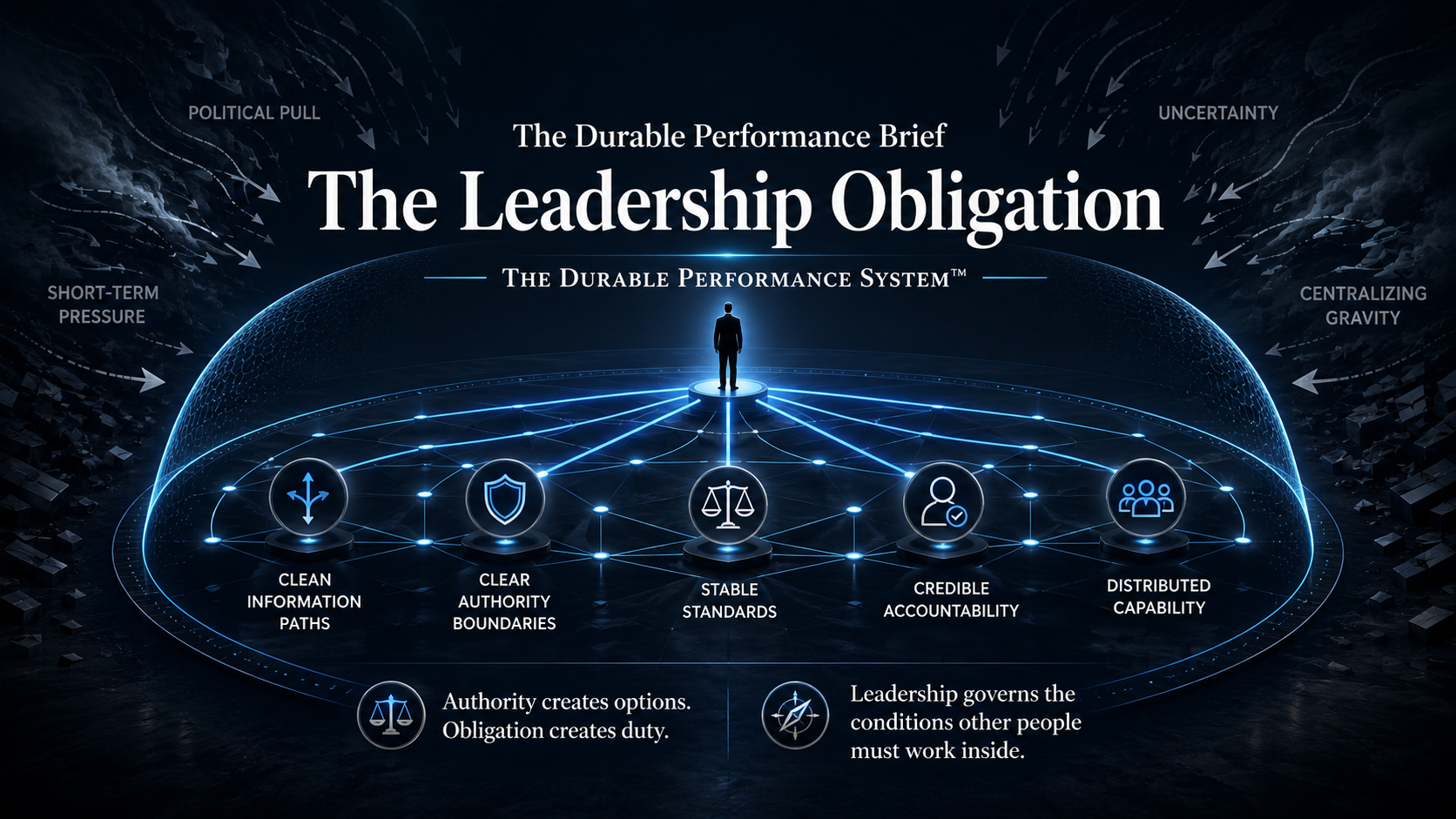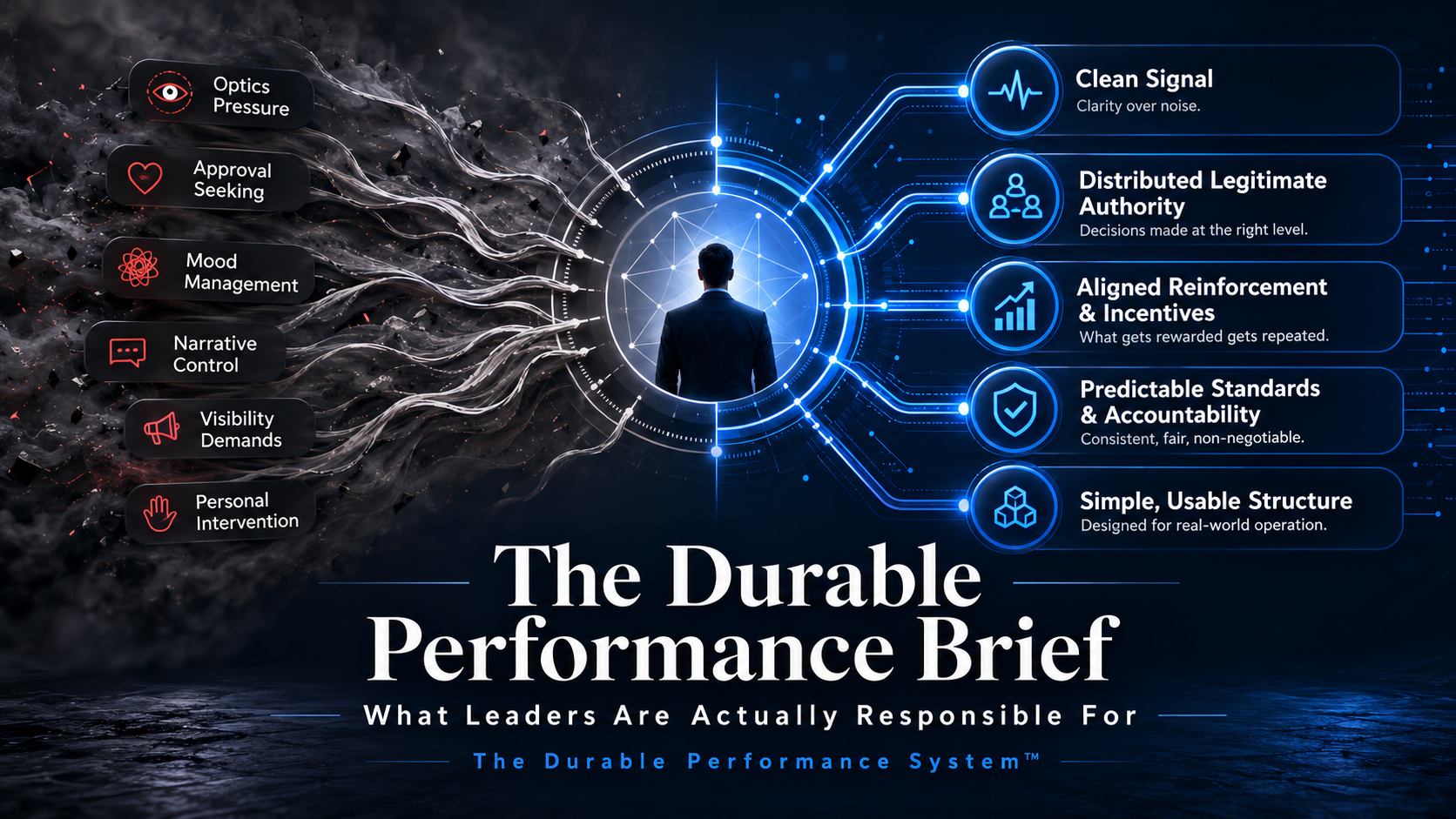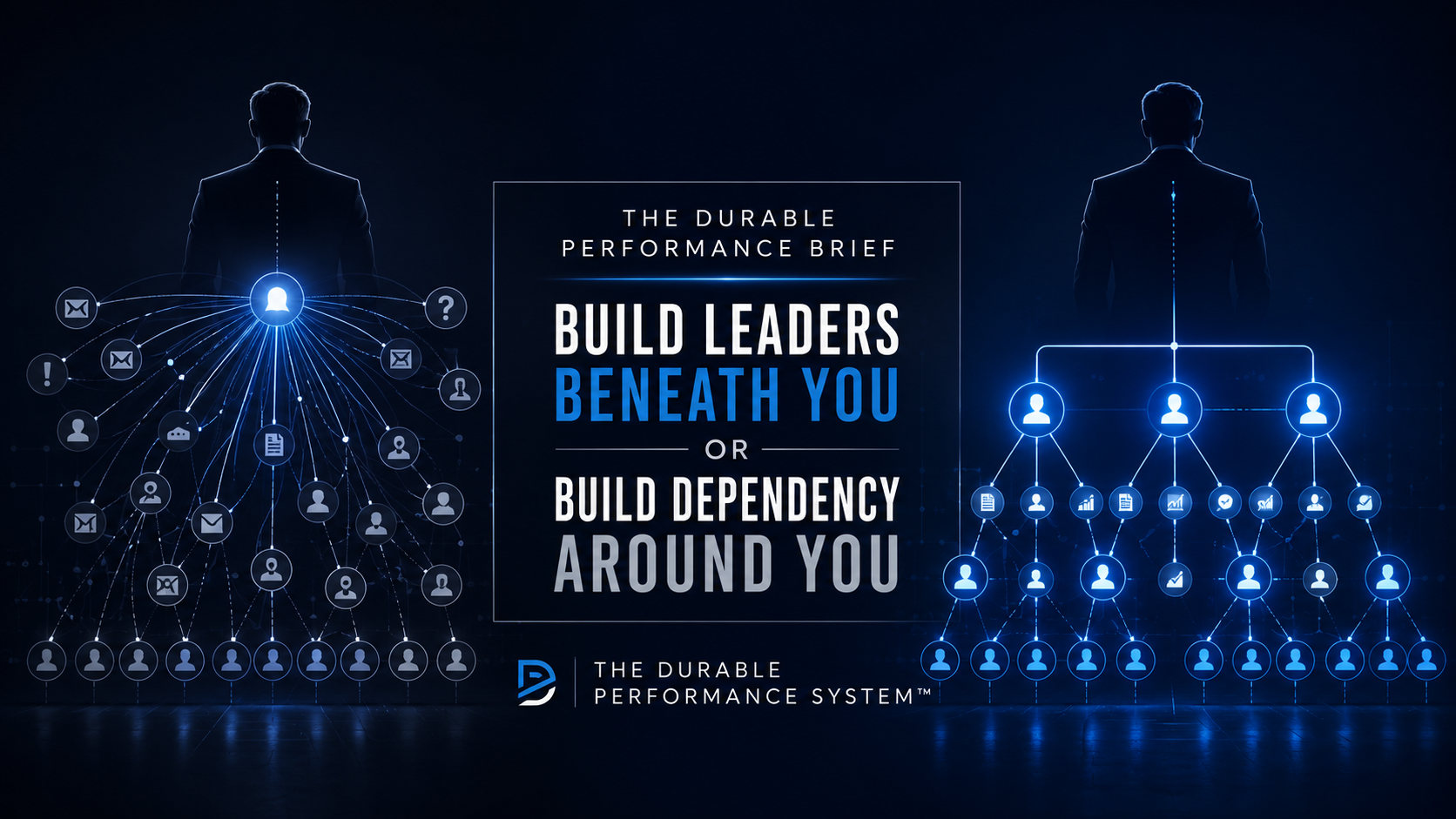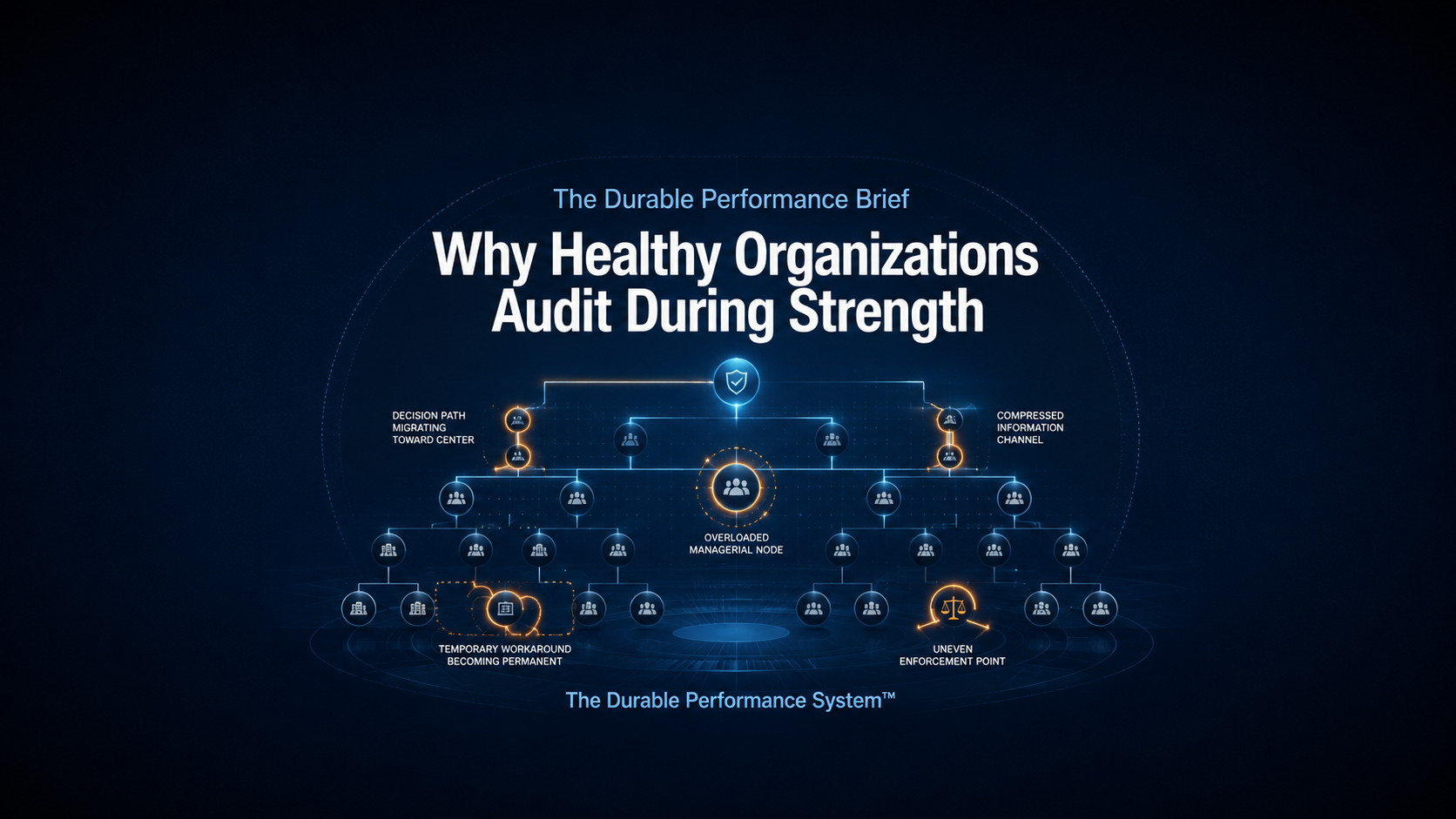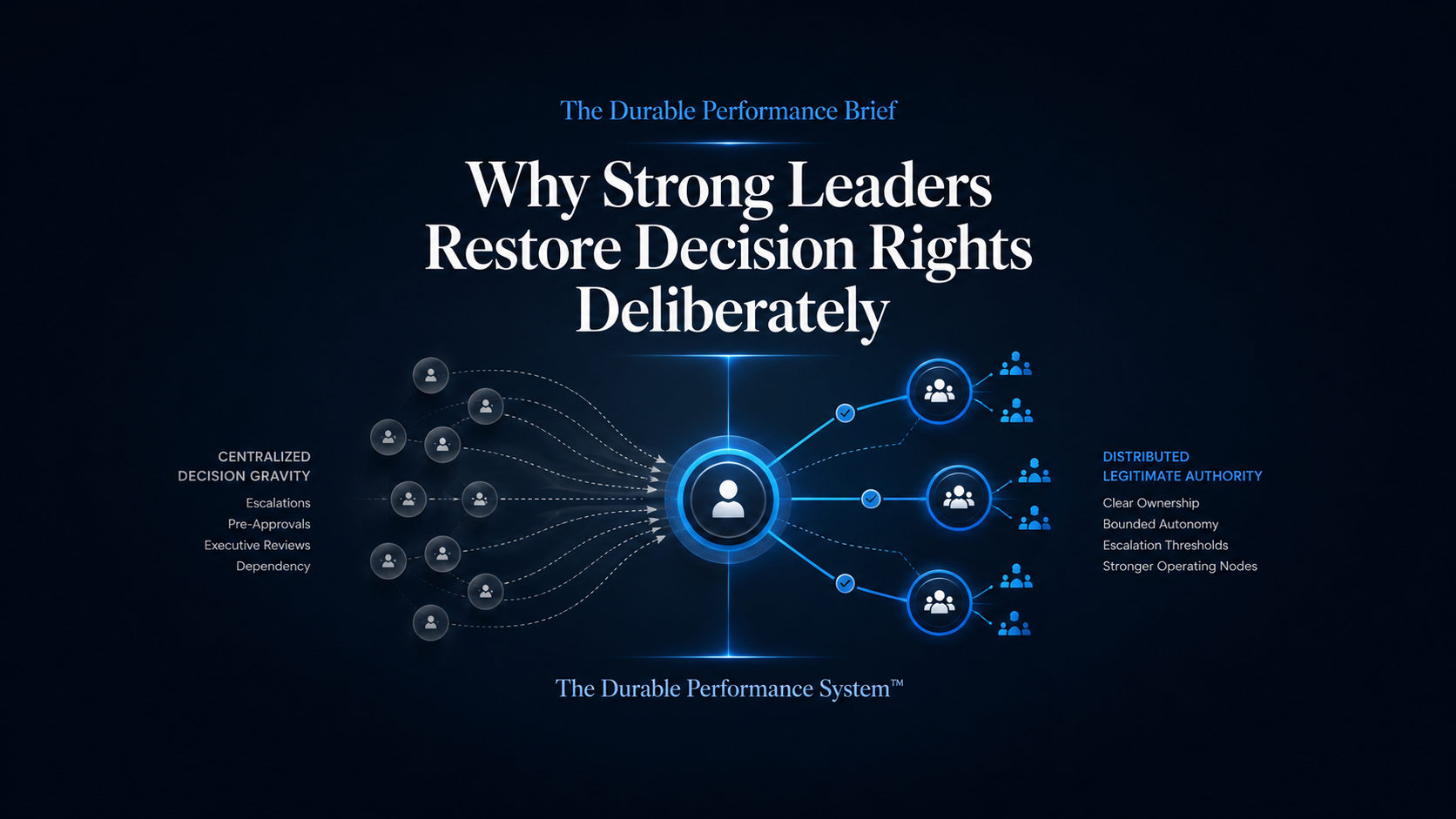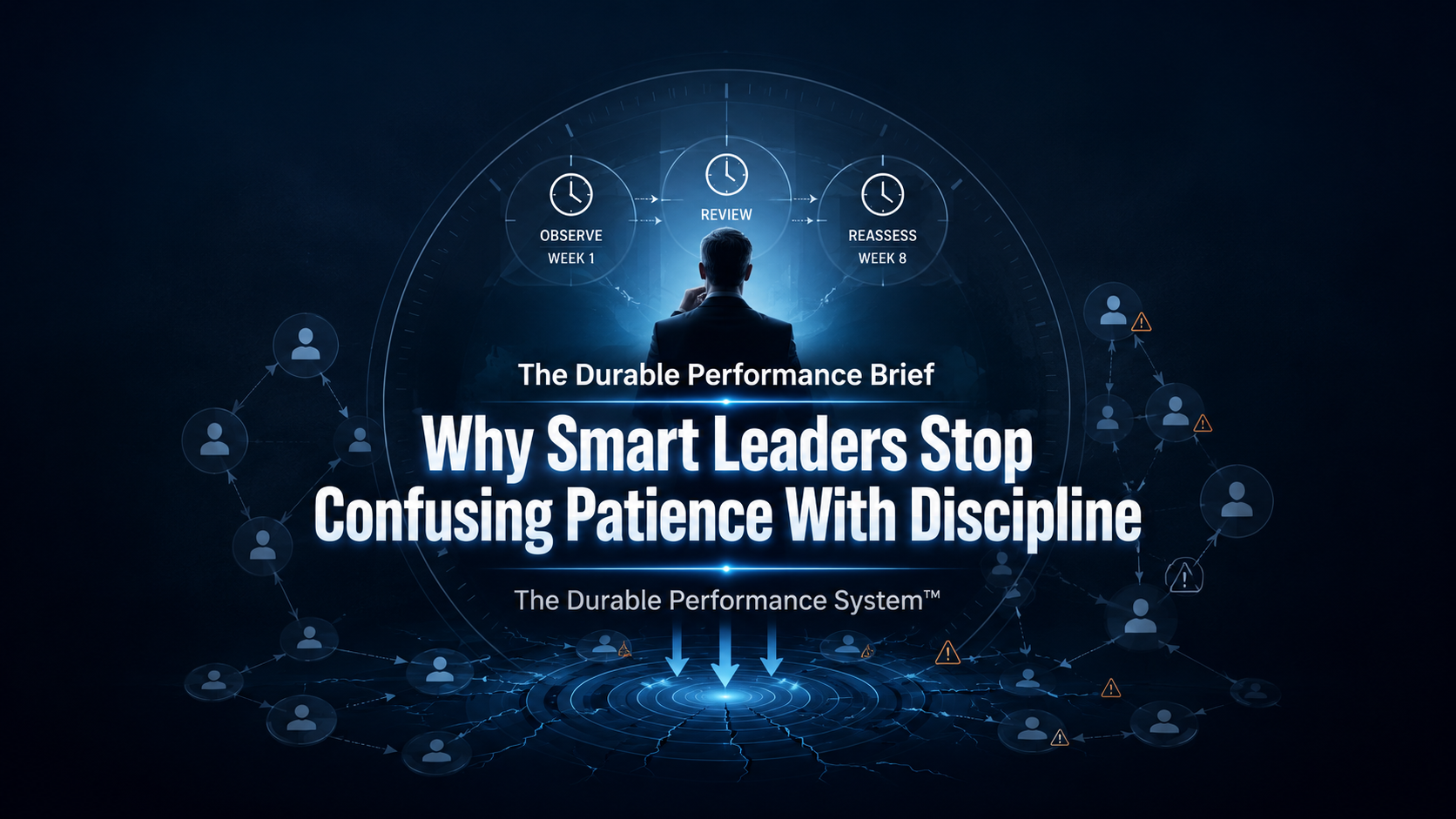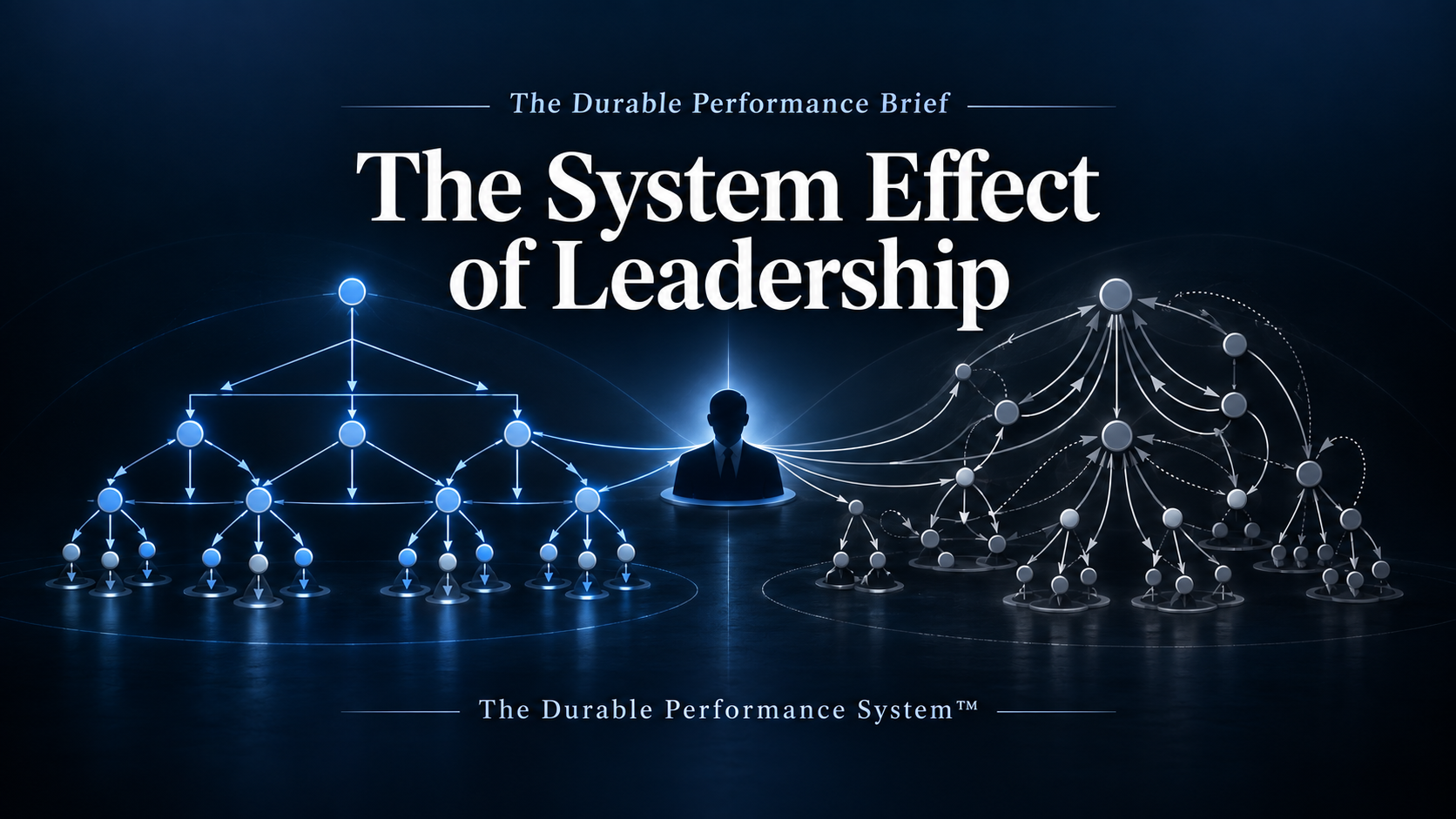
Category: The Durable Performance Brief

Weekly essays from The Durable Performance Brief on organizational drift, authority, incentives, accountability, consequence, and durable performance.

  • Why Smart Leaders Stop Using Ambiguity as a Leadership Style

    Why Smart Leaders Stop Using Ambiguity as a Leadership Style

    Edition 12 | June 10, 2026

    Many leaders think ambiguity keeps options open.

    What it often keeps open is exposure.

    That is the mistake.

    Ambiguity can sound sophisticated. It can feel flexible, empowering, and strategically mature. But when leaders stay vague about ownership, standards, tradeoffs, or escalation thresholds, the system does not experience elegant nuance. It experiences interpretive burden. People closest to the work are forced to decode what leadership “really means,” what matters most right now, and what standard may later be applied after the fact. That is not clarity under complexity. It is uncertainty with organizational consequences.

    The Core Thesis

    Ambiguity is not neutral.

    It is a structural choice.

    When leaders are unclear, the missing clarity does not disappear. It gets redistributed downward into the organization. Managers absorb it first. They have to translate broad executive language into actual direction, reconcile unstated priorities, and enforce work against standards that were never fully named. Teams then adapt around that uncertainty by over-consulting, escalating early, triangulating informally, and staying closer to power than to principle. When formal clarity is weak, people build “black-market clarity” through side conversations, pre-meetings, and unwritten rules.

    That is why ambiguous leadership does not create freedom.

    It creates alternate systems of meaning.

    And alternate systems of meaning rarely favor trust. They favor politics, interpretation, and self-protection. People start asking: What counts here, really? What did they mean? What will they say they meant later? That interpretive fear is one of the clearest signs that leadership language has become atmospheric instead of operational.

    This is also why ambiguity and selective accountability are closely linked.

    If expectations stay broad enough, almost any outcome can be criticized later. If priorities stay fluid enough, leadership can always reinterpret what mattered most. If standards stay soft enough, almost anyone can be described as misaligned when politically useful. That is not mature flexibility. It is optionality purchased at the expense of clarity.

    What This Looks Like in the Wild

    A senior leader tells a cross-functional group to move faster, stay coordinated, use judgment, and keep leadership close because the work has visibility.

    Everyone nods.

    Almost nothing is clear.

    Who owns the tradeoff? What decisions remain local? What requires escalation? What does “close” mean? What standard cannot be crossed? What would count as failure here?

    Now the teams must infer.

    One group escalates too early. Another moves and gets reopened later. A manager tries to enforce a standard that was never fully named. Leadership becomes frustrated that the teams are “not aligned.” But the problem is often not alignment failure. It is leadership ambiguity.

    You can usually spot this pattern before any KPI fully breaks.

    Managers become rigid, political, or timid. Decision quality drops because ownership, standards, and consequences all blur. Teams spend more time testing what leadership really means than acting decisively inside clear guardrails. The result is a system that is constantly active but less decisive, thoughtful but less aligned, careful but less accountable. What often gets called complexity is sometimes just the downstream effect of unclear leadership.

    Why Leaders Misread It

    Because vague language often sounds polished.

    It feels emotionally safer to say something broad, balanced, and atmospherically intelligent than to say the operationally real thing. Ambiguity also preserves personal optionality. It postpones visible choice when stakeholders want different things. It reduces the discomfort of naming a hard boundary too early. These motives are human. None of them eliminate the structural cost.

    Leaders also confuse ambiguity with empowerment.

    They say: I do not want to micromanage. I want people to think. I want the team to use judgment.

    Those instincts can be healthy.

    But empowerment without clarity is abandonment dressed up in modern leadership language. Real empowerment requires boundaries: who decides, what matters most, what tradeoffs govern, what standards are non-negotiable, what threshold requires escalation, and what outcome would count as failure here. Without those anchors, “use your judgment” becomes stressful and political because the person acting knows the decision may later be interpreted against a standard that was never fully named.

    One Practical Diagnostic

    Ask this in your next leadership meeting:

    Could a reasonable person act decisively from what we actually said?

    Then press harder:

    • Could a manager enforce from it?
    • Could ownership be protected through it?
    • Could someone later be held accountable without leadership having to reinterpret what was supposedly meant?
    • Where are teams currently inferring guardrails that leadership never made explicit?
    • What side conversations exist mainly to create clarity the formal system did not provide?

    That diagnostic matters because if people cannot operate, enforce, and act from what was said, the language is not leadership. It is atmospherics.

    If You Change One Thing This Week

    Take one currently vague instruction and replace it with five explicit elements:

    1. Owner — who decides
    2. Boundary — what standard still holds
    3. Threshold — what actually requires escalation
    4. Time horizon — when this guidance will be reassessed
    5. Failure line — what outcome is unacceptable even under uncertainty

    Do not aim for total certainty.

    Aim for usable clarity.

    Strong leaders do not eliminate nuance. They pair nuance with enough clarity that the system can move without political guesswork.

    Go Deeper

    This issue builds on ideas from What Smart Leaders Stop Doing, part of The Durable Performance System™ series.

    Related read: What Smart Leaders Stop Doing — a structural guide to the leadership behaviors that quietly create interpretive fear, political navigation, and selective accountability by leaving too much unsaid.

    Closing Thought

    People can handle difficult clarity better than prolonged fog.

    They can work inside a hard line, a clear owner, a real standard, and a visible consequence.

    What weakens organizations is not always hard truth.

    Often it is the leader’s preference for optionality over legibility.

    Because once people must decode leadership like weather, politics starts replacing trust.

    Question for readers: Where in your organization are people working hardest to infer what leadership meant instead of acting on what leadership clearly said?

    Next Wednesday: Why smart leaders stop protecting people from consequences.

    Part of The Durable Performance System™ Books, field guides, and frameworks on power, incentives, authority, accountability, and execution. Published every Wednesday morning.

    Explore the books →

    Continue Through The Durable Performance System™

  • Why Smart Leaders Stop Delaying Correction Because the Person Is Valuable

    Why Smart Leaders Stop Delaying Correction Because the Person Is Valuable

    Edition 11 | June 3, 2026

    Most leaders do not delay correction because they are unaware.

    They delay because they understand the cost.

    That is what makes this pattern so dangerous.

    The issue is usually visible. The drag is usually felt. The conversations often happen privately long before anything changes publicly. Leadership sees the behavior, names the risk, discusses the options, and then decides: not now. After the launch. After the renewal. After the quarter. After things settle down. That is the pattern Chapter 9 describes directly, and it is dangerous precisely because the reasoning feels responsible.

    The Core Thesis

    Delay is not neutral.

    Delay is a decision.

    When leaders postpone correction for someone valuable, the organization does not experience a thoughtful pause. It experiences an active extension of the current behavior inside the system. Managers keep working around it. Peers keep absorbing it. The protected person keeps receiving signals that concern exists, but consequence remains deferred. The standard stays visible in language and blurry in timing.

    That is the structural problem.

    Because timing teaches.

    People do not only study what leaders correct. They study when leaders correct. They notice who gets immediate accountability and who gets a long runway. They notice who receives sharp clarity and who receives endless context. They learn, quickly, what kind of value changes the timetable of accountability.

    That lesson spreads fast.

    Ambitious people start drawing the wrong conclusion: become important enough and correction gets softer, narrower, or later. Managers start learning that some cases will receive urgency and others interpretation. Peers start learning who is operating under a different calendar. The leader believes they are buying time. The system begins learning permission.

    What This Looks Like in the Wild

    A leader says the issue is real, but the person is too critical to confront fully right now.

    A correction conversation keeps getting deferred because the team is already strained.

    An executive agrees the behavior is costly, but the timing never seems quite right.

    A manager is told to “hang in a little longer” because the person is valuable, the quarter is fragile, or the coverage gap is too risky.

    Nothing about this looks like tolerance.

    That is why it survives.

    It looks like sequencing. Strategic patience. Commercial maturity. The leader is not pretending the issue is fine. They are just saying the moment is not ideal. But once correction is delayed past the point of clarity, the system is no longer experiencing prudence. It is experiencing permission.

    The hidden cost lands on disciplined people first.

    They carry extra cleanup, extra emotional management, extra restraint, extra ambiguity, and extra signal distortion. Often they do it quietly. They do not always escalate. They simply register the pattern. Over time, some get quieter, more transactional, less courageous, or more willing to leave. By then, leadership often misreads the loss.

    Why Leaders Misread It

    Because valuable people change the equation.

    Correction might trigger attrition, customer instability, short-term revenue loss, political backlash, or a painful capability gap. All of that is real. That is why this distortion is not driven by ignorance. It is driven by incomplete arithmetic. Leaders ask: What happens if I act? They fail to ask with equal seriousness: What is happening because I have not?

    That omission is where delay becomes expensive.

    While leadership is carefully calculating the visible cost of action, the organization is already paying the invisible cost of inaction: in trust, credibility, managerial courage, silence, softened standards, and the widening belief that some people are governed by a different calendar.

    This is where a useful distinction matters.

    Sometimes sequencing is real. Sometimes timing does matter. Sometimes a leader should line up backfill, stabilize a dependency, or define a contained transition before acting fully. But governed sequencing sounds different from avoidance. Governed sequencing has a real date, a fixed threshold, an explicit standard, and a defined consequence path. Avoidance sounds like: let’s get through the next few weeks and revisit later. Those are not the same thing.

    One Practical Diagnostic

    Ask this in your next leadership meeting:

    What known issue in our system are we calling complex when we actually mean expensive?

    Then press harder:

    • Who is receiving more time than the standard would normally allow because their value makes correction uncomfortable?
    • What is the organization already learning from the fact that this remains unresolved?
    • What cost are managers and disciplined peers carrying while leadership waits?
    • If we say we are sequencing correction, what is the actual date, threshold, and plan?
    • If this person were less valuable, how long ago would this have been addressed fully?

    Those questions matter because leaders do not just teach through standards.

    They teach through timing.

    If You Change One Thing This Week

    Take one deferred correction case and force a distinction:

    Is this governed sequencing or emotional delay?

    If it is governed sequencing, write down four things now:

    1. the exact issue
    2. the structural cost it is creating
    3. the real timeline for action
    4. the consequence path if the behavior continues

    If you cannot name those four things clearly, you are probably not sequencing.

    You are sheltering.

    Smart leaders do not stop valuing important people. They stop allowing importance to suspend credible correction. The more valuable the person, the more disciplined the correction path must become. Not softer. Clearer.

    Go Deeper

    This issue builds on ideas from What Smart Leaders Stop Doing, part of The Durable Performance System™ series.

    Related read:
    What Smart Leaders Stop Doing — a structural guide to the leadership behaviors that quietly teach the system that value changes the timetable of accountability, and that delay can become permission when correction stays unresolved too long.

    Closing Thought

    The real test of leadership is not whether you value important people.

    It is whether you can still connect recognition to consequence when enforcement becomes inconvenient.

    Because once delay becomes the operating answer to valuable distortion, the system is no longer governed by standards.

    It is being governed by dependency.

    Question for readers: Where in your organization has “bad timing” become a shelter for a problem leadership already understands clearly?

    Next Wednesday: Why smart leaders stop using ambiguity as a leadership style.

    Part of The Durable Performance System™
    Books, field guides, and frameworks on power, incentives, authority, accountability, and execution.
    Published every Wednesday morning.

    Explore the books →

    Continue Through The Durable Performance System™

  • Why Smart Leaders Stop Praising Output While Rewarding Distortion

    Why Smart Leaders Stop Praising Output While Rewarding Distortion

    Edition 10 | May 27, 2026

    Most leaders think they know what their organization rewards.

    Many do not.

    They know what they praise.

    That is not the same thing.

    Organizations do not learn the real reward system from values statements, leadership language, or offsite talking points. They learn it from who gets protected, who gets promoted, who gets interpreted generously, who keeps winning despite the damage around them, and what kind of behavior still advances when the numbers are useful.

    That is where distortion gets normalized.

    Not when leadership says the wrong things.

    When leadership says the right things while rewarding their opposite.

    The Core Thesis

    Most reward-system corruption does not begin with open hypocrisy.

    It begins with misalignment.

    A leader praises ownership, then advances the person who manages upward well but leaves confusion below. A leader praises candor, then prefers those who package risk elegantly. A leader praises collaboration, then keeps expanding the politically forceful performer because their results are visible and defensible. The leader believes the organization is hearing the words. The organization is actually studying the outcomes. And outcomes always teach faster.

    That is the structural problem.

    Because once people see that output carries more weight than system effect, they begin adapting rationally. They stop asking what leadership says it wants and start asking what kind of winner actually rises here. If distorted winners advance, distortion becomes career logic.

    This is why output can become a shield.

    Not because output is unimportant. It is.

    But output is visible, countable, and easy to defend. The distortion around it is harder to count: the trust weakened, the peer damage normalized, the corners others learn to cut, the quieter truth, the standard bent through visible success. When leaders privilege what is measurable over what is structural, they start rewarding people for making the system weaker while making the numbers look stronger.

    What This Looks Like in the Wild

    A person who always keeps senior leaders comfortable gets described as strategic.

    A person who never brings raw problems, only polished stories, gets described as composed.

    A person who escalates relentlessly and keeps themselves covered gets described as mature.

    A person who produces output through fear, exemption, or overcontrol gets described as high-performing.

    That is how distortion hides.

    It borrows respectable language.

    The most expensive version appears in promotion decisions.

    Nothing teaches the organization faster than promotion. Not town halls. Not principles. Not posters. Promotion says: be more like this. So when leaders elevate someone whose numbers are strong but whose system effect is corrosive, the organization learns that corrosive success still counts as success. If leaders reward ambition without discipline, visibility without substance, or force without trust, distortion stops being incidental. It becomes adaptive.

    That is when the career logic begins to separate from the declared logic.

    Leadership says: own outcomes.
    Career logic says: protect yourself from exposure.

    Leadership says: tell the truth early.
    Career logic says: do not surface a problem until it is packaged.

    Leadership says: standards matter.
    Career logic says: standards matter unless your output is too important.

    That split is where cynicism starts.

    Not because people are cynical by nature.

    Because the system has become clearer than the speech.

    Why Leaders Misread It

    Because praise feels like proof.

    A leader assumes that if they praise the right things, they are rewarding the right things.

    Not necessarily.

    Praise is one signal.

    Reward is the full behavioral system around it: advancement, protection, access, tolerance, attention, exception, and consequence. Leaders often mistake verbal endorsement for structural endorsement. The organization does not. It watches who wins.

    Leaders also misread the cost because output is easier to measure than distortion.

    The number is clean.

    The side effects are diffuse.

    Under pressure, it feels responsible to privilege what is most visible and defensible. That is one reason rewarding the wrong behavior persists across average organizations: results are easier to count than judgment, restraint, trust-building, or long-term contribution. But the side effects are the main effect. They are what reshape the system over time.

    One Practical Diagnostic

    Ask this in your next leadership meeting:

    If someone studied our promotions and protections instead of our values statements, what would they conclude we actually reward?

    Then press harder:

    • Who gets ahead faster than their structural effect justifies?
    • Who receives generous interpretation because their output is strong?
    • What behavior do we praise in language while rewarding its opposite in outcomes?
    • Would we want more of the organization to behave like the people we currently elevate?
    • What do ambitious people here quietly believe they must become to win?

    Those questions matter because reward systems are always teaching.

    Especially when leadership is not paying attention.

    If You Change One Thing This Week

    Review one recent promotion, expansion-of-scope decision, or high-potential designation through a different lens:

    Did this person create output in a way we would want repeated?

    Not just:

    Did they deliver?

    Ask:

    Did they strengthen trust?
    Did they preserve clean signal?
    Did they reduce dependence?
    Did they make the operating conditions better for other people?
    Would giving them more authority make the system stronger?

    If the answer is no, do not hide behind admiration.

    Say the harder sentence:

    Not like this.

    That is not pettiness. It is architectural discipline. If leadership cannot withhold advancement from people whose results travel with distortion, then the reward system no longer belongs to leadership. It belongs to momentum. And momentum is rarely structural or durable on its own.

    Go Deeper

    This issue builds on ideas from What Smart Leaders Stop Doing, part of The Durable Performance System™ series.

    Related read:
    What Smart Leaders Stop Doing — a structural guide to the leadership behaviors that quietly redirect ambition, normalize distortion, and teach organizations to reward what makes the system weaker.

    Closing Thought

    Organizations do not become what leaders say they value.

    They become what leaders repeatedly reward, protect, excuse, and advance.

    So when leaders praise ownership but reward optics, the organization learns optics. When leaders praise candor but reward polished reassurance, the organization learns curation. When leaders praise standards but advance distorted winners, the organization learns conditionality.

    And once ambition starts serving distortion more reliably than discipline, the organization will not just tolerate the wrong behavior.

    It will manufacture more of it.

    Question for readers: What kind of winner is your organization quietly teaching ambitious people to become?

    Next Wednesday: Why smart leaders stop delaying correction because the person is valuable.

    Part of The Durable Performance System™
    Books, field guides, and frameworks on power, incentives, authority, accountability, and execution.
    Published every Wednesday morning.

    Explore the books →

    Continue Through The Durable Performance System™

  • Why Smart Leaders Stop Asking for More Visibility Than They Need

    Why Smart Leaders Stop Asking for More Visibility Than They Need

    Edition 9 | May 20, 2026

    Most leaders do not ask for more visibility because they are careless.

    They ask for it because uncertainty is uncomfortable.

    A metric moves the wrong way. A project slips. A customer issue surfaces. Confidence drops. Someone senior asks a hard question. In that moment, more dashboards, more updates, more reviews, and more detail feel like responsibility. But that instinct often produces a structural mistake: leaders ask for more reporting than they actually need, and the system starts reallocating energy away from judgment and toward presentation. That is the distinction What Smart Leaders Stop Doing makes directly: visibility is not the same thing as reporting, and the two become dangerously confused under pressure.

    The Core Thesis

    Healthy visibility helps leaders see what matters clearly enough to make sound decisions.

    Unhealthy visibility creates a growing burden of artifacts designed to reduce anxiety at the center.

    That difference matters because organizations adapt quickly. Once leaders start asking for more visibility than decision quality requires, people begin packaging work upward in polished form. Managers consolidate, frame, smooth, and anticipate. Teams spend more time feeding the visibility system and less time correcting the operating system. The leader wants clearer reality. They often end up farther from it.

    This is why more reporting is not automatically more control.

    A fuller dashboard can still carry filtered truth. A longer update can still change nothing. A standing review can still produce motion without better decisions. The hidden structural question is simple: What decision will this information change? If the answer is vague, the request is probably not about leadership signal. It is about comfort.

    That is not a minor distinction.

    When visibility expands beyond decision necessity, it starts functioning more like surveillance, reassurance, or weak-trust compensation. Then behavior changes fast. People become more careful, more performative, more update-oriented, and less candid. The organization looks attentive. It becomes less alive.

    What This Looks Like in the Wild

    You can usually see this pattern before performance fully breaks.

    Dashboards multiply while decision quality stays flat.

    Weekly updates get longer, broader, and more frequent.

    Status meetings end with alignment language instead of decisions and owners.

    The same variance gets explained repeatedly without corrective action.

    Managers spend more time shaping the update than changing the reality behind it.

    Those are not just communication annoyances. They are structural indicators of signal distortion and visibility burden. The Field Guide names the same drift patterns directly: dashboard inflation, reporting noise, metric sprawl, status meeting growth, narrative protection, late discovery, escalation for visibility, and artifact-first behavior.

    One of the highest-cost effects sits in the middle layer.

    Managers become translators.

    Instead of strengthening local judgment, they consolidate information upward. Instead of coaching teams through the work, they coach teams through how the work will be represented. Instead of preserving signal integrity, they smooth the narrative to reduce executive volatility. That turns management into reporting infrastructure, which is not a neutral use of leadership bandwidth. It is structural leakage.

    Why Leaders Misread It

    Because artifact volume feels like discipline.

    A richer dashboard feels rigorous. A longer update feels responsible. More status detail feels like care. A leader in more meetings feels engaged. But as the book argues, visible action and real leadership are not the same thing. More reviews, more oversight, and more executive visibility can feel serious while quietly teaching the organization that upward legibility matters more than operating truth.

    Leaders also misread the root problem.

    Often they ask for more visibility because they cannot trust what they already receive.

    That is real.

    But when trust is low, the answer is not automatically more reporting. Sometimes the answer is fewer metrics, cleaner definitions, sharper operating reviews, more direct exposure to the work, and more honest consequence when signal gets distorted. Many leaders choose artifacts instead because artifacts are easier than confronting the trust problem underneath. They look diligent. They do not solve the truth problem. They often bury it.

    One Practical Diagnostic

    Ask this in your next leadership meeting:

    Which recurring visibility artifacts actually change a decision?

    Then press harder:

    • Which report changes ownership, timing, resource allocation, or risk posture?
    • Which dashboard exists mainly because no one has removed it?
    • Which meeting ends with more explanation but not more correction?
    • Where are managers spending time preparing visibility upward that should be spent strengthening judgment downward?

    That gets you out of preference and into structure. The Field Guide’s Signal Distortion Audit uses exactly that discipline: inventory recurring reports, dashboards, and updates, capture the decision each one informs, and kill or consolidate the ones with low impact and high burden.

    If You Change One Thing This Week

    Kill one recurring report or status meeting that does not reliably change a decision.

    Not reduce it.

    Not rename it.

    Remove it.

    Then add one guardrail: no new recurring visibility artifact gets created without a named decision owner and an expiration date.

    That is a meaningful correction because visibility is never free. It is paid for in time, attention, behavior, and truth quality. Smart leaders do not stop caring about visibility. They stop demanding more of it than the system can carry cleanly.

    Go Deeper

    This issue builds on ideas from What Smart Leaders Stop Doing, part of The Durable Performance System™ series.

    Related read:
    What Smart Leaders Stop Doing — a structural guide to the leadership behaviors that quietly distort signal, overload managers, and teach the organization to optimize for presentation instead of operating strength.

    Closing Thought

    The danger is not that organizations stop working.

    It is that they get better at looking informed while becoming less truthful.

    When leaders ask for more visibility than they need, the system starts producing cleaner narrative instead of cleaner signal. And once upward legibility matters more than usable reality, performance gets weaker behind a more professional-looking surface.

    Question for readers: Where in your organization is reporting expanding faster than decision quality?

    Next Wednesday: Why smart leaders stop praising output while rewarding distortion.

    Part of The Durable Performance System™
    Books, field guides, and frameworks on power, incentives, authority, accountability, and execution.
    Published every Wednesday morning.

    Explore the books →

    Continue Through The Durable Performance System™

  • Why Smart Leaders Stop Tolerating High-Performer Exemptions

    Why Smart Leaders Stop Tolerating High-Performer Exemptions

    Edition 8 | May 13, 2026

    The fastest way to corrupt a leadership system is not low performance.

    It is selective consequence.

    The moment people realize the standard changes depending on who is involved, the organization starts learning the wrong lesson. Not what leadership says. What leadership protects. That is why high-performer exemptions are so dangerous. They do not merely excuse one person. They retrain the system.

    The Core Thesis

    Most leaders do not make exceptions for high performers because they admire hypocrisy.

    They do it because they feel trapped.

    The person is productive. Hard to replace. Close to important customers. Politically influential. Embedded in a fragile workflow. Or simply valuable enough that correction feels expensive. So instead of enforcing the standard cleanly, leadership starts managing around the person. The language softens. The consequence delays. The issue gets reframed as nuance, timing, or complexity. The person stays valuable. The standard becomes conditional.

    That is the structural break.

    Because the leader believes they are making a contained exception.

    The organization experiences a rule change.

    Once people see that output can buy behavioral leniency, they stop treating standards as shared operating conditions. They start treating them as negotiable. The question quietly shifts from What is the standard? to Who is the standard for?

    This is why selective consequence is more corrosive than many visible performance issues. Low performance is easier to name. Open confusion is easier to diagnose. Selective enforcement is harder because the organization can remain commercially productive while trust, truth, and accountability thin underneath. Drift does not need chaos. It only needs repeated tolerance applied unevenly enough to feel normal.

    What This Looks Like in the Wild

    A revenue producer keeps creating interpersonal damage, but the conversation stays narrow: yes, they are difficult, but they deliver.

    A strong operator humiliates peers, overrides process, or destabilizes a team, but leadership keeps describing them as intense rather than unacceptable.

    A high-value person misses a line others would be held to, but the consequence becomes coaching language, private patience, or one more contextual explanation.

    None of this gets announced.

    That is why it spreads.

    People just begin noticing who gets more interpretation. Who gets more patience. Who remains “worth it” long after their structural cost should have been counted honestly. Then the organization starts adapting around the double standard. Candor drops. Managers spend more time containing than building. Disciplined contributors lower their own expectations, withdraw, or leave. Leadership keeps measuring the producer’s direct output while missing the distributed tax spreading across everyone else.

    That distributed tax is the part leaders misprice.

    It shows up in quieter meetings, softer truth, more cover-seeking, rising cynicism, and the loss of disciplined people who no longer trust the system to mean what it says. The Field Guide’s drift indicators name the same pattern directly: uneven standards, cover-seeking behavior, and high-performer churn risk are signals of leadership maturity breaking down.

    Why Leaders Misread It

    Because they use incomplete arithmetic.

    They ask:

    What do we lose if we confront, sideline, or remove this person?

    They do not ask:

    What are we already losing by protecting them?

    That second question is harder because the losses are slow, social, and inconvenient. They do not appear on one dashboard. They arrive through reduced ownership, weaker truth, managerial hesitation, rework, and the erosion of trust in leadership language itself. By the time the cost becomes undeniable, the exemption has often hardened into precedent.

    This is also where leaders hide behind a useful-sounding distinction.

    Some difficult high performers are genuinely complex. Some need sharper management, not immediate removal. Some are intense but still coachable.

    That is real.

    But complexity is not exemption.

    A strong leader may tailor the correction path. They may stage it differently. Sequence it differently. Protect dignity differently. But the standard still has to apply. The moment the standard becomes person-dependent, leadership is borrowing results against institutional trust.

    One Practical Diagnostic

    Ask this in your next leadership meeting:

    Which behavior are we currently asking the rest of the organization to absorb because the person creating it is valuable?

    Then make the question harder:

    1. Would the response be different if an average performer did the same thing?
    2. What managerial time is being spent containing this person?
    3. What truth has gotten quieter around them?
    4. Who has already adjusted downward because leadership has not held the line?
    5. What standard now sounds optional because of this one exception?

    If the answer reveals a two-tier system, the problem is not talent management.

    It is selective consequence.

    If You Change One Thing This Week

    Choose one protected behavior and remove its exemption.

    Not necessarily the person.

    The exemption.

    Name the standard clearly. Name the breach plainly. Define the correction path. Define the consequence if it continues. Then hold the line predictably.

    Do not use vague language like “needs to be easier to work with.”

    Be specific.

    • What behavior stops now?
    • What standard applies?
    • What happens if it repeats?
    • Who is responsible for enforcement?

    The goal is not theatrical punishment.

    It is structural credibility.

    Because once disciplined contributors can see that the standard means the same thing for valuable people too, trust starts returning faster than leaders expect. And once the exemption disappears, the rest of the organization stops learning the wrong lesson.

    Go Deeper

    This issue builds on ideas from What Smart Leaders Stop Doing, part of The Durable Performance System™ series.

    Related read:
    What Smart Leaders Stop Doing — a structural guide to the leadership behaviors that quietly create selective consequence, weaken trust, and make standards conditional under pressure.

    Closing Thought

    High performance should buy trust.

    It should not buy exemption.

    Because the moment a leader asks the organization to carry damage that one valuable person is allowed to create, the system stops respecting the standard and starts studying the protection.

    And what leadership protects, the organization eventually becomes.

    Question for readers: Where in your organization has one valuable person been allowed to teach everyone else that the standard is negotiable?

    Next Wednesday: Why smart leaders stop asking for more visibility than they need.

    Part of The Durable Performance System™
    Books, field guides, and frameworks on power, incentives, authority, accountability, and execution.
    Published every Wednesday morning.

    Explore the books →

    Continue Through The Durable Performance System™

  • Why Smart Leaders Stop Overruling Too Early

    Why Smart Leaders Stop Overruling Too Early

    Edition 7 | May 6, 2026

    Smart leaders stop overruling too early because improving one decision can weaken the system that needs to learn how to decide.

    Most leaders do not weaken a system by disappearing.

    They weaken it by arriving too soon.

    That is the contradiction.

    A leader sees the answer quickly. A manager is circling. A team is undercooking the decision. The tradeoff looks obvious. The risk of delay feels unnecessary.

    So the leader steps in.

    They simplify the choice. Break the tie. Clarify the answer. Save time. Protect quality.

    In the moment, it often works.

    That is exactly what makes it dangerous.

    Because when leaders overrule too early, they do more than improve one decision. They teach the system what happens when judgment starts forming below them:

    It gets replaced.

    Once that lesson lands, people adapt.

    The Core Thesis

    Most early override does not come from ego.

    It comes from pressure.

    The leader really can often see the better answer faster. They have more pattern recognition. They know where weak reasoning usually leads. They want to prevent avoidable noise. They want to protect standards. They want to keep momentum.

    That motive is understandable.

    The structural effect is still costly.

    A leader can improve the immediate decision while weakening the surrounding system.

    That is the real issue.

    Short-term quality is not the same thing as long-term capability.

    When leaders repeatedly substitute their judgment before local reasoning has fully formed, managers stop carrying decisions to conclusion. Teams stop testing their own thinking deeply. Tradeoffs start getting previewed instead of owned. Recommendations start arriving half-formed because everyone knows the real answer will come from above anyway.

    That is the sequence: repeated override teaches people that judgment below the leader gets replaced, then the system adapts around that rule.

    The leader experiences less friction.

    The system experiences less ownership.

    What This Looks Like in the Wild

    This pattern rarely looks aggressive.

    It usually looks helpful.

    A manager brings a decision upward before they have fully reasoned it because experience has taught them that local judgment may be reopened anyway.

    A leader asks a few questions, then lands the decision before the manager has fully worked the tradeoffs.

    A team begins shaping its analysis toward what the leader is likely to prefer instead of pushing its own reasoning to full strength.

    People bring drafts of judgment instead of finished judgment.

    Meetings get faster.

    Capability gets weaker.

    That is why this distortion survives for so long. The near-term signal looks positive. Decisions move. Ambiguity drops. The leader appears sharp and involved.

    But beneath that efficiency, the organization is quietly being retrained.

    • Managers become more careful.
    • More politically alert.
    • More likely to seek cover.
    • Less likely to fully commit.

    The immediate victim of early override is often the capable middle manager, whose authority is not always weakened formally first, but emotionally first. They begin feeling responsible for complexity without being fully trusted to resolve it.

    That is how judgment narrows without anyone announcing that authority has moved.

    Why Leaders Misread It

    Because being right feels like evidence.

    And sometimes it is.

    But leadership cannot be judged only by whether the leader improved the answer in the room. It also has to be judged by whether the system became stronger because they were there.

    That is a harder standard.

    It means a leader has to ask:

    • Did I help the decision improve?
    • Or did I just keep the organization dependent on my speed?

    Those are not the same outcome.

    This is where many strong leaders get trapped. They intervene early because they care, because they are capable, because they can see the answer faster, because teaching feels slower than solving, and because allowing imperfect reasoning to continue feels risky.

    None of those motives erase the structural cost.

    Over time, the leader gets more questions, more previews, more half-formed issues, and more dependency.

    Then the overload itself starts to feel like proof that others are not strong enough.

    Often it is also proof that the leader has trained the system to wait.

    One Practical Diagnostic

    Ask yourself this before you answer a manager’s question this week:

    Am I coaching the decision, or taking it away?

    Then press further:

    • Did the other person fully reason their position before I spoke?
    • Am I improving judgment, or replacing it?
    • Do people bring me finished thinking, or unfinished issues?
    • Which decisions keep reaching me that should have become stronger below me before I ever saw them?

    Those are not style questions.

    They are system-design questions.

    The leader self-test in What Smart Leaders Stop Doing frames the issue exactly this way: how often do I answer before the other person has fully reasoned their position, and do people experience my involvement as developmental or as the moment real authority arrives?

    If You Change One Thing This Week

    In your next three decision meetings, delay your answer.

    Not forever.

    Just long enough to force full reasoning to surface first.

    Use a simple sequence:

    1. What is your recommendation?
    2. What tradeoffs are you accepting?
    3. What did you rule out and why?
    4. What would make this decision worth escalating?

    Then stop.

    Let the owner finish the thinking before you improve it.

    That one sequencing change matters because judgment develops inside productive tension. When leaders remove that tension too early, they remove the condition in which judgment matures. Great leaders tolerate more local imperfection in exchange for stronger long-term capability, letting reasoning surface before shaping it.

    Closing Thought

    A leader who answers too early may improve the moment.

    A leader who answers too early too often weakens the system.

    Because once people learn that leadership always arrives before judgment has to finish forming, they stop building judgment at all.

    Question for readers: Where in your organization is leadership helping so quickly that ownership never gets the chance to become real?


    Related Books

    Primary related book: What Smart Leaders Stop Doing

    This edition connects directly to leadership behaviors that feel helpful in the moment but quietly centralize authority, suppress judgment, and make the organization more dependent on the center.

    Secondary related book: The Durable Performance Field Guide

    Use this book when the next step is to define decision ownership, escalation thresholds, authority clarity, and practical redesign steps.

    Explore the books →

    Continue Through The Durable Performance System™

    Next Wednesday: Why smart leaders stop tolerating high-performer exemptions.

  • Why Smart Leaders Stop Mistaking Escalation for Alignment

    Why Smart Leaders Stop Mistaking Escalation for Alignment

    Edition 6 | April 29, 2026

    Smart leaders stop mistaking escalation for alignment because alignment should clarify ownership, not transfer every difficult decision upward.

    Most organizations do not drown in bad decisions first.

    They drown in transferred decisions.

    That is the distinction leaders miss when escalation starts sounding like discipline.

    Alignment is supposed to clarify who carries the call.

    Escalation transfers the call upward.

    Those are not the same thing.

    But in many organizations, they slowly become indistinguishable. A manager raises something “for visibility.” A director wants to “stay close.” A cross-functional tension gets pushed higher “just to be safe.” An executive team tells itself it is protecting quality.

    What it is often protecting is discomfort.

    And once discomfort starts getting treated like material risk, escalation rises for the wrong reasons.

    That is where decision velocity begins to collapse.

    The Core Thesis

    Leaders usually misread escalation as evidence of seriousness.

    It is often evidence of structural ambiguity.

    A healthy system does not eliminate escalation. It makes it legible. People know what belongs locally, what requires consultation, what crosses a real threshold, and what truly needs higher-level ownership.

    An unhealthy system does something else.

    It treats uncertainty, visibility, stakeholder sensitivity, and personal discomfort as reasons to elevate. That feels prudent in the moment. It also teaches the organization the wrong operating logic.

    People stop asking:

    Who should own this?

    They start asking:

    Who do we need to involve so no one gets exposed?

    That is not alignment.

    That is authority drift with professional language around it.

    The cost is larger than delay.

    When escalation becomes default, three things happen at once.

    • Ownership weakens because local leaders learn that serious decisions do not really belong to them.
    • Signal gets curated because anything moving upward now has to be packaged carefully.
    • The center gets crowded because senior leaders start adjudicating routine complexity instead of designing better systems.

    By the time executives feel buried, the structural lesson has already been taught.

    If the center keeps touching the work, the edge stops trusting its own judgment.

    What This Looks Like in the Wild

    You can usually see this pattern before any KPI turns visibly red.

    Routine tradeoffs start getting elevated because someone more senior “may have an opinion.”

    Cross-functional teams spend more time socializing decisions than making them.

    People ask for approval when what they really need is clarity.

    Leaders say they want ownership, but local calls get reopened once they create any visible discomfort.

    Escalation volume rises without a corresponding rise in actual risk.

    The room still feels disciplined.

    That is why this pattern survives.

    Nothing about it looks irresponsible. The calendars are full. The updates are thoughtful. The language is measured. Everyone appears collaborative.

    But beneath that professionalism, the organization is relearning where authority really lives.

    And once people believe the safest path is elevation, they adapt quickly.

    • They escalate sooner.
    • They recommend instead of decide.
    • They manage upward instead of resolving tension close to the work.
    • They optimize for survivable judgment, not durable judgment.

    That is how strong organizations become cautious without announcing it.

    Why Leaders Misread It

    Because escalation often arrives wearing the costume of maturity.

    Leaders hear words like alignment, coordination, visibility, and risk management.

    All of those sound reasonable.

    But reasonable language can hide weak architecture.

    Real alignment does not require constant elevation.

    It requires clear decision rights, explicit thresholds, visible tradeoffs, and trustworthy consequence. People need to know when they are deciding, when they are consulting, when they are informing, and when they are truly crossing into a higher-risk category that justifies escalation.

    Without that clarity, escalation becomes emotional rather than structural.

    People elevate because the issue is sensitive.

    Because a stakeholder is loud.

    Because a miss would be embarrassing.

    Because waiting feels safer than acting.

    Because no one trusts that a local call will survive if someone more senior disagrees later.

    That is not a communication problem.

    It is an authority design problem.

    One Practical Diagnostic

    Ask this in your next leadership meeting:

    Which decisions are being escalated repeatedly without a real change in risk?

    Then force a harder distinction:

    • Which escalations crossed a true threshold?
    • Which escalations happened because ownership was unclear?
    • Which happened because people feared being reopened later?
    • Which happened because “alignment” has quietly become permission?

    If a decision category keeps rising without new materiality, the system is not being careful.

    It is being trained to wait.

    If You Change One Thing This Week

    Pick one recurring decision category that keeps reaching higher than it should.

    Then define four things in writing:

    • Decision owner: Who can make the call without permission?
    • Consulted: Whose input matters before the call is made?
    • Informed: Who needs visibility after the call?
    • Escalation threshold: What specifically changes the level of ownership?

    Do not use vague language.

    Not “important.” Not “high visibility.” Not “sensitive.”

    Define the actual threshold.

    Revenue exposure above a certain level. Regulatory risk. Irreversible customer impact. Cross-functional tradeoff above a named boundary.

    Anything less precise teaches politics.

    Anything less precise turns alignment into delay.

    Closing Thought

    Alignment clarifies ownership.

    Escalation transfers ownership.

    When leaders confuse the two, they do not build a more disciplined organization.

    They build a more cautious one.

    And cautious systems rarely fail all at once.

    They just keep sending the decision upward until nobody below feels allowed to carry it.

    Question for readers: Where in your organization is “alignment” still being used to justify escalation that no longer serves the work?


    Related Books

    Primary related book: What Smart Leaders Stop Doing

    This edition connects directly to leadership behaviors that feel diligent in the moment but quietly centralize authority, distort signal, and make organizations more dependent on the center.

    Secondary related book: The Durable Performance Field Guide

    Use this book when the next step is to define decision ownership, escalation thresholds, authority clarity, and practical redesign steps.

    Explore the books →

    Continue Through The Durable Performance System™

    Next Wednesday: Why smart leaders stop overruling too early.

  • Why Smart Leaders Stop Centralizing Decisions to Feel Safe

    Why Smart Leaders Stop Centralizing Decisions to Feel Safe

    Edition 5 | April 22, 2026

    Smart leaders stop centralizing decisions to feel safe because short-term certainty often creates long-term dependency.

    Few leadership errors feel more responsible in the moment than pulling a decision upward.

    A call needs to be made. Risk feels elevated. Confidence in local judgment drops. The stakes look too visible, too political, too expensive, or too exposed.

    So leadership steps in.

    Not recklessly. Usually calmly. Usually with good intent.

    “Let’s look at this one.” “Bring this up for visibility.” “We should align before we move.” “Given the sensitivity here, route it through me.”

    Each move sounds prudent.

    That is what makes the pattern so dangerous.

    Most decision centralization does not begin as ego. It begins as caution.

    Why It Happens

    Leaders centralize because certainty feels safer than distributed judgment.

    When pressure rises, centralization creates immediate reassurance. It feels cleaner. More controlled. More disciplined.

    But the structural problem is that short-term certainty often produces long-term dependency.

    The Durable Performance System™ is explicit on this point: authority absorbs pressure during uncertainty and is often not intentionally returned. Over time, ownership narrows, decision velocity slows, escalation increases, and trust thins beneath visible stability.

    That is the trade leaders often fail to see.

    The system feels safer now. Then it gets slower. Then narrower. Then more political. Then more dependent on the center than it should ever be.

    What the System Learns

    Once leaders repeatedly pull decisions upward, people stop practicing judgment at the edge.

    They begin waiting. They begin escalating earlier. They begin packaging decisions instead of making them. They begin asking what will be approved rather than what is right.

    That adaptation is rational.

    People learn from consequence, not leadership aspiration. When standards, authority, and enforcement move inconsistently, behavior recalibrates toward safety. Systems adapt to what is enforced, not what is intended.

    This is why decision centralization is so expensive.

    It does not merely change where decisions happen. It changes what kind of organization people believe they are in.

    The Part Leaders Miss

    Many leaders think they are temporarily protecting quality.

    Sometimes they are.

    But temporary controls have a way of surviving long after the moment that justified them has passed. In the architecture of durable performance, incremental additions are one of entropy’s most reliable vehicles: approval layers remain, escalation becomes precautionary, and executive calendars slowly absorb work that should have stayed distributed.

    That is the invisible shift.

    No formal announcement occurs. No major redesign is declared. The language stays the same.

    But structure has already moved.

    What This Looks Like in the Wild

    You can usually spot this pattern before performance visibly weakens.

    Watch for this:

    • Routine decisions needing director or executive visibility
    • Managers escalating to reduce personal exposure, not because new risk exists
    • More approvals without clearer outcomes
    • Meetings expanding around calls that used to be made locally
    • Leaders spending more time adjudicating than designing
    • Teams preparing recommendations more often than exercising judgment

    Those are not isolated annoyances.

    They are structural indicators that authority is migrating upward and local capability is contracting. The architecture of drift is directional: distributed authority becomes centralized authority, wide information becomes compressed information, and consistent consequence becomes selective tolerance.

    One Practical Diagnostic

    Ask this in your next leadership meeting:

    Which decisions are now escalated that would have been handled locally six months ago?

    Then ask:

    • What changed?
    • Was the new control meant to be temporary?
    • What risk still justifies centralization?
    • What authority was absorbed and never returned?
    • What capability have we quietly taught the system not to build?

    That is the real issue.

    Because if escalation rises without a true rise in underlying risk, authority has drifted upward. And when authority drifts upward, decision latency, coordination load, and political behavior usually rise with it.

    If You Change One Thing This Week

    Pick five decision types that create recurring heat.

    For each one, define:

    • Who decides
    • Who approves
    • Who is consulted
    • Who is informed
    • What threshold actually justifies escalation
    • When temporary executive visibility expires

    That is consistent with the Field Guide’s emphasis on explicit decision ownership, escalation thresholds, and structural removal of ambiguity. Ownership without authority converts correction into reporting, and diffused authority breeds politics.

    Closing Thought

    The point of leadership is not to make yourself the safest place for every important decision.

    It is to build a system where good decisions can happen at the right level, under real guardrails, without unnecessary dependence on the center.

    Because once people stop deciding, they do not become more aligned.

    They become more cautious.

    And caution, repeated often enough, becomes structural dependency.

    Question for readers: Where in your organization has decision-making moved upward in ways that now feel normal?


    Related Books

    Primary related book: What Smart Leaders Stop Doing

    This edition connects directly to leadership behaviors that feel diligent in the moment but quietly narrow authority, distort signal, and weaken ownership over time.

    Secondary related book: The Durable Performance Field Guide

    Use this book when the next step is to define decision ownership, escalation thresholds, authority clarity, and practical redesign steps.

    Explore the books →

    Continue Through The Durable Performance System™

    Next Wednesday: Why smart leaders stop mistaking escalation for alignment.

  • Why Smart Leaders Stop Solving Problems Too Close to the Surface

    Why Smart Leaders Stop Solving Problems Too Close to the Surface

    Edition 4 | April 15, 2026

    Smart leaders stop solving problems too close to the surface because recurring issues usually point to deeper structural conditions.

    Most leaders are not afraid of problems.

    They are afraid of unresolved problems.

    That sounds similar. It is not.

    A leader who can tolerate the existence of a problem long enough to understand its structure has a chance to correct it. A leader who feels compelled to fix what is visible immediately usually ends up treating symptoms as causes and activity as resolution.

    That is where this issue begins.

    Because many leadership teams do not struggle with inaction. They struggle with shallow action.

    A miss appears. A customer escalates. A team slips a date. A manager loses credibility. A meeting goes sideways.

    So leadership responds.

    They add oversight. They tighten the cadence. They ask for more reporting. They change ownership. They launch a corrective plan.

    Everything looks active.

    But the same category of problem keeps returning.

    That is the signal.

    The Structural Error

    The easiest part of a problem to see is rarely the deepest part of the system producing it.

    A missed deadline is a symptom. A customer escalation is a symptom. A weak manager can be a symptom.

    The cause is often somewhere deeper: unclear decision rights, conflicting incentives, filtered signal, softened standards, tolerance of exceptions, or authority sitting in the wrong place.

    That is why surface correction can feel responsible while extending the life of the problem underneath it. Leaders often add activity faster than they remove distortion, and the organization gets louder before it gets stronger.

    Why This Happens

    Surface solving offers emotional relief.

    It creates the feeling of momentum. It gives stakeholders something visible to point to. It protects leaders from the discomfort of deeper diagnosis.

    That is what makes it so dangerous.

    Because deeper correction is harder.

    It may require redefining authority. Removing approvals. Confronting tolerated behavior. Admitting that a prior design choice created drag. Acknowledging that a trusted leader has been preserving the wrong pattern.

    Activity is socially safer than architecture.

    So many organizations stay near the visible event and call that decisiveness.

    What This Looks Like in the Wild

    A team misses a target.

    Leadership increases the review cadence.

    The miss happens again.

    Leadership asks for more detailed reporting.

    The miss happens again.

    Leadership adds escalation thresholds or changes ownership.

    The miss happens again.

    At no point is the organization passive. At every point it is active.

    But all the activity stays close to the symptom.

    No one asks whether the target is colliding with other incentives. No one asks whether authority sits at the right level to act in time. No one asks whether the signal arriving at the review is already filtered. No one asks whether too many exceptions have already softened the standard being defended.

    That is what it means to solve too close to the surface.

    The More Dangerous Version

    This pattern becomes more expensive when it is repeated across multiple incidents.

    Because once a problem category starts recurring, you are no longer looking at isolated mistakes.

    You are looking at a structural signature.

    A missed handoff. A delayed launch. A confused meeting. A customer escalation. A manager constantly seeking approval. A team afraid to act.

    At first these look unrelated.

    Underneath, they may all be carrying the same underlying pattern: authority drift, signal distortion, incentive conflict, unclear ownership, tolerance of exceptions, or consequence inconsistency.

    The leader who sees only incidents will keep fixing incidents.

    The leader who sees patterns can redesign the system.

    One Practical Diagnostic

    Ask this in your next leadership meeting:

    What arrangement keeps producing this class of problem?

    Not: Who owns the latest failure?

    Not: What process broke this time?

    Not: How do we tighten oversight?

    Ask:

    • What is repeating here?
    • What moved before this failed?
    • Who had the information but not the authority?
    • Who had the authority but not the incentive?
    • What standard was already soft before this became visible?

    Those are structural questions.

    They are slower. Less performative. Often less satisfying in the moment.

    They are also the only questions that reliably produce durable correction.

    If You Change One Thing This Week

    Pick one recurring problem your organization keeps “fixing.”

    Then ban symptom language for one review cycle.

    Do not ask: How do we respond faster?

    Ask: What condition made this problem more likely?

    That shift matters because recurring issues are usually architectural, not personal. Fixing the person without fixing the structure often produces brief improvement followed by relapse. The system pulls behavior back toward what is rewarded and tolerated.

    Closing Thought

    Weak leaders rush to closure.

    Smart leaders stay with the problem long enough to understand its shape.

    Because every time leadership fixes the appearance of a problem while leaving the producing conditions intact, the system learns to fail more elegantly.

    And elegant failure is still failure.

    Question for readers: Where in your organization are problems being corrected at the symptom level while the producing conditions remain untouched?


    Related Books

    Primary related book: What Smart Leaders Stop Doing

    This edition connects directly to leadership behaviors that feel responsible in the moment but quietly narrow authority, distort signal, and weaken ownership over time.

    Secondary related book: The Architecture of Durable Performance

    Use this book when the issue needs to be understood through the full system: authority, incentives, information flow, accountability, consequence, and structural drift.

    Explore the books →

    Continue Through The Durable Performance System™

    Next Wednesday: Why smart leaders stop centralizing decisions to feel safe.

  • When Visibility Starts Replacing Truth

    When Visibility Starts Replacing Truth

    Edition 3 | April 8, 2026

    When visibility starts replacing truth, leaders feel closer to the business while the signal is getting worse.

    Most leaders do not ask for more visibility because they are careless.

    They ask for it because they are trying to regain control.

    That sounds responsible. It often looks responsible. But in many organizations, more visibility does not produce more truth.

    It produces more artifacts.

    More dashboards. More updates. More status meetings. More packets. More narrative.

    And once that pattern takes hold, the organization starts confusing motion with signal. The Field Guide defines signal integrity as the system’s ability to transmit reality to decision-makers without filtration, compression, or performance theater. When signal degrades, leadership compensates by asking for more visibility, and the system responds by producing more artifacts rather than more truth.

    That is the shift that matters.

    Because once visibility becomes the substitute for truth, the system starts working for reassurance instead of correction.

    How It Starts

    This pattern rarely begins with vanity.

    It usually begins after pressure.

    A miss gets attention. A forecast slips. A customer issue becomes visible. A leader loses confidence in what they are hearing. So reporting expands.

    That decision feels rational. In The Architecture of Durable Performance, entropy advances through narrow, defensible adjustments that appear proportionate in the moment: reporting is consolidated for clarity, escalation is encouraged for alignment, and temporary controls persist long after the moment that created them. Over time, those additions alter structural gravity beneath visible stability.

    No one says, “We are replacing truth with optics.”

    They say: “We need more visibility.” “We need tighter reviews.” “We need a better read on what’s happening.”

    And the system adapts.

    What the Organization Learns

    Once leaders begin rewarding visible activity over clean signal, people respond rationally.

    They explain more. They package more. They pre-defend more. They document more. They spend more time shaping the update than changing the reality behind it.

    That sequence is explicit in 10 Stupid Things Corporations Do: when explanation replaces correction, signal integrity collapses, reality is filtered before it reaches decision-makers, and the organization begins protecting narrative over outcomes. Over time, frontline truth gets softened into acceptable language and “good enough” explanation becomes the mechanism that lets drift survive.

    That is not communication improvement.

    That is signal distortion with professional language around it.

    Why Leaders Miss It

    Leaders miss this pattern because artifact volume feels like discipline.

    A fuller dashboard feels like control. A longer update feels like care. A standing review feels like rigor. A leader in more meetings feels engaged.

    But as What Smart Leaders Stop Doing argues, visible action and real leadership are not the same thing. More reviews, more oversight, more executive visibility, and more status meetings can feel serious while teaching the organization that the center matters more than the truth. When that happens, people prepare for leadership instead of correcting the work.

    The trap is simple:

    Leaders experience visibility as reassurance. The system experiences it as load.

    What It Looks Like in the Wild

    You can usually spot this pattern before it shows up as a full performance problem.

    Watch for this:

    • Dashboards multiplying while decision quality stays flat
    • Weekly updates expanding in length, audience, and frequency
    • Status meetings ending with alignment instead of decisions
    • The same variance being explained repeatedly without corrective action
    • Risks surfacing late, only after they are externally visible
    • Teams producing more artifacts to stay safe, not to improve outcomes

    Those are not isolated annoyances. The Signal Integrity chapter in the Field Guide lists the same indicators: dashboard inflation, reporting noise, metric sprawl, status meeting growth, narrative protection, late discovery, escalation for visibility, and artifact-first behavior.

    One Practical Diagnostic

    Ask this in your next leadership meeting:

    Which recurring visibility artifacts actually change a decision?

    That question matters because the Field Guide’s Signal Distortion Audit is built around exactly that discipline: inventory every recurring report, dashboard, and update; capture the decision each one informs; and mark whether it is decision-critical, decision-supporting, narrative, or unknown. The rule is blunt: if decision impact is low and the prep plus consumption time is high, it should be consolidated or killed within 30 days.

    That gets you out of preference and into structure.

    Not what feels useful. What actually changes action.

    If You Change One Thing This Week

    Kill one recurring report or status meeting that does not reliably change a decision.

    Not reduce it. Not “keep an eye on it.” Remove it.

    Stop producing any report that does not change a decision, stop adding KPIs without retiring one, stop status meetings that do not end with decisions and owners, and require decision-owner approval plus an expiration date for any new recurring artifact.

    Subtraction is not retreat.

    It is architecture under protection.

    Closing Thought

    The danger is not that organizations stop working.

    It is that they get better at looking informed while becoming less truthful.

    When visibility starts replacing truth, leaders feel closer to the business at the exact moment the signal is getting worse.

    Clean signal is a performance advantage.

    Question for readers: Where in your organization is reporting expanding faster than decision quality?


    Related Books

    Primary related book: The Durable Performance Field Guide

    This edition connects directly to the Field Guide’s applied tools for diagnosing signal distortion, auditing reporting load, removing noise, and rebuilding visibility systems that reflect outcomes instead of performance theater.

    Secondary related book: 10 Stupid Things Corporations Do

    Use this book when the issue is narrative protection, explanation without correction, or corporate habits that let performance problems survive longer than they should.

    Explore the books →

    Continue Through The Durable Performance System™

    Next Wednesday: Why smart leaders stop solving problems too close to the surface.