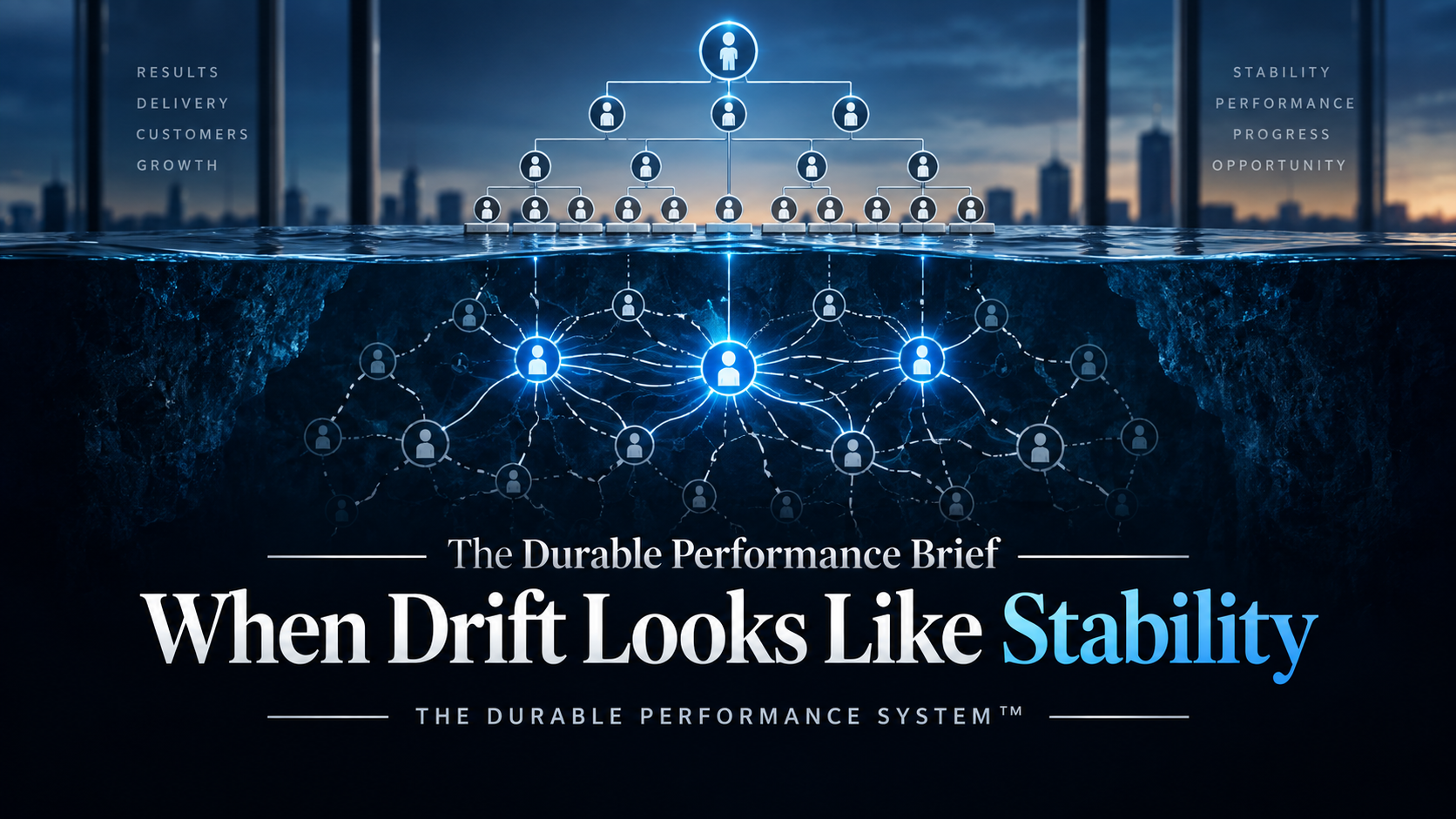
The Durable Performance Brief · Edition 26 · September 16, 2026
Organizations rarely worry when the numbers still look acceptable.
Revenue is holding.
Customers are staying.
Attrition is manageable.
Projects are getting finished.
The team is still delivering.
Nothing appears broken enough to demand a major correction.
That is precisely what makes some forms of organizational drift difficult to see.
A system can remain stable because it is healthy.
It can also remain stable because capable people are quietly compensating for everything that is not.
The outcomes can look remarkably similar.
The structural conditions underneath them are not.
The Core Thesis
Stability is an outcome. It is not a diagnosis.
When leaders see acceptable results, they naturally infer that the operating system producing those results is working reasonably well.
Sometimes that conclusion is correct.
Sometimes the organization is spending hidden capacity to preserve visible performance.
Managers resolve the same recurring conflicts.
High performers absorb extra work.
Experienced employees know which processes to bypass.
Teams compensate for unclear ownership through relationships.
Leaders personally intervene when important work starts to wobble.
Customers encounter friction, but strong employees recover the experience before it becomes a visible loss.
The organization still performs.
But it is performing partly through compensation rather than design.
That distinction matters because compensation can preserve results while concealing deterioration.
See more on Organizational Drift for how weakening standards, authority, accountability, and execution discipline can progress before failure becomes obvious.
The Hidden Labor of Stability
Imagine a team that consistently meets its commitments.
From the dashboard, the team looks healthy.
Now look closer.
One senior employee knows which approvals can be accelerated through personal relationships.
A manager spends several hours each week resolving ownership questions that should already be clear.
Two high performers routinely pick up work when handoffs fail.
A project lead schedules informal pre-meetings because the formal meeting cannot reliably produce a decision.
Everyone knows which executive needs to be consulted before certain decisions, even though no policy requires it.
None of those behaviors necessarily appears in a performance report.
Together, they may be the reason the performance report still looks good.
That is hidden structural labor.
The organization is consuming judgment, relationships, managerial attention, discretionary effort, and personal endurance to compensate for conditions the formal system has stopped handling well.
This is where Organizational Effectiveness becomes a more useful lens than results alone.
The question is not simply:
What did we produce?
It is also:
What did the organization have to consume to produce it?
High Performers Can Hide Weak Systems
Strong people are one of the greatest assets an organization can have.
They are also remarkably effective at hiding structural weakness.
When a process breaks, they improvise.
When ownership is unclear, they figure it out.
When priorities collide, they absorb more.
When a customer is frustrated, they repair the relationship.
When another team misses a handoff, they compensate.
That is valuable.
It can also delay correction.
Leadership sees acceptable output and concludes that the underlying arrangement is working.
The high performer experiences something different: more friction, more invisible work, and more responsibility for keeping weaknesses from becoming visible.
Over time, the organization begins depending on compensation it never deliberately designed.
That is fragile stability.
The danger becomes obvious only when the person stops compensating.
They leave.
They burn out.
They move roles.
Demand increases beyond what they can absorb.
Or they simply stop spending discretionary effort repairing problems the organization refuses to remove.
Then what looks like sudden deterioration may actually be the disappearance of a subsidy that had been hiding the problem for years.
Managers Can Hide It Too
Managers often become structural shock absorbers.
They translate ambiguous priorities.
Negotiate around unclear authority.
Resolve conflicts privately.
Chase decisions.
Reconcile contradictory expectations.
Protect teams from organizational noise.
Good managers should do some of this.
The problem is recurrence.
If the same managerial intervention is required week after week, the manager may no longer be handling exceptions.
They may be compensating for architecture.
That distinction is important.
A strong manager can make a weak system look functional for a surprisingly long time.
Leadership may even praise them for being indispensable.
But if the organization needs that manager’s constant translation and intervention simply to maintain normal operation, indispensability is not necessarily evidence of organizational strength.
It may be evidence that the structure has outsourced its weaknesses to a person.
Why Dashboards Miss This
Most organizational measures focus on visible outputs.
Revenue.
Margin.
Delivery.
Retention.
Customer satisfaction.
Productivity.
Those measures matter.
But they usually do not show how much hidden effort was required to produce them.
A project delivered on time looks successful whether it moved cleanly through the system or required three senior people to rescue it.
A customer retained looks successful whether the experience worked as designed or an exceptional employee repaired it manually.
A target achieved looks successful whether priorities were clear or the team worked nights to absorb conflicting demands.
The output is identical.
The durability is not.
This is why Execution Drag deserves attention even while performance remains acceptable. Friction, overload, handoffs, ambiguity, and coordination burden can rise long before the final output reveals the cost.
The Compensation Test
A useful way to distinguish healthy stability from fragile stability is to remove the compensation mentally.
Ask:
What would happen if our strongest people stopped compensating for the system?
Not if they stopped caring.
Not if they performed poorly.
If they simply stopped doing work the structure should already handle.
What happens if managers stop chasing routine decisions?
If high performers stop absorbing overflow?
If employees stop using personal relationships to navigate unclear processes?
If senior leaders stop rescuing ordinary execution problems?
If teams stop holding pre-meetings before the real meeting?
Would performance remain roughly intact?
If yes, the system may be healthier than it feels.
If performance deteriorates quickly, you have identified something important:
The stability was being subsidized.
One Practical Diagnostic
In your next leadership meeting, choose one area that appears to be performing well.
Then ask:
What invisible work is keeping this stable?
Look specifically for:
- recurring managerial intervention
- high performers carrying work outside their role
- manual workarounds
- unofficial approval paths
- relationship-dependent coordination
- repeated rescue
- extra hours that have become normal
- meetings required mainly to compensate for unclear ownership
- experienced employees translating rules everyone else struggles to navigate
Then ask one more question:
If we removed the compensation but changed nothing else, what would break?
Do not blame the people doing the compensating.
Their behavior may be exactly what has kept the organization functioning.
Treat their effort as diagnostic evidence.
They are showing you where the structure is asking people to do work the structure should be doing itself.
If You Change One Thing This Week
Find one recurring act of compensation.
Not the biggest problem in the company.
One repeated workaround that everyone has learned to accept.
Then trace backward.
Why is the workaround necessary?
What ambiguity, approval, handoff, capacity problem, incentive, or missing decision right created it?
What would have to change for a capable person to stop compensating without performance getting worse?
Then fix that condition.
The goal is not to make strong people contribute less.
It is to stop spending their strength on preventable friction.
That is an important distinction.
High performers should create leverage.
They should not be used as structural adhesive.
For the broader mechanism, explore Organizational Entropy—the accumulation of complexity, exceptions, weakened standards, and structural misalignment that can continue beneath visible strength.
Go Deeper
This issue builds on ideas from Why Organizations Drift, part of The Durable Performance System™ series.
Related read:
Why Organizations Drift examines why deterioration can remain hidden inside organizations that still appear functional. Reasonable accommodations accumulate, enforcement weakens, strong people compensate, and visible stability can persist long after the underlying system has started changing.
Closing Thought
Some organizations are stable because their systems are strong.
Others are stable because their people are.
For a while, both can look successful.
The difference appears under pressure.
A durable system does not require extraordinary people to continually rescue ordinary work.
It allows strong people to spend their judgment on creating value rather than compensating for preventable weakness.
So when everything still looks fine, do not ask only:
Are we performing?
Ask:
What is making that performance possible?
The answer will tell you whether you are looking at strength—
or compensation that has not failed yet.
Question for readers: What part of your organization looks healthy today mainly because capable people keep absorbing the friction?
Next Wednesday: When intent stops controlling behavior.
Part of The Durable Performance System™
Books, field guides, and frameworks on power, incentives, authority, accountability, and execution.
Published every Wednesday morning.
Curtisstoaks.com – YouTube – @curtisstoaksauthor