What Is Incentive Architecture?
Incentive architecture is the system of rewards, recognition, protection, promotion, measurement, tolerance, and consequence that teaches people what the organization truly values. It is part of organizational design and a direct influence on organizational effectiveness.
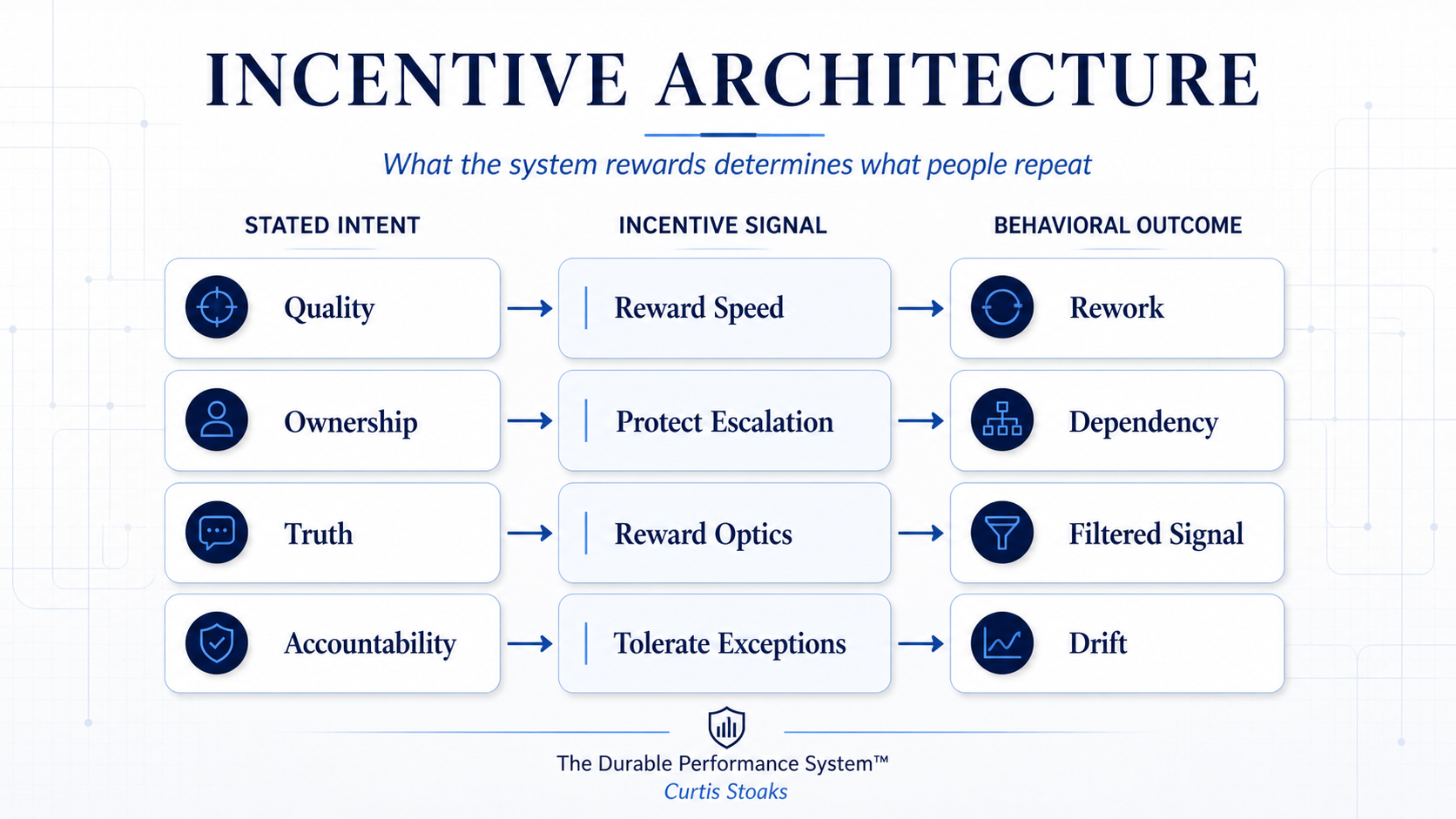
The system follows what it rewards.
Organizations do not become what leaders say they value. They become what incentives, promotions, exceptions, protections, and consequences repeatedly reinforce.
Prefer to read? Continue below for the definition, failure patterns, effects, and diagnostic questions.
Incentive architecture is the behavioral operating system.
It includes more than compensation. It also includes praise, promotion, status, visibility, protection, access, scorecards, tolerance, resource allocation, and consequence.
Together, these signals make some behaviors feel safer, more valuable, and more rational than others.
As part of organizational design , incentive architecture determines which behaviors the operating system encourages, protects, discourages, and corrects.
Stated values are not experienced incentives.
Values describe what leaders intend. Incentives reveal what the organization actually reinforces through repeated treatment of behavior and results.
The system rewards what it repeats.
When a behavior persists, the first question is not whether people understand the expectation. It is what the system is doing that makes the behavior rational.
Incentives shape the design and determine what it produces.
Incentive architecture is not an isolated compensation or culture practice. It is part of the operating structure that connects expectations, behavior, decisions, protection, and consequence.
Organizational Design
Organizational design includes how work, authority, information, incentives, accountability, coordination, and operating mechanisms are arranged.
Incentive architecture determines which outcomes receive reward, which behaviors gain protection, which metrics shape attention, which exceptions are tolerated, and where consequence is applied or withheld.
Organizational Effectiveness
Organizational effectiveness reveals whether the system produces intended outcomes while preserving quality, judgment, ownership, adaptability, trust, and durable capability.
Misaligned incentives reduce effectiveness by encouraging behavior that improves visible measures or short-term results while creating hidden risk, rework, weak ownership, filtered information, and long-term structural cost.
Six patterns that teach the wrong behavior.
Weak incentive architecture often appears as a culture, motivation, or accountability problem. The deeper issue is that the organization reinforces behavior it later claims to dislike.
Rewarding Outcomes While Condemning the Method
Leaders celebrate the result while overlooking the shortcuts, overload, hidden risk, or damaged relationships used to produce it.
Protecting High Performers From Consequence
Valuable employees receive softer standards, teaching the organization that results can purchase exemption.
Promoting Visible Activity Over Durable Results
People learn to optimize updates, motion, responsiveness, and visibility rather than completion, quality, or structural improvement.
Tolerating Behavior That Contradicts Standards
Repeated non-enforcement converts stated expectations into optional guidance.
Rewarding Caution While Demanding Speed
People are asked to move faster while the system punishes local judgment and protects escalation.
Celebrating Heroics That Compensate for Weak Systems
Individual sacrifice receives praise while the structural condition creating the emergency remains untouched.
Weak incentive architecture becomes visible in what people optimize.
Behavior often reveals the real reward system more accurately than policy, values language, or leadership messaging.
Activity Beats Outcomes
People learn to show motion, produce updates, and remain visible even when the work is not moving.
Speed Beats Judgment
The organization praises fast action while absorbing rework, defects, and weak decisions elsewhere.
Volume Beats Quality
Teams optimize output count while durability, customer impact, craft, and long-term value decline.
Protection Beats Correction
Valuable people, popular initiatives, and visible leaders receive softer treatment than the standard requires.
Escalation Feels Safer
Waiting, aligning, and moving decisions upward protect people more reliably than exercising judgment.
Optics Beat Truth
Updates, dashboards, and presentations become safer to optimize than the reality they are supposed to reveal.
Behavior follows experienced consequence more than instruction.
Leaders often assume behavior follows expectations. They restate values, reinforce priorities, and explain what should matter.
Employees watch what gets promoted, praised, protected, ignored, funded, measured, and corrected. When those signals contradict stated priorities, behavior follows the signal.
The organization may keep correcting language while preserving the architecture that produced the behavior.
The pattern is predictable.
- 1 A stated expectation exists. Leaders say they value quality, ownership, speed, accountability, truth, or collaboration.
- 2 The system rewards something else. Different behavior is praised, promoted, protected, funded, or tolerated.
- 3 Rational behavior shifts. Teams adapt toward what is safer, more visible, or more rewarded.
- 4 The operating design changes. Metrics, promotion rules, exceptions, recognition practices, and protection patterns become embedded in how the organization operates.
- 5 Leadership names the symptom. The issue is framed as culture, discipline, motivation, accountability, or communication.
- 6 Correction remains inconsistent. Leaders restate the expectation while continuing to reward or protect the conflicting behavior.
- 7 Effectiveness narrows. Short-term measures may improve while quality, trust, capability, ownership, and durable performance weaken.
- 8 The pattern becomes cultural. Messaging changes while the reward structure continues teaching the same behavior.
Reward systems shape the wider operating environment.
Incentive architecture changes organizational design, affects organizational effectiveness, influences what people report, shapes how they decide, and determines whether accountability and standards remain credible.
Organizational Design
Metrics, recognition, promotion, protection, resource allocation, tolerance, and consequence become permanent parts of how behavior is directed.
Explore organizational design →Organizational Effectiveness
Misaligned reinforcement can improve visible measures while weakening quality, judgment, ownership, trust, adaptability, and durable results.
Explore organizational effectiveness →Signal Integrity
If polish, confidence, or protection receive more reward than candor, truth becomes filtered.
Explore signal integrity →Decision Velocity
If delay and escalation are safer than judgment, the organization slows while continuing to ask for speed.
Explore decision velocity →Accountability Design
Standards and consequence lose credibility when application changes based on value, status, popularity, or short-term results.
Explore accountability design →Leadership Behavior
Leaders reveal priorities through what they fund, praise, protect, revisit, excuse, and correct.
Explore leadership systems →Employee Behavior
People adapt toward the choices that create safety, recognition, opportunity, reduced exposure, and career advantage.
Organizational Drift
Protected exceptions and inconsistent correction teach the system that stated standards are negotiable.
Explore organizational drift →Incentives operate through design, authority, signal, and consequence.
Organizational Design
Incentives are part of the wider arrangement of work, authority, information, accountability, coordination, and operating mechanisms.
Explore organizational design →Organizational Effectiveness
Incentive quality becomes visible through the behavior, decisions, standards, capability, trust, adaptability, and outcomes the system repeatedly produces.
Explore organizational effectiveness →Authority Design
When escalation receives more protection than judgment, incentive architecture pulls authority upward.
Explore authority design →Signal Integrity
What the organization rewards people for reporting determines whether operating truth travels directly or becomes safer and more polished.
Explore signal integrity →Accountability Design
Consistent standards, follow-up, correction, and consequence determine whether stated expectations are credible.
Explore accountability design →Leadership Systems
Leaders create behavioral rules through the attention, protection, resources, praise, exceptions, and consequences they control.
Explore leadership systems →Questions that reveal weak incentive architecture.
If these questions produce immediate examples, the organization is not dealing only with a motivation gap. It is dealing with incentive design.
Use the Drift Diagnostic →Align reward, recognition, protection, and consequence.
Identify the behavior each metric, promotion, exception, recognition practice, and consequence teaches. Remove rewards for activity that does not create durable value. Stop protecting results that depend on damaging methods. Apply standards consistently. Reward judgment, candor, completion, and structural improvement.
The goal is not to eliminate incentives. It is to make the desired behavior the rational behavior.
Make accountability credible.
Incentives remain distorted when standards, ownership, correction, and consequence are applied inconsistently.
Choose the next structural path.
Incentive architecture becomes actionable when leaders examine how reinforcement is arranged, what behavior the current system produces, and whether reward and consequence support the outcomes the organization claims to value.
Organizational Design
Examine how metrics, recognition, promotion, protection, tolerance, resources, standards, and consequence are arranged.
Explore Organizational Design →Organizational Effectiveness
Evaluate whether the reward system strengthens judgment, quality, ownership, trust, adaptability, capability, and durable outcomes.
Explore Organizational Effectiveness →Accountability Design
Align ownership, authority, standards, measurement, follow-up, correction, and consequence.
Explore Accountability Design →Signal Integrity
Examine whether people are rewarded for candor, early warning, and correction—or for confidence, protection, and polished reporting.
Explore Signal Integrity →The Drift Diagnostic
Identify where rewards, protections, exceptions, soft consequence, distorted metrics, or inconsistent standards may already be changing the system.
Take the Drift Diagnostic →The Durable Performance System™
See how incentive architecture connects with design, effectiveness, authority, signal, accountability, consequence, and execution.
See the Complete System →About incentive architecture.
Is incentive architecture only about compensation?
How are incentives different from stated values?
How does incentive architecture relate to organizational design?
How does incentive architecture affect organizational effectiveness?
What is the clearest sign of weak incentive architecture?
Why are high performers often protected from consequence?
How should leaders improve incentive architecture?
The system teaches what the system rewards.
The earlier leaders can see what behavior is being rewarded, protected, promoted, tolerated, and corrected, the easier it becomes to improve organizational design, strengthen organizational effectiveness, and realign incentives before distortion becomes culture.