What Is Organizational Drift?
Organizational drift is the gradual erosion of standards, authority, accountability, information quality, and execution discipline. Over time, those changes alter organizational design, weaken organizational effectiveness, and make declining performance feel normal before visible failure forces correction.
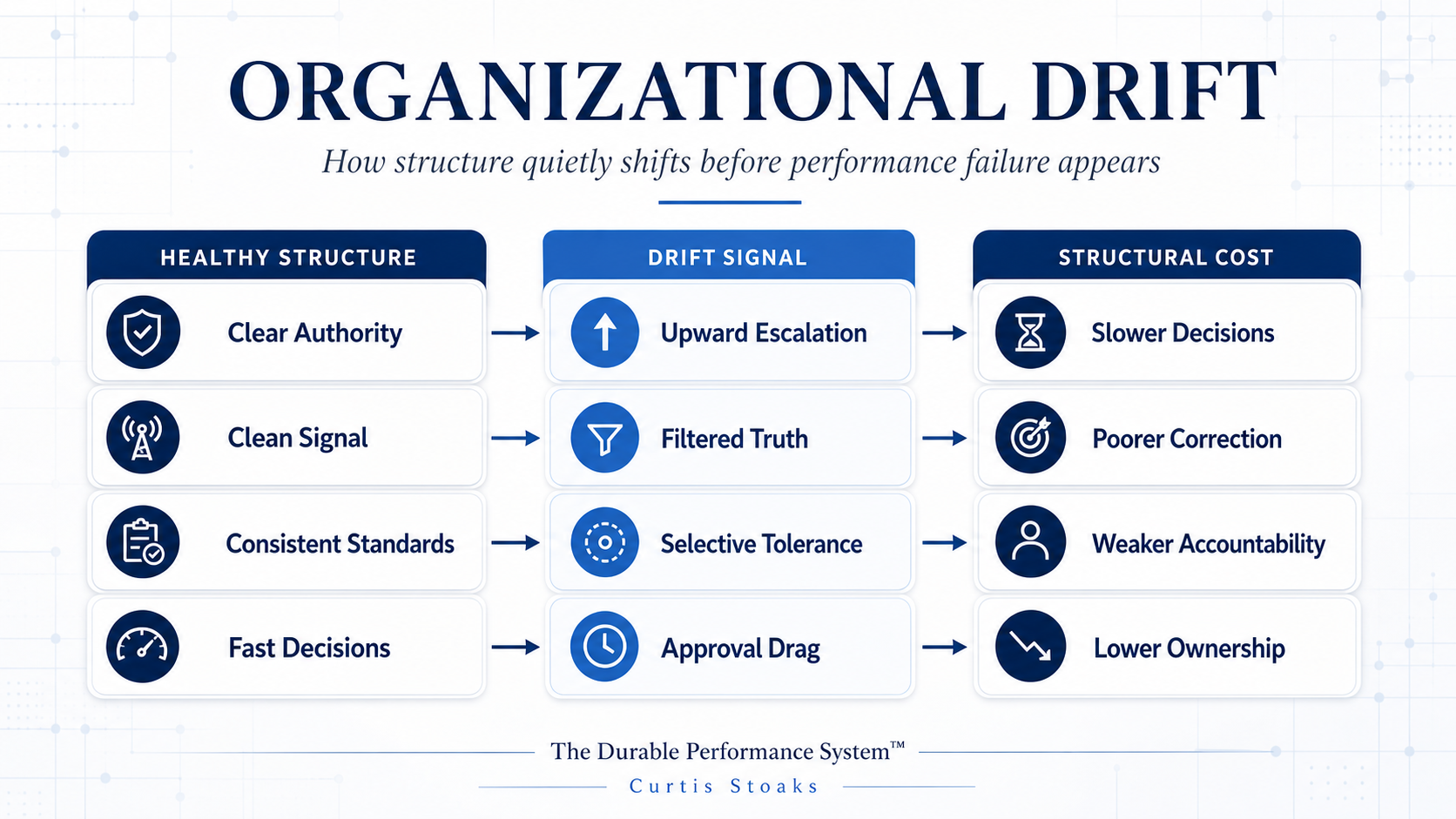
Drift begins before failure becomes visible.
Organizations rarely weaken through one dramatic event. They drift through reasonable exceptions, softened standards, delayed correction, and structural changes that accumulate quietly.
Prefer to read? Continue below for the definition, causes, early signals, drift sequence, and diagnostic questions.
Organizational drift is erosion without interruption.
The organization still operates. Results may remain defensible. People still work hard. Yet the system gradually moves away from its stated standards because repeated exceptions, weakened enforcement, unclear authority, distorted incentives, and filtered information are allowed to persist.
The practical problem is not that leaders lack intent. It is that intent no longer governs the operating reality.
If an outcome persists, the structure permits it.
Drift is reinforced by what the organization rewards, protects, tolerates, escalates, delays, measures, and corrects.
Messaging cannot substitute for enforcement.
More meetings, values language, reporting, or reminders will not correct a structural condition unless authority, incentives, standards, and consequence also change.
Drift changes the design before it destroys the result.
Organizational drift connects the way the system gradually changes with the declining quality and durability of what that system produces.
Organizational Design
Organizational design determines how work, authority, incentives, information, accountability, and coordination are arranged.
Drift alters that arrangement through accumulated approvals, lingering exceptions, authority migration, filtered reporting, selective standards, and controls that remain after their original purpose has passed.
Organizational Effectiveness
Organizational effectiveness reveals whether the current arrangement reliably produces intended outcomes while preserving capability, clarity, trust, adaptability, and execution.
As drift accumulates, the organization consumes more attention, coordination, oversight, and personal effort to produce the same or weaker results.
Drift develops when temporary protection becomes permanent design.
The initial action is often reasonable. The damage appears when the action survives beyond the pressure that justified it and the system adapts around it.
Weak Enforcement
Standards remain visible, but application becomes delayed, selective, or dependent on who is involved.
Unexpired Exceptions
Temporary accommodations survive after the original condition passes and quietly become precedent.
Authority Migration
Routine judgment moves upward because local decisions feel exposed, reversible, or insufficiently protected.
Signal Compression
Operating reality is summarized, softened, and packaged as it travels through organizational layers.
Incentive Contradiction
The organization rewards outcomes or behaviors that conflict with the standards leadership says it values.
Additive Correction
Every problem attracts another approval, report, meeting, control, or policy instead of disciplined removal.
Drift becomes visible before failure does.
The organization may still appear stable while authority, information, accountability, execution discipline, and overall effectiveness are already weakening beneath the surface.
Authority Moves Upward
Routine decisions require more alignment, visibility, escalation, and senior approval than they once did.
Explore authority design →Information Gets Compressed
Updates become cleaner and safer while leadership receives less direct operating truth.
Explore signal integrity →Exceptions Become Precedent
Temporary accommodations remain after the original pressure has passed and begin rewriting what the system allows.
Accountability Weakens
Standards still exist, but people learn when they apply, to whom they apply, and when they can be negotiated.
Explore accountability design →Motion Replaces Progress
Meetings, dashboards, reports, and updates increase while fewer decisions or outcomes change because of them.
Explore execution drag →High Performers Compensate
The strongest people absorb friction until the organization mistakes personal sacrifice for structural health.
Failure demands attention. Drift invites explanation.
Leaders are trained to respond to obvious problems, not slow erosion. A missed number can be contextualized. A delayed decision can be explained. A recurring exception can be defended.
Each explanation may be reasonable in isolation. The danger is accumulation. What feels manageable once becomes structural when repeated.
Visible results can continue for a time because strong employees, managers, or senior leaders compensate for the weakening design. That compensation can conceal declining effectiveness.
The pattern is predictable.
- 1 Pressure rises. A miss, escalation, reorganization, customer issue, or leadership concern creates uncertainty.
- 2 Control gets added. Leaders respond with more approval, visibility, reporting, protection, or exception.
- 3 The addition survives. What was temporary becomes normal because removing it feels riskier than keeping it.
- 4 The design changes. Decision rights, information flow, accountability, coordination, and operating expectations shift.
- 5 Behavior adapts. People learn to wait, package truth, escalate, over-explain, and protect themselves.
- 6 Effectiveness narrows. Speed drops, ownership weakens, truth travels carefully, and results require more intervention to sustain.
One weakened condition increases pressure on the others.
Drift is not a collection of unrelated symptoms. It spreads through the operating system and becomes increasingly self-reinforcing.
Organizational Design
Drift gradually changes how work, decisions, information, accountability, and coordination operate—even when the formal structure remains unchanged.
Explore organizational design →Organizational Effectiveness
The organization requires more effort, supervision, coordination, and rescue to produce outcomes that were once easier to sustain.
Explore organizational effectiveness →Organizational Entropy
Accumulated tolerance, complexity, and unresolved distortion make the organization less capable of self-correction.
Explore organizational entropy →Decision Velocity
More escalation and approval slow judgment, increase coordination cost, and push routine decisions upward.
Explore decision velocity →Incentive Architecture
People adapt to what receives reward, recognition, protection, and tolerance—not only to what leaders say.
Explore incentive architecture →Structural Simplicity
Added controls, reports, meetings, and processes increase weight without necessarily improving capability.
Explore structural simplicity →Drift becomes structural when explanation replaces interruption.
Once the organization adapts to the exception, correction requires more than renewed intent. It requires removal, restored authority, stronger signal, predictable standards, enforced consequence, and deliberate redesign.
Questions that reveal organizational drift.
If several questions produce immediate examples, drift is not theoretical. The system is already giving you data.
This page defines drift. The book explains its mechanics.
This concept page provides a concise definition, early signals, causes, design consequences, and diagnostic entry point.
Why Organizations Drift develops the full argument: how reasonable accommodations, selective enforcement, tolerated exceptions, succession, scale, and weakened discipline become structural decay.
Move from recognizing drift into structural correction.
Use the next pathway that best matches the question already in front of you.
Examine Organizational Design
Identify how decision rights, information, incentives, accountability, and coordination have shifted.
Explore Organizational Design →Evaluate Organizational Effectiveness
Examine what the current arrangement produces and what the system must consume to keep producing it.
Explore Organizational Effectiveness →Take the Drift Diagnostic
Identify authority drift, signal distortion, execution friction, and weak ownership.
Start the Diagnostic →See the Complete System
Understand how drift connects to authority, incentives, information, accountability, consequence, and execution.
Explore the System →Use the Resources
Access the diagnostic, structural tools, doctrine overviews, and applied materials.
View Resources →Read the Brief
Browse focused essays on drift, design, authority, accountability, execution, and durable performance.
Browse the Brief Archive →About organizational drift.
Is organizational drift the same as organizational failure?
Does organizational drift mean leaders no longer care?
How does organizational drift affect organizational design?
How does organizational drift reduce organizational effectiveness?
What is usually the first sign of drift?
Can organizational drift be corrected?
How should an organization begin diagnosing drift?
Drift becomes expensive when leaders wait for it to become obvious.
The earlier leaders can identify how the design has shifted and where authority moved, signal compressed, incentives tilted, accountability softened, and friction accumulated, the easier it becomes to restore organizational effectiveness before the system hardens around the wrong behavior.