Edition 6 | April 29, 2026
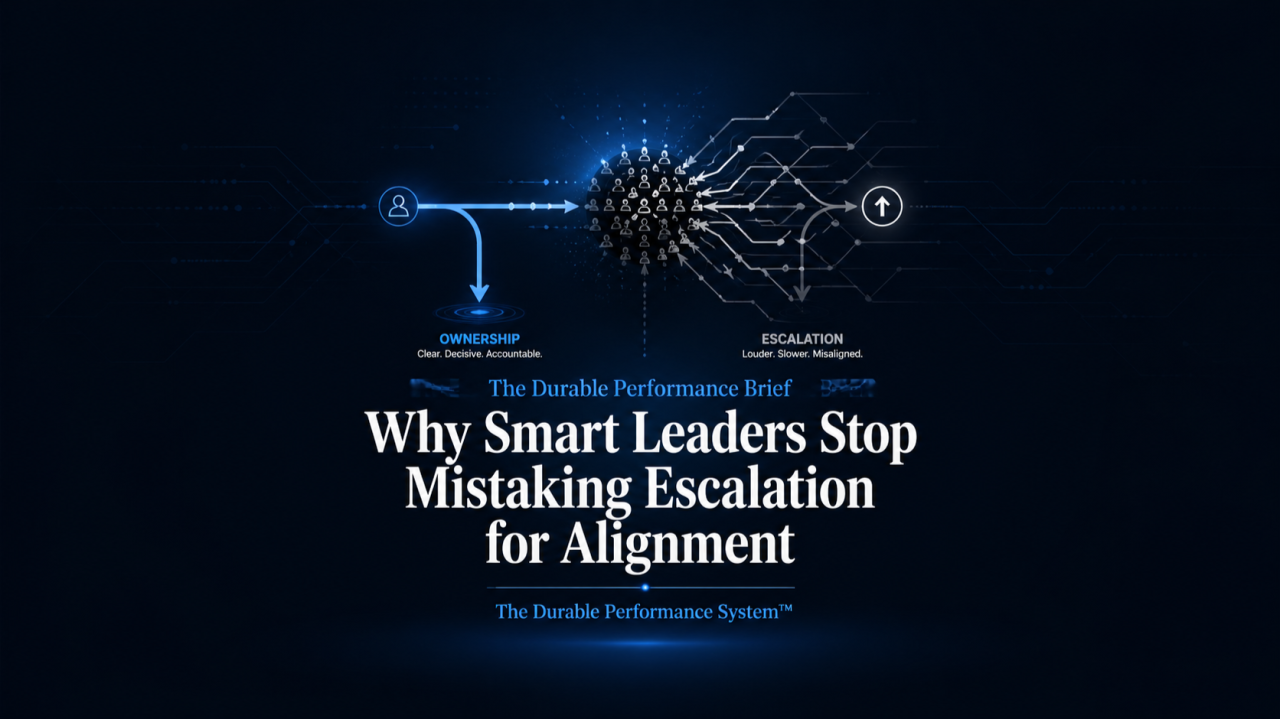
Smart leaders stop mistaking escalation for alignment because alignment should clarify ownership, not transfer every difficult decision upward.
Most organizations do not drown in bad decisions first.
They drown in transferred decisions.
That is the distinction leaders miss when escalation starts sounding like discipline.
Alignment is supposed to clarify who carries the call.
Escalation transfers the call upward.
Those are not the same thing.
But in many organizations, they slowly become indistinguishable. A manager raises something “for visibility.” A director wants to “stay close.” A cross-functional tension gets pushed higher “just to be safe.” An executive team tells itself it is protecting quality.
What it is often protecting is discomfort.
And once discomfort starts getting treated like material risk, escalation rises for the wrong reasons.
That is where decision velocity begins to collapse.
The Core Thesis
Leaders usually misread escalation as evidence of seriousness.
It is often evidence of structural ambiguity.
A healthy system does not eliminate escalation. It makes it legible. People know what belongs locally, what requires consultation, what crosses a real threshold, and what truly needs higher-level ownership.
An unhealthy system does something else.
It treats uncertainty, visibility, stakeholder sensitivity, and personal discomfort as reasons to elevate. That feels prudent in the moment. It also teaches the organization the wrong operating logic.
People stop asking:
Who should own this?
They start asking:
Who do we need to involve so no one gets exposed?
That is not alignment.
That is authority drift with professional language around it.
The cost is larger than delay.
When escalation becomes default, three things happen at once.
- Ownership weakens because local leaders learn that serious decisions do not really belong to them.
- Signal gets curated because anything moving upward now has to be packaged carefully.
- The center gets crowded because senior leaders start adjudicating routine complexity instead of designing better systems.
By the time executives feel buried, the structural lesson has already been taught.
If the center keeps touching the work, the edge stops trusting its own judgment.
What This Looks Like in the Wild
You can usually see this pattern before any KPI turns visibly red.
Routine tradeoffs start getting elevated because someone more senior “may have an opinion.”
Cross-functional teams spend more time socializing decisions than making them.
People ask for approval when what they really need is clarity.
Leaders say they want ownership, but local calls get reopened once they create any visible discomfort.
Escalation volume rises without a corresponding rise in actual risk.
The room still feels disciplined.
That is why this pattern survives.
Nothing about it looks irresponsible. The calendars are full. The updates are thoughtful. The language is measured. Everyone appears collaborative.
But beneath that professionalism, the organization is relearning where authority really lives.
And once people believe the safest path is elevation, they adapt quickly.
- They escalate sooner.
- They recommend instead of decide.
- They manage upward instead of resolving tension close to the work.
- They optimize for survivable judgment, not durable judgment.
That is how strong organizations become cautious without announcing it.
Why Leaders Misread It
Because escalation often arrives wearing the costume of maturity.
Leaders hear words like alignment, coordination, visibility, and risk management.
All of those sound reasonable.
But reasonable language can hide weak architecture.
Real alignment does not require constant elevation.
It requires clear decision rights, explicit thresholds, visible tradeoffs, and trustworthy consequence. People need to know when they are deciding, when they are consulting, when they are informing, and when they are truly crossing into a higher-risk category that justifies escalation.
Without that clarity, escalation becomes emotional rather than structural.
People elevate because the issue is sensitive.
Because a stakeholder is loud.
Because a miss would be embarrassing.
Because waiting feels safer than acting.
Because no one trusts that a local call will survive if someone more senior disagrees later.
That is not a communication problem.
It is an authority design problem.
One Practical Diagnostic
Ask this in your next leadership meeting:
Which decisions are being escalated repeatedly without a real change in risk?
Then force a harder distinction:
- Which escalations crossed a true threshold?
- Which escalations happened because ownership was unclear?
- Which happened because people feared being reopened later?
- Which happened because “alignment” has quietly become permission?
If a decision category keeps rising without new materiality, the system is not being careful.
It is being trained to wait.
If You Change One Thing This Week
Pick one recurring decision category that keeps reaching higher than it should.
Then define four things in writing:
- Decision owner: Who can make the call without permission?
- Consulted: Whose input matters before the call is made?
- Informed: Who needs visibility after the call?
- Escalation threshold: What specifically changes the level of ownership?
Do not use vague language.
Not “important.” Not “high visibility.” Not “sensitive.”
Define the actual threshold.
Revenue exposure above a certain level. Regulatory risk. Irreversible customer impact. Cross-functional tradeoff above a named boundary.
Anything less precise teaches politics.
Anything less precise turns alignment into delay.
Closing Thought
Alignment clarifies ownership.
Escalation transfers ownership.
When leaders confuse the two, they do not build a more disciplined organization.
They build a more cautious one.
And cautious systems rarely fail all at once.
They just keep sending the decision upward until nobody below feels allowed to carry it.
Question for readers: Where in your organization is “alignment” still being used to justify escalation that no longer serves the work?
Related Books
Primary related book: What Smart Leaders Stop Doing
This edition connects directly to leadership behaviors that feel diligent in the moment but quietly centralize authority, distort signal, and make organizations more dependent on the center.
Secondary related book: The Durable Performance Field Guide
Use this book when the next step is to define decision ownership, escalation thresholds, authority clarity, and practical redesign steps.
Continue Through The Durable Performance System™
Next Wednesday: Why smart leaders stop overruling too early.