Edition 18 | July 22, 2026
Weak organizations do not always lose decision quality first.
They lose decision location.
The call still gets made. Sometimes it is even the right call. But it no longer gets made where it should.
A decision that once belonged to a manager begins requiring director input. A routine customer exception moves upward “for visibility.” A cross-functional disagreement becomes an executive issue. A team that was told to take ownership starts scheduling pre-alignment meetings before acting.
No one formally announces that authority has changed.
It migrates.
And once authority moves upward, it rarely moves back down without deliberate leadership action.
The Core Thesis
Temporary centralization easily becomes permanent operating design.
Pressure rises. A visible mistake occurs. Confidence in local judgment drops. Senior leaders step closer to stabilize the situation.
That intervention may be justified.
The problem begins when the conditions that caused the intervention pass, but the authority remains at the center.
Managers remember being reversed.
Teams remember that acting independently created exposure.
Functions remember that broad alignment felt safer than ownership.
Leaders remember the cost of the original mistake and remain reluctant to return discretion.
The organization now has structural memory.
Centralization teaches caution. Caution increases escalation. Escalation creates dependency. Dependency then becomes evidence that continued centralization is necessary.
The system has built a loop that will not correct itself.
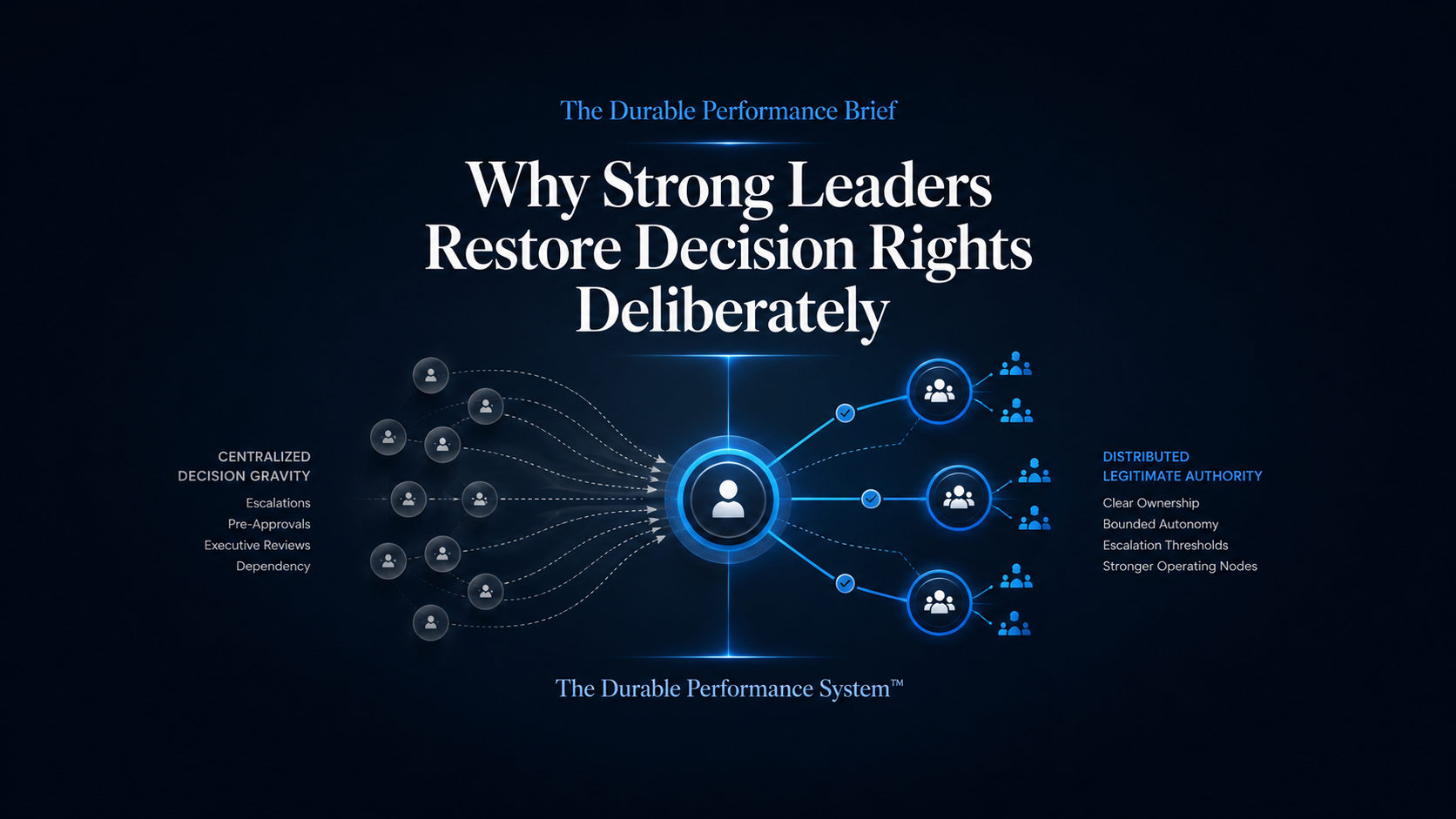
Strong leaders understand that restoring decision rights requires more than telling people to “take ownership.” It requires moving legitimate authority back to the proper level and changing the behaviors that made local ownership feel unsafe in the first place.
What This Looks Like in the Wild
Formal authority and actual authority begin separating.
The role description says the manager decides.
The manager still seeks approval.
The operating model says the team owns customer exceptions.
Senior leaders still expect a preview.
The organization says decisions should remain close to the work.
Executives routinely reopen decisions after they are made.
This creates ceremonial ownership.
People are allowed to research, package, recommend, and present. But the system still teaches them that the real decision belongs elsewhere.
That is not delegated authority.
It is delegated preparation.
The difference becomes visible in behavior:
- Routine decisions are escalated for protection rather than risk.
- Meetings labeled “alignment” function as unofficial approvals.
- Leaders complain about excessive escalation while continuing to accept it.
- Teams prepare executive-facing narratives before acting.
- Managers ask permission where they should be exercising judgment.
- People closest to the work hesitate because their authority does not feel durable.
Eventually, the organization stops asking, “Who should decide this?”
It starts asking, “Who must be involved so no one gets exposed?”
That is decision architecture turning into political self-protection.
Why Leaders Misread It
Because many leaders believe they have returned authority when they have only changed their language.
They say:
“You own this.”
But they still expect to be consulted before anything significant happens.
They still ask enough questions to signal that the decision remains provisional.
They still intervene when the local choice differs from what they would have chosen.
They still reverse legitimate decisions because senior discomfort rises after the fact.
The organization notices.
A decision right is not real merely because a leader assigned it in a meeting. It becomes real when the decision survives reasonable disagreement, executive interest, and imperfect outcomes.
This is the difficult part of restoration.
Leaders must accept that local decisions will sometimes differ from their preferences. Some will be imperfect. A senior leader may have made a marginally better call.
But a slightly imperfect decision made at the correct level can create more long-term organizational strength than a perfectly optimized decision repeatedly pulled back to the center.
Strong leaders coach judgment without absorbing ownership.
They examine reasoning, clarify risk, challenge assumptions, and sharpen tradeoffs. But they resist becoming the decision-maker simply because they could improve the decision.
One Practical Diagnostic
Choose the five recurring decisions that generate the most escalation in your organization.
For each one, ask:
Who formally owns this decision?
Then ask the more important question:
Who can actually make it without seeking informal permission?
Look for the gap.
Then examine:
- Who decides?
- Who approves?
- Who must be consulted?
- Who only needs to be informed?
- What specific risk threshold requires escalation?
- Is the decision reversible?
- Does the person accountable for the outcome control the main variables that shape it?
- What happens when a legitimate local decision makes a senior leader uncomfortable?
If the formal owner cannot make the call without previewing, socializing, or protecting themselves politically, the authority is not truly local.
If a decision repeatedly escalates without new risk, authority has drifted upward. It should either be returned or explicitly redesigned.
If You Change One Thing This Week
Return one class of reversible decisions to the proper level.
Do not issue a broad statement about empowerment.
Choose a real decision category.
Pricing exceptions below a defined amount.
Routine staffing adjustments within budget.
Customer remedies inside an established range.
Project sequencing within an approved priority set.
Then define four things clearly:
The owner
Name the role that makes the final call.
The boundary
Clarify what sits inside that person’s authority.
The escalation threshold
Specify the risk, cost, legal exposure, customer impact, or cross-functional condition that changes the decision level.
The protection
Commit that senior leaders will not casually reopen a legitimate decision that remained within the boundary.
This last element is essential.
Authority cannot be restored if it disappears the moment someone more senior becomes interested.
Restoration becomes credible through repeated lived moments: someone makes a legitimate decision, the decision remains local, and leadership protects the boundary even when it would have chosen differently.
Go Deeper
This issue builds on ideas from What Smart Leaders Stop Doing, part of The Durable Performance System™ series.
Related read:
What Smart Leaders Stop Doing examines how capable leaders unintentionally centralize authority, create escalation dependence, and weaken ownership beneath them—and how deliberate decision-right restoration reverses that pattern.
Closing Thought
Authority rarely returns simply because the crisis has passed.
Someone has to put it back.
That requires leaders to do more than ask for ownership.
They must define it.
Transfer it.
Bound it.
And protect it after the decision is made.
Because an organization does not become stronger when more people prepare recommendations for the center.
It becomes stronger when legitimate decisions can be made—and allowed to stand—at the right level.
Question for readers: What decision still rises to senior leadership even though the information, capability, and accountability already live somewhere below?
Next Wednesday: Why healthy organizations audit during strength.
Part of The Durable Performance System™
Books, field guides, and frameworks on power, incentives, authority, accountability, and execution.
Published every Wednesday morning.