Tag: Decision Velocity

Posts about how quickly and clearly organizations make, own, and execute decisions without unnecessary delay, escalation, or approval drag.

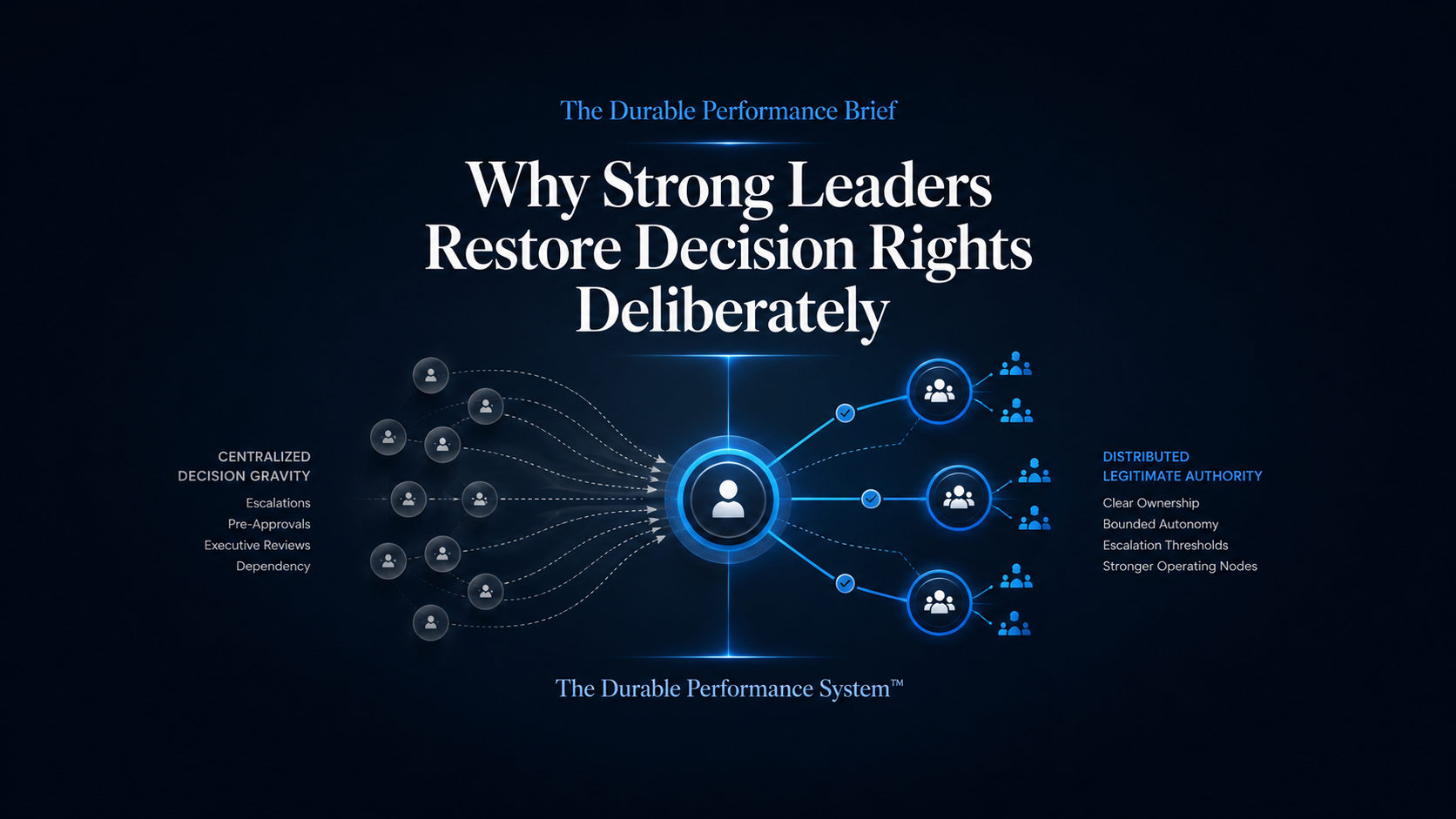
  • Why Strong Leaders Restore Decision Rights Deliberately

    Why Strong Leaders Restore Decision Rights Deliberately

    Edition 18 | July 22, 2026

    Weak organizations do not always lose decision quality first.

    They lose decision location.

    The call still gets made. Sometimes it is even the right call. But it no longer gets made where it should.

    A decision that once belonged to a manager begins requiring director input. A routine customer exception moves upward “for visibility.” A cross-functional disagreement becomes an executive issue. A team that was told to take ownership starts scheduling pre-alignment meetings before acting.

    No one formally announces that authority has changed.

    It migrates.

    And once authority moves upward, it rarely moves back down without deliberate leadership action.

    The Core Thesis

    Temporary centralization easily becomes permanent operating design.

    Pressure rises. A visible mistake occurs. Confidence in local judgment drops. Senior leaders step closer to stabilize the situation.

    That intervention may be justified.

    The problem begins when the conditions that caused the intervention pass, but the authority remains at the center.

    Managers remember being reversed.

    Teams remember that acting independently created exposure.

    Functions remember that broad alignment felt safer than ownership.

    Leaders remember the cost of the original mistake and remain reluctant to return discretion.

    The organization now has structural memory.

    Centralization teaches caution. Caution increases escalation. Escalation creates dependency. Dependency then becomes evidence that continued centralization is necessary.

    The system has built a loop that will not correct itself.

    Strong leaders understand that restoring decision rights requires more than telling people to “take ownership.” It requires moving legitimate authority back to the proper level and changing the behaviors that made local ownership feel unsafe in the first place.

    What This Looks Like in the Wild

    Formal authority and actual authority begin separating.

    The role description says the manager decides.

    The manager still seeks approval.

    The operating model says the team owns customer exceptions.

    Senior leaders still expect a preview.

    The organization says decisions should remain close to the work.

    Executives routinely reopen decisions after they are made.

    This creates ceremonial ownership.

    People are allowed to research, package, recommend, and present. But the system still teaches them that the real decision belongs elsewhere.

    That is not delegated authority.

    It is delegated preparation.

    The difference becomes visible in behavior:

    • Routine decisions are escalated for protection rather than risk.
    • Meetings labeled “alignment” function as unofficial approvals.
    • Leaders complain about excessive escalation while continuing to accept it.
    • Teams prepare executive-facing narratives before acting.
    • Managers ask permission where they should be exercising judgment.
    • People closest to the work hesitate because their authority does not feel durable.

    Eventually, the organization stops asking, “Who should decide this?”

    It starts asking, “Who must be involved so no one gets exposed?”

    That is decision architecture turning into political self-protection.

    Why Leaders Misread It

    Because many leaders believe they have returned authority when they have only changed their language.

    They say:

    “You own this.”

    But they still expect to be consulted before anything significant happens.

    They still ask enough questions to signal that the decision remains provisional.

    They still intervene when the local choice differs from what they would have chosen.

    They still reverse legitimate decisions because senior discomfort rises after the fact.

    The organization notices.

    A decision right is not real merely because a leader assigned it in a meeting. It becomes real when the decision survives reasonable disagreement, executive interest, and imperfect outcomes.

    This is the difficult part of restoration.

    Leaders must accept that local decisions will sometimes differ from their preferences. Some will be imperfect. A senior leader may have made a marginally better call.

    But a slightly imperfect decision made at the correct level can create more long-term organizational strength than a perfectly optimized decision repeatedly pulled back to the center.

    Strong leaders coach judgment without absorbing ownership.

    They examine reasoning, clarify risk, challenge assumptions, and sharpen tradeoffs. But they resist becoming the decision-maker simply because they could improve the decision.

    One Practical Diagnostic

    Choose the five recurring decisions that generate the most escalation in your organization.

    For each one, ask:

    Who formally owns this decision?

    Then ask the more important question:

    Who can actually make it without seeking informal permission?

    Look for the gap.

    Then examine:

    • Who decides?
    • Who approves?
    • Who must be consulted?
    • Who only needs to be informed?
    • What specific risk threshold requires escalation?
    • Is the decision reversible?
    • Does the person accountable for the outcome control the main variables that shape it?
    • What happens when a legitimate local decision makes a senior leader uncomfortable?

    If the formal owner cannot make the call without previewing, socializing, or protecting themselves politically, the authority is not truly local.

    If a decision repeatedly escalates without new risk, authority has drifted upward. It should either be returned or explicitly redesigned.

    If You Change One Thing This Week

    Return one class of reversible decisions to the proper level.

    Do not issue a broad statement about empowerment.

    Choose a real decision category.

    Pricing exceptions below a defined amount.

    Routine staffing adjustments within budget.

    Customer remedies inside an established range.

    Project sequencing within an approved priority set.

    Then define four things clearly:

    The owner
    Name the role that makes the final call.

    The boundary
    Clarify what sits inside that person’s authority.

    The escalation threshold
    Specify the risk, cost, legal exposure, customer impact, or cross-functional condition that changes the decision level.

    The protection
    Commit that senior leaders will not casually reopen a legitimate decision that remained within the boundary.

    This last element is essential.

    Authority cannot be restored if it disappears the moment someone more senior becomes interested.

    Restoration becomes credible through repeated lived moments: someone makes a legitimate decision, the decision remains local, and leadership protects the boundary even when it would have chosen differently.

    Go Deeper

    This issue builds on ideas from What Smart Leaders Stop Doing, part of The Durable Performance System™ series.

    Related read:
    What Smart Leaders Stop Doing examines how capable leaders unintentionally centralize authority, create escalation dependence, and weaken ownership beneath them—and how deliberate decision-right restoration reverses that pattern.

    Closing Thought

    Authority rarely returns simply because the crisis has passed.

    Someone has to put it back.

    That requires leaders to do more than ask for ownership.

    They must define it.

    Transfer it.

    Bound it.

    And protect it after the decision is made.

    Because an organization does not become stronger when more people prepare recommendations for the center.

    It becomes stronger when legitimate decisions can be made—and allowed to stand—at the right level.

    Question for readers: What decision still rises to senior leadership even though the information, capability, and accountability already live somewhere below?

    Next Wednesday: Why healthy organizations audit during strength.

    Part of The Durable Performance System™
    Books, field guides, and frameworks on power, incentives, authority, accountability, and execution.
    Published every Wednesday morning.

    Explore the books →

    Continue Through The Durable Performance System™

  • Why Smart Leaders Stop Asking for More Visibility Than They Need

    Why Smart Leaders Stop Asking for More Visibility Than They Need

    Edition 9 | May 20, 2026

    Most leaders do not ask for more visibility because they are careless.

    They ask for it because uncertainty is uncomfortable.

    A metric moves the wrong way. A project slips. A customer issue surfaces. Confidence drops. Someone senior asks a hard question. In that moment, more dashboards, more updates, more reviews, and more detail feel like responsibility. But that instinct often produces a structural mistake: leaders ask for more reporting than they actually need, and the system starts reallocating energy away from judgment and toward presentation. That is the distinction What Smart Leaders Stop Doing makes directly: visibility is not the same thing as reporting, and the two become dangerously confused under pressure.

    The Core Thesis

    Healthy visibility helps leaders see what matters clearly enough to make sound decisions.

    Unhealthy visibility creates a growing burden of artifacts designed to reduce anxiety at the center.

    That difference matters because organizations adapt quickly. Once leaders start asking for more visibility than decision quality requires, people begin packaging work upward in polished form. Managers consolidate, frame, smooth, and anticipate. Teams spend more time feeding the visibility system and less time correcting the operating system. The leader wants clearer reality. They often end up farther from it.

    This is why more reporting is not automatically more control.

    A fuller dashboard can still carry filtered truth. A longer update can still change nothing. A standing review can still produce motion without better decisions. The hidden structural question is simple: What decision will this information change? If the answer is vague, the request is probably not about leadership signal. It is about comfort.

    That is not a minor distinction.

    When visibility expands beyond decision necessity, it starts functioning more like surveillance, reassurance, or weak-trust compensation. Then behavior changes fast. People become more careful, more performative, more update-oriented, and less candid. The organization looks attentive. It becomes less alive.

    What This Looks Like in the Wild

    You can usually see this pattern before performance fully breaks.

    Dashboards multiply while decision quality stays flat.

    Weekly updates get longer, broader, and more frequent.

    Status meetings end with alignment language instead of decisions and owners.

    The same variance gets explained repeatedly without corrective action.

    Managers spend more time shaping the update than changing the reality behind it.

    Those are not just communication annoyances. They are structural indicators of signal distortion and visibility burden. The Field Guide names the same drift patterns directly: dashboard inflation, reporting noise, metric sprawl, status meeting growth, narrative protection, late discovery, escalation for visibility, and artifact-first behavior.

    One of the highest-cost effects sits in the middle layer.

    Managers become translators.

    Instead of strengthening local judgment, they consolidate information upward. Instead of coaching teams through the work, they coach teams through how the work will be represented. Instead of preserving signal integrity, they smooth the narrative to reduce executive volatility. That turns management into reporting infrastructure, which is not a neutral use of leadership bandwidth. It is structural leakage.

    Why Leaders Misread It

    Because artifact volume feels like discipline.

    A richer dashboard feels rigorous. A longer update feels responsible. More status detail feels like care. A leader in more meetings feels engaged. But as the book argues, visible action and real leadership are not the same thing. More reviews, more oversight, and more executive visibility can feel serious while quietly teaching the organization that upward legibility matters more than operating truth.

    Leaders also misread the root problem.

    Often they ask for more visibility because they cannot trust what they already receive.

    That is real.

    But when trust is low, the answer is not automatically more reporting. Sometimes the answer is fewer metrics, cleaner definitions, sharper operating reviews, more direct exposure to the work, and more honest consequence when signal gets distorted. Many leaders choose artifacts instead because artifacts are easier than confronting the trust problem underneath. They look diligent. They do not solve the truth problem. They often bury it.

    One Practical Diagnostic

    Ask this in your next leadership meeting:

    Which recurring visibility artifacts actually change a decision?

    Then press harder:

    • Which report changes ownership, timing, resource allocation, or risk posture?
    • Which dashboard exists mainly because no one has removed it?
    • Which meeting ends with more explanation but not more correction?
    • Where are managers spending time preparing visibility upward that should be spent strengthening judgment downward?

    That gets you out of preference and into structure. The Field Guide’s Signal Distortion Audit uses exactly that discipline: inventory recurring reports, dashboards, and updates, capture the decision each one informs, and kill or consolidate the ones with low impact and high burden.

    If You Change One Thing This Week

    Kill one recurring report or status meeting that does not reliably change a decision.

    Not reduce it.

    Not rename it.

    Remove it.

    Then add one guardrail: no new recurring visibility artifact gets created without a named decision owner and an expiration date.

    That is a meaningful correction because visibility is never free. It is paid for in time, attention, behavior, and truth quality. Smart leaders do not stop caring about visibility. They stop demanding more of it than the system can carry cleanly.

    Go Deeper

    This issue builds on ideas from What Smart Leaders Stop Doing, part of The Durable Performance System™ series.

    Related read:
    What Smart Leaders Stop Doing — a structural guide to the leadership behaviors that quietly distort signal, overload managers, and teach the organization to optimize for presentation instead of operating strength.

    Closing Thought

    The danger is not that organizations stop working.

    It is that they get better at looking informed while becoming less truthful.

    When leaders ask for more visibility than they need, the system starts producing cleaner narrative instead of cleaner signal. And once upward legibility matters more than usable reality, performance gets weaker behind a more professional-looking surface.

    Question for readers: Where in your organization is reporting expanding faster than decision quality?

    Next Wednesday: Why smart leaders stop praising output while rewarding distortion.

    Part of The Durable Performance System™
    Books, field guides, and frameworks on power, incentives, authority, accountability, and execution.
    Published every Wednesday morning.

    Explore the books →

    Continue Through The Durable Performance System™

  • Why Smart Leaders Stop Overruling Too Early

    Why Smart Leaders Stop Overruling Too Early

    Edition 7 | May 6, 2026

    Smart leaders stop overruling too early because improving one decision can weaken the system that needs to learn how to decide.

    Most leaders do not weaken a system by disappearing.

    They weaken it by arriving too soon.

    That is the contradiction.

    A leader sees the answer quickly. A manager is circling. A team is undercooking the decision. The tradeoff looks obvious. The risk of delay feels unnecessary.

    So the leader steps in.

    They simplify the choice. Break the tie. Clarify the answer. Save time. Protect quality.

    In the moment, it often works.

    That is exactly what makes it dangerous.

    Because when leaders overrule too early, they do more than improve one decision. They teach the system what happens when judgment starts forming below them:

    It gets replaced.

    Once that lesson lands, people adapt.

    The Core Thesis

    Most early override does not come from ego.

    It comes from pressure.

    The leader really can often see the better answer faster. They have more pattern recognition. They know where weak reasoning usually leads. They want to prevent avoidable noise. They want to protect standards. They want to keep momentum.

    That motive is understandable.

    The structural effect is still costly.

    A leader can improve the immediate decision while weakening the surrounding system.

    That is the real issue.

    Short-term quality is not the same thing as long-term capability.

    When leaders repeatedly substitute their judgment before local reasoning has fully formed, managers stop carrying decisions to conclusion. Teams stop testing their own thinking deeply. Tradeoffs start getting previewed instead of owned. Recommendations start arriving half-formed because everyone knows the real answer will come from above anyway.

    That is the sequence: repeated override teaches people that judgment below the leader gets replaced, then the system adapts around that rule.

    The leader experiences less friction.

    The system experiences less ownership.

    What This Looks Like in the Wild

    This pattern rarely looks aggressive.

    It usually looks helpful.

    A manager brings a decision upward before they have fully reasoned it because experience has taught them that local judgment may be reopened anyway.

    A leader asks a few questions, then lands the decision before the manager has fully worked the tradeoffs.

    A team begins shaping its analysis toward what the leader is likely to prefer instead of pushing its own reasoning to full strength.

    People bring drafts of judgment instead of finished judgment.

    Meetings get faster.

    Capability gets weaker.

    That is why this distortion survives for so long. The near-term signal looks positive. Decisions move. Ambiguity drops. The leader appears sharp and involved.

    But beneath that efficiency, the organization is quietly being retrained.

    • Managers become more careful.
    • More politically alert.
    • More likely to seek cover.
    • Less likely to fully commit.

    The immediate victim of early override is often the capable middle manager, whose authority is not always weakened formally first, but emotionally first. They begin feeling responsible for complexity without being fully trusted to resolve it.

    That is how judgment narrows without anyone announcing that authority has moved.

    Why Leaders Misread It

    Because being right feels like evidence.

    And sometimes it is.

    But leadership cannot be judged only by whether the leader improved the answer in the room. It also has to be judged by whether the system became stronger because they were there.

    That is a harder standard.

    It means a leader has to ask:

    • Did I help the decision improve?
    • Or did I just keep the organization dependent on my speed?

    Those are not the same outcome.

    This is where many strong leaders get trapped. They intervene early because they care, because they are capable, because they can see the answer faster, because teaching feels slower than solving, and because allowing imperfect reasoning to continue feels risky.

    None of those motives erase the structural cost.

    Over time, the leader gets more questions, more previews, more half-formed issues, and more dependency.

    Then the overload itself starts to feel like proof that others are not strong enough.

    Often it is also proof that the leader has trained the system to wait.

    One Practical Diagnostic

    Ask yourself this before you answer a manager’s question this week:

    Am I coaching the decision, or taking it away?

    Then press further:

    • Did the other person fully reason their position before I spoke?
    • Am I improving judgment, or replacing it?
    • Do people bring me finished thinking, or unfinished issues?
    • Which decisions keep reaching me that should have become stronger below me before I ever saw them?

    Those are not style questions.

    They are system-design questions.

    The leader self-test in What Smart Leaders Stop Doing frames the issue exactly this way: how often do I answer before the other person has fully reasoned their position, and do people experience my involvement as developmental or as the moment real authority arrives?

    If You Change One Thing This Week

    In your next three decision meetings, delay your answer.

    Not forever.

    Just long enough to force full reasoning to surface first.

    Use a simple sequence:

    1. What is your recommendation?
    2. What tradeoffs are you accepting?
    3. What did you rule out and why?
    4. What would make this decision worth escalating?

    Then stop.

    Let the owner finish the thinking before you improve it.

    That one sequencing change matters because judgment develops inside productive tension. When leaders remove that tension too early, they remove the condition in which judgment matures. Great leaders tolerate more local imperfection in exchange for stronger long-term capability, letting reasoning surface before shaping it.

    Closing Thought

    A leader who answers too early may improve the moment.

    A leader who answers too early too often weakens the system.

    Because once people learn that leadership always arrives before judgment has to finish forming, they stop building judgment at all.

    Question for readers: Where in your organization is leadership helping so quickly that ownership never gets the chance to become real?


    Related Books

    Primary related book: What Smart Leaders Stop Doing

    This edition connects directly to leadership behaviors that feel helpful in the moment but quietly centralize authority, suppress judgment, and make the organization more dependent on the center.

    Secondary related book: The Durable Performance Field Guide

    Use this book when the next step is to define decision ownership, escalation thresholds, authority clarity, and practical redesign steps.

    Explore the books →

    Continue Through The Durable Performance System™

    Next Wednesday: Why smart leaders stop tolerating high-performer exemptions.

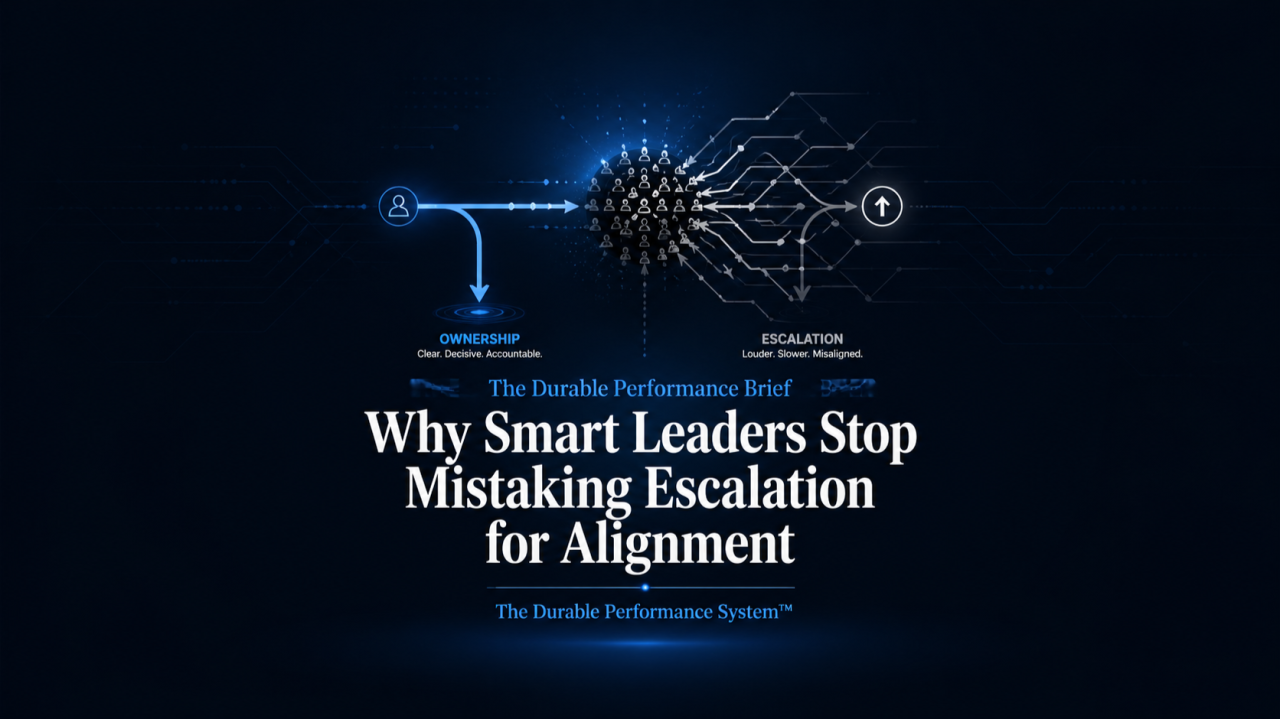
  • Why Smart Leaders Stop Mistaking Escalation for Alignment

    Why Smart Leaders Stop Mistaking Escalation for Alignment

    Edition 6 | April 29, 2026

    Smart leaders stop mistaking escalation for alignment because alignment should clarify ownership, not transfer every difficult decision upward.

    Most organizations do not drown in bad decisions first.

    They drown in transferred decisions.

    That is the distinction leaders miss when escalation starts sounding like discipline.

    Alignment is supposed to clarify who carries the call.

    Escalation transfers the call upward.

    Those are not the same thing.

    But in many organizations, they slowly become indistinguishable. A manager raises something “for visibility.” A director wants to “stay close.” A cross-functional tension gets pushed higher “just to be safe.” An executive team tells itself it is protecting quality.

    What it is often protecting is discomfort.

    And once discomfort starts getting treated like material risk, escalation rises for the wrong reasons.

    That is where decision velocity begins to collapse.

    The Core Thesis

    Leaders usually misread escalation as evidence of seriousness.

    It is often evidence of structural ambiguity.

    A healthy system does not eliminate escalation. It makes it legible. People know what belongs locally, what requires consultation, what crosses a real threshold, and what truly needs higher-level ownership.

    An unhealthy system does something else.

    It treats uncertainty, visibility, stakeholder sensitivity, and personal discomfort as reasons to elevate. That feels prudent in the moment. It also teaches the organization the wrong operating logic.

    People stop asking:

    Who should own this?

    They start asking:

    Who do we need to involve so no one gets exposed?

    That is not alignment.

    That is authority drift with professional language around it.

    The cost is larger than delay.

    When escalation becomes default, three things happen at once.

    • Ownership weakens because local leaders learn that serious decisions do not really belong to them.
    • Signal gets curated because anything moving upward now has to be packaged carefully.
    • The center gets crowded because senior leaders start adjudicating routine complexity instead of designing better systems.

    By the time executives feel buried, the structural lesson has already been taught.

    If the center keeps touching the work, the edge stops trusting its own judgment.

    What This Looks Like in the Wild

    You can usually see this pattern before any KPI turns visibly red.

    Routine tradeoffs start getting elevated because someone more senior “may have an opinion.”

    Cross-functional teams spend more time socializing decisions than making them.

    People ask for approval when what they really need is clarity.

    Leaders say they want ownership, but local calls get reopened once they create any visible discomfort.

    Escalation volume rises without a corresponding rise in actual risk.

    The room still feels disciplined.

    That is why this pattern survives.

    Nothing about it looks irresponsible. The calendars are full. The updates are thoughtful. The language is measured. Everyone appears collaborative.

    But beneath that professionalism, the organization is relearning where authority really lives.

    And once people believe the safest path is elevation, they adapt quickly.

    • They escalate sooner.
    • They recommend instead of decide.
    • They manage upward instead of resolving tension close to the work.
    • They optimize for survivable judgment, not durable judgment.

    That is how strong organizations become cautious without announcing it.

    Why Leaders Misread It

    Because escalation often arrives wearing the costume of maturity.

    Leaders hear words like alignment, coordination, visibility, and risk management.

    All of those sound reasonable.

    But reasonable language can hide weak architecture.

    Real alignment does not require constant elevation.

    It requires clear decision rights, explicit thresholds, visible tradeoffs, and trustworthy consequence. People need to know when they are deciding, when they are consulting, when they are informing, and when they are truly crossing into a higher-risk category that justifies escalation.

    Without that clarity, escalation becomes emotional rather than structural.

    People elevate because the issue is sensitive.

    Because a stakeholder is loud.

    Because a miss would be embarrassing.

    Because waiting feels safer than acting.

    Because no one trusts that a local call will survive if someone more senior disagrees later.

    That is not a communication problem.

    It is an authority design problem.

    One Practical Diagnostic

    Ask this in your next leadership meeting:

    Which decisions are being escalated repeatedly without a real change in risk?

    Then force a harder distinction:

    • Which escalations crossed a true threshold?
    • Which escalations happened because ownership was unclear?
    • Which happened because people feared being reopened later?
    • Which happened because “alignment” has quietly become permission?

    If a decision category keeps rising without new materiality, the system is not being careful.

    It is being trained to wait.

    If You Change One Thing This Week

    Pick one recurring decision category that keeps reaching higher than it should.

    Then define four things in writing:

    • Decision owner: Who can make the call without permission?
    • Consulted: Whose input matters before the call is made?
    • Informed: Who needs visibility after the call?
    • Escalation threshold: What specifically changes the level of ownership?

    Do not use vague language.

    Not “important.” Not “high visibility.” Not “sensitive.”

    Define the actual threshold.

    Revenue exposure above a certain level. Regulatory risk. Irreversible customer impact. Cross-functional tradeoff above a named boundary.

    Anything less precise teaches politics.

    Anything less precise turns alignment into delay.

    Closing Thought

    Alignment clarifies ownership.

    Escalation transfers ownership.

    When leaders confuse the two, they do not build a more disciplined organization.

    They build a more cautious one.

    And cautious systems rarely fail all at once.

    They just keep sending the decision upward until nobody below feels allowed to carry it.

    Question for readers: Where in your organization is “alignment” still being used to justify escalation that no longer serves the work?


    Related Books

    Primary related book: What Smart Leaders Stop Doing

    This edition connects directly to leadership behaviors that feel diligent in the moment but quietly centralize authority, distort signal, and make organizations more dependent on the center.

    Secondary related book: The Durable Performance Field Guide

    Use this book when the next step is to define decision ownership, escalation thresholds, authority clarity, and practical redesign steps.

    Explore the books →

    Continue Through The Durable Performance System™

    Next Wednesday: Why smart leaders stop overruling too early.

  • Why Smart Leaders Stop Centralizing Decisions to Feel Safe

    Why Smart Leaders Stop Centralizing Decisions to Feel Safe

    Edition 5 | April 22, 2026

    Smart leaders stop centralizing decisions to feel safe because short-term certainty often creates long-term dependency.

    Few leadership errors feel more responsible in the moment than pulling a decision upward.

    A call needs to be made. Risk feels elevated. Confidence in local judgment drops. The stakes look too visible, too political, too expensive, or too exposed.

    So leadership steps in.

    Not recklessly. Usually calmly. Usually with good intent.

    “Let’s look at this one.” “Bring this up for visibility.” “We should align before we move.” “Given the sensitivity here, route it through me.”

    Each move sounds prudent.

    That is what makes the pattern so dangerous.

    Most decision centralization does not begin as ego. It begins as caution.

    Why It Happens

    Leaders centralize because certainty feels safer than distributed judgment.

    When pressure rises, centralization creates immediate reassurance. It feels cleaner. More controlled. More disciplined.

    But the structural problem is that short-term certainty often produces long-term dependency.

    The Durable Performance System™ is explicit on this point: authority absorbs pressure during uncertainty and is often not intentionally returned. Over time, ownership narrows, decision velocity slows, escalation increases, and trust thins beneath visible stability.

    That is the trade leaders often fail to see.

    The system feels safer now. Then it gets slower. Then narrower. Then more political. Then more dependent on the center than it should ever be.

    What the System Learns

    Once leaders repeatedly pull decisions upward, people stop practicing judgment at the edge.

    They begin waiting. They begin escalating earlier. They begin packaging decisions instead of making them. They begin asking what will be approved rather than what is right.

    That adaptation is rational.

    People learn from consequence, not leadership aspiration. When standards, authority, and enforcement move inconsistently, behavior recalibrates toward safety. Systems adapt to what is enforced, not what is intended.

    This is why decision centralization is so expensive.

    It does not merely change where decisions happen. It changes what kind of organization people believe they are in.

    The Part Leaders Miss

    Many leaders think they are temporarily protecting quality.

    Sometimes they are.

    But temporary controls have a way of surviving long after the moment that justified them has passed. In the architecture of durable performance, incremental additions are one of entropy’s most reliable vehicles: approval layers remain, escalation becomes precautionary, and executive calendars slowly absorb work that should have stayed distributed.

    That is the invisible shift.

    No formal announcement occurs. No major redesign is declared. The language stays the same.

    But structure has already moved.

    What This Looks Like in the Wild

    You can usually spot this pattern before performance visibly weakens.

    Watch for this:

    • Routine decisions needing director or executive visibility
    • Managers escalating to reduce personal exposure, not because new risk exists
    • More approvals without clearer outcomes
    • Meetings expanding around calls that used to be made locally
    • Leaders spending more time adjudicating than designing
    • Teams preparing recommendations more often than exercising judgment

    Those are not isolated annoyances.

    They are structural indicators that authority is migrating upward and local capability is contracting. The architecture of drift is directional: distributed authority becomes centralized authority, wide information becomes compressed information, and consistent consequence becomes selective tolerance.

    One Practical Diagnostic

    Ask this in your next leadership meeting:

    Which decisions are now escalated that would have been handled locally six months ago?

    Then ask:

    • What changed?
    • Was the new control meant to be temporary?
    • What risk still justifies centralization?
    • What authority was absorbed and never returned?
    • What capability have we quietly taught the system not to build?

    That is the real issue.

    Because if escalation rises without a true rise in underlying risk, authority has drifted upward. And when authority drifts upward, decision latency, coordination load, and political behavior usually rise with it.

    If You Change One Thing This Week

    Pick five decision types that create recurring heat.

    For each one, define:

    • Who decides
    • Who approves
    • Who is consulted
    • Who is informed
    • What threshold actually justifies escalation
    • When temporary executive visibility expires

    That is consistent with the Field Guide’s emphasis on explicit decision ownership, escalation thresholds, and structural removal of ambiguity. Ownership without authority converts correction into reporting, and diffused authority breeds politics.

    Closing Thought

    The point of leadership is not to make yourself the safest place for every important decision.

    It is to build a system where good decisions can happen at the right level, under real guardrails, without unnecessary dependence on the center.

    Because once people stop deciding, they do not become more aligned.

    They become more cautious.

    And caution, repeated often enough, becomes structural dependency.

    Question for readers: Where in your organization has decision-making moved upward in ways that now feel normal?


    Related Books

    Primary related book: What Smart Leaders Stop Doing

    This edition connects directly to leadership behaviors that feel diligent in the moment but quietly narrow authority, distort signal, and weaken ownership over time.

    Secondary related book: The Durable Performance Field Guide

    Use this book when the next step is to define decision ownership, escalation thresholds, authority clarity, and practical redesign steps.

    Explore the books →

    Continue Through The Durable Performance System™

    Next Wednesday: Why smart leaders stop mistaking escalation for alignment.

  • When Alignment Starts Hiding Dependency

    When Alignment Starts Hiding Dependency

    Edition 2 | April 1, 2026

    When alignment starts hiding dependency, authority has already started moving upward.

    Most leaders say they want alignment.

    That sounds responsible. It sounds mature. It sounds disciplined.

    But in many organizations, “alignment” is no longer about shared understanding.

    It is about permission.

    That shift matters.

    Because once alignment becomes shorthand for approval, authority has already started moving upward. In The Durable Performance System™, authority drift usually does not look dramatic. Decisions move upward, sideways, into committee, into pre-alignment, and into executive visibility loops until ownership becomes ceremonial.

    That is not coordination.

    That is dependency with better language.

    How It Starts

    Authority rarely migrates upward because someone announces a structural redesign.

    It usually begins after pressure.

    A visible miss. A reorg. A customer issue. A bad call that embarrassed someone important. A season where leaders decide to get “closer to decisions.”

    The instinct feels understandable.

    More oversight. More reviews. More approvals. More executive visibility.

    It all looks disciplined.

    But drift often disguises itself as control. More approvals feel responsible, more reporting feels structured, and more oversight feels protective, even while capability declines underneath.

    The Phrase to Watch

    There is one phrase that often signals the drift:

    “We just want alignment.”

    In The Architecture of Durable Performance, the sequence is explicit: when incentives tilt toward optics protection and visible risk reduction, managers absorb less discretion, escalation becomes precautionary, and “alignment” becomes shorthand for approval. Within weeks, managers start forwarding decisions preemptively and ownership narrows before performance visibly declines.

    That is the real danger.

    The room still looks calm. The updates still sound clean. The process still looks professional.

    But the organization is quietly relearning where authority really lives.

    What the System Learns

    Once authority moves upward often enough, people stop asking:

    Who should decide this?

    They start asking:

    Who do we need to involve so no one gets exposed?

    That is a structural turning point.

    Because at that moment, the system is no longer optimizing for judgment.

    It is optimizing for safety.

    And safety, in the wrong form, teaches dependency.

    The doctrine is blunt on this: centralization teaches caution, caution teaches escalation, escalation teaches dependency, and dependency teaches more centralization. Once that loop takes hold, authority rarely flows back down on its own.

    Why Leaders Miss It

    Leaders miss this pattern because the motive usually sounds responsible.

    They are trying to reduce risk. Protect quality. Avoid surprises. Preserve trust. Keep things tight.

    But the system does not adapt to what leaders mean.

    It adapts to what leaders repeatedly cause. A leader can be well-intentioned and still create a system that becomes slower, narrower, more political, more dependent, and less truthful under pressure.

    That is why this is not a character question.

    It is a system effect question.

    If executive load shifts from design to adjudication, gravity has centralized.

    What It Looks Like in the Wild

    You can usually spot authority drift before it shows up in a KPI.

    Watch for this:

    • Decisions that used to be local now need director or executive input
    • Managers asking for “alignment” before making routine calls
    • More meetings for the same decisions than six months ago
    • Escalation volume rising without any real increase in underlying risk
    • Clean dashboards paired with informal reports of friction
    • Leaders spending more time resolving than designing

    Those are not random irritants.

    They are structural indicators.

    One Practical Diagnostic

    Ask this in your next leadership meeting:

    Which decisions are being escalated repeatedly without new risk?

    The Field Guide gives a clean rule: if a decision is repeatedly escalated without new risk, authority has drifted upward and must be returned or redesigned. It also recommends mapping the hottest decisions with explicit D/A/C/I roles, thresholds, escalation triggers, and a 30-day escalation audit.

    That is the kind of diagnostic that surfaces reality quickly.

    Not who is loudest. Not who is smartest. Not who is most persuasive.

    Just where the authority actually lives.

    If You Change One Thing This Week

    Pick 10 decision types that create the most heat in your organization.

    For each one, define:

    • Who decides
    • Who approves
    • Who is consulted
    • Who is informed
    • What threshold actually justifies escalation

    That is straight from the Authority Clarity Checklist and Decision Rights Blueprint in the Field Guide. The point is not paperwork. The point is to collapse committee drift and make decision ownership explicit again.

    Because vague authority does not create flexibility.

    It creates politics.

    Closing Thought

    When organizations say they want ownership, they often mean they want better recommendations.

    Real ownership is harder than that.

    It means authority sits where the work is. It means lower layers are allowed to decide within real guardrails. It means leaders resist reentering simply because they could improve the call marginally.

    That is durable performance.

    Not endless visibility. Not precautionary escalation. Not alignment theater.

    When alignment starts hiding dependency, performance gets slower long before it gets weaker.

    Question for readers: Where in your organization has “alignment” quietly become a permission system?


    Related Books

    Primary related book: The Architecture of Durable Performance

    This edition connects directly to the system’s authority and decision-velocity doctrine. The Architecture of Durable Performance explains how authority, incentives, information flow, accountability, and consequence determine whether performance holds or drifts.

    Secondary related book: What Smart Leaders Stop Doing

    Use this book when the issue is leadership behavior that unintentionally creates dependency, over-escalation, or decision bottlenecks.

    Explore the books →

    Continue Through The Durable Performance System™