Edition 25 | September 9, 2026
Most leaders judge themselves using evidence that is too close to them.
They worked hard. They stayed involved. They supported the team. They made themselves available. They tried to be fair. They protected people. They solved difficult problems. They carried a lot.
All of that may be true.
None of it tells you whether their leadership made the organization stronger.
That requires a different question:
What became more true because you were there?
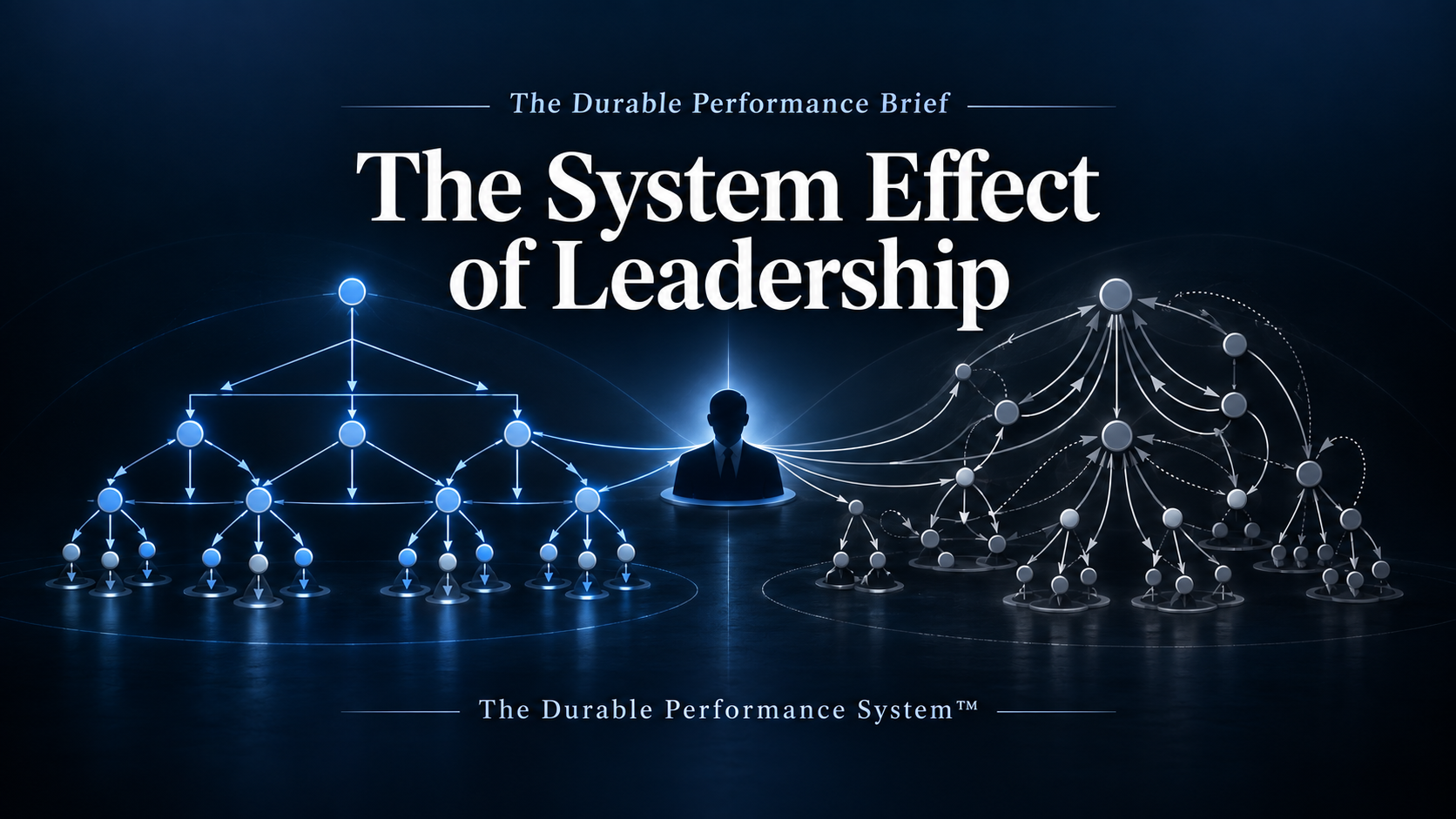
That is the system effect of leadership.
The Core Thesis
Leadership should ultimately be judged by structural effect, not self-perception.
Intent matters. Character matters. Effort matters. Results matter.
But none of them is wide enough by itself.
A decent, hardworking, deeply committed leader can still create an organization that becomes slower, more cautious, more politically dependent, less truthful, more centralized, and increasingly reliant on that leader’s personal intervention.
The motive may be admirable.
The effect can still weaken the system.
This is why Leadership Systems matters. Repeated leadership behavior becomes operating structure. Over time, the organization learns where authority really lives, how truth should travel, what standards actually hold, which behavior receives protection, and how much independent judgment is genuinely safe.
The system keeps the record.
What Strong System Effect Looks Like
Strong leadership leaves fingerprints.
Truth gets cleaner—not because difficult information disappears, but because people do not need to package it as carefully before sending it upward.
Authority gets clearer—not because every decision becomes simple, but because people know what they legitimately own and when escalation is actually required.
Standards become more predictable—not because leadership becomes harsh, but because the line survives status, performance, and inconvenience.
Managers become stronger—not because they receive more motivational language, but because they carry real authority, real consequence, and visible backing.
Escalation becomes more disciplined.
Complexity falls.
Dependence on the center decreases.
The leader remains important. They simply become less structurally necessary in places where capability should already exist below them.
This is also an Organizational Effectiveness question. A healthy organization should not be judged only by what it produces, but by what it must consume to produce it.
How much executive attention is required?
How much managerial rework?
How much coordination?
How much heroics?
How much political interpretation?
How much repeated rescue?
Strong results can coexist with weak architecture for a long time. The cost usually appears in what the organization must keep spending to hold those results together.
What Weak System Effect Looks Like
Weak system effect is harder to see because the leader often looks impressive.
Busy. Responsive. Engaged. Highly informed. Needed everywhere.
The calendar is full because important issues require the leader’s attention. The leader may even be producing excellent personal work.
Meanwhile, bad news gets polished. Routine decisions move upward. Managers hesitate. Teams ask for more interpretation. Reporting grows. High performers receive more protection. Serious movement increasingly waits for the center.
The leader becomes more important while the system becomes less capable.
That is the trap.
Personal contribution can rise at the same time structural strength falls.
This is why indispensability is such an unreliable leadership metric.
Sometimes indispensability reflects extraordinary value.
Sometimes it reflects an organization that has learned not to operate without you.
The Delay Makes This Hard to See
Leadership behavior and system effect rarely arrive at the same time.
Centralize a decision today and the decision may improve immediately.
Ask for more reporting and visibility may improve immediately.
Protect a strong performer and short-term stability may improve.
Absorb pressure and the team may experience real relief.
Step into a difficult problem and it may get solved faster.
The structural bill arrives later.
People begin waiting.
Truth gets packaged.
Standards become conditional.
Managers build less pressure-bearing capacity.
The center gets crowded.
What felt helpful at the point of intervention eventually becomes normal operating behavior.
That delay is why leadership cannot be judged only by whether an intervention worked.
It has to be judged by what repeated intervention taught.
Why the System Is the Better Witness
People can be influenced by personality.
Meetings can be managed.
Narratives can be polished.
Leadership explanations can be sophisticated and sincere.
The system is harder to persuade.
It records what actually happened to authority, truth, standards, decision speed, managerial courage, local judgment, reporting burden, and dependence.
It does not care whether centralization was described as diligence. It records whether decisions moved upward.
It does not care whether more reporting was called visibility. It records whether truth became more curated.
It does not care whether selective tolerance was described as nuance. It records whether standards became less predictable.
The system records consequence.
That makes it the most honest witness to leadership effect.
One Practical Diagnostic
Ask this:
What is my leadership making more normal?
Then examine the last six to twelve months.
Are people telling hard truths earlier or later?
Are managers bringing finished judgment or half-formed problems?
Are decisions sitting lower and cleaner, or moving upward more often?
Has escalation become more selective or more routine?
Are standards more predictable or more interpreted?
Has reporting become lighter and more useful, or heavier and more reassuring?
Are strong people learning judgment and ownership, or learning proximity and narrative management?
What stops working when you are unavailable?
Then add one harder question:
What part of my leadership feels most valuable to me but may be teaching the system the wrong lesson?
That is often where the useful diagnosis begins.
If You Change One Thing This Week
Choose one behavior you personally repeat as a leader.
Not something your team does.
Something you do.
Perhaps you reopen decisions.
Ask for routine visibility.
Join meetings after your involvement is no longer necessary.
Resolve cross-functional tension yourself.
Allow exceptions for someone difficult to replace.
Answer before a manager has finished reasoning.
Now stop asking whether the behavior feels helpful.
Measure its system effect.
Does it create cleaner truth or more packaging?
Clearer authority or more escalation?
Stronger managers or more dependence?
Less complexity or another recurring layer?
Better ownership or better preparation for you?
If the effect contradicts the intention, change the behavior.
For deeper context, see more on Authority Design when the pattern involves decision ownership and escalation, and explore Signal Integrity when leadership behavior is changing how truth travels.
Go Deeper
This issue builds on ideas from What Smart Leaders Stop Doing, part of The Durable Performance System™ series.
The book examines leadership not as a matter of style, but as system effect: whether authority becomes clearer or more centralized, truth cleaner or more curated, standards more predictable or more selective, and capability stronger or dependence deeper.
Closing Thought
One of the strongest defenses a leader can offer is:
I was trying to help.
That may be completely true.
It is still not the final question.
The final question is:
What did your help teach the system to become?
Leadership is not ultimately what the leader intended.
It is not what the leader carried.
It is not even what the leader accomplished personally.
Leadership is what becomes structurally more true because that leader was there.
Let the system judge.
Question for readers: If you judged your leadership only by structural effect—not effort or intent—what would you have to admit?
Next Wednesday: When drift looks like stability.
Part of The Durable Performance System™
Books, field guides, and frameworks on power, incentives, authority, accountability, and execution.
Published every Wednesday morning.
Curtisstoaks.com – YouTube – @curtisstoaksauthor