Tag: Signal Integrity

Posts about whether truth reaches decision-makers clearly, without narrative protection, filtered reporting, visibility theater, or distorted metrics.

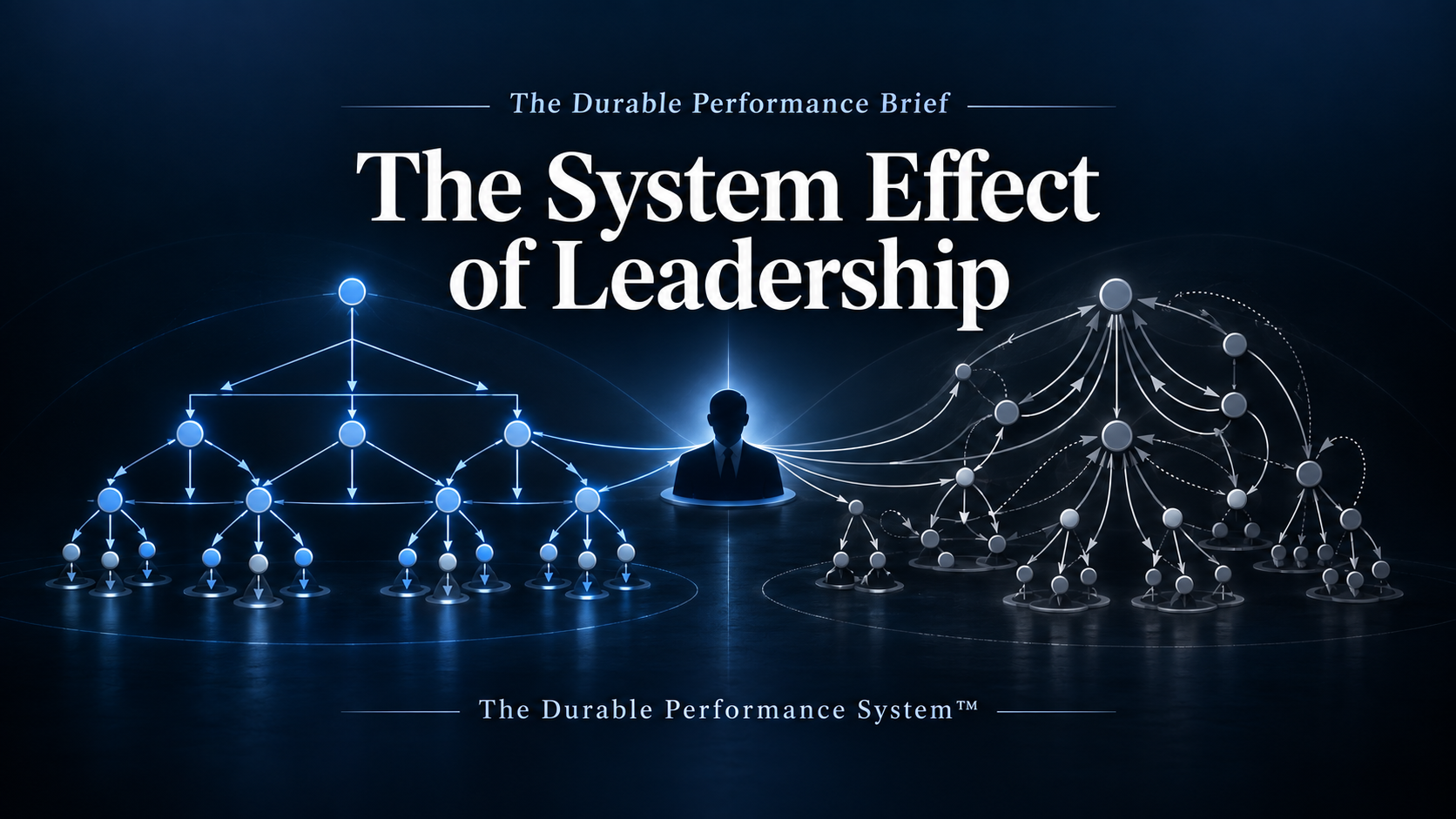
  • The System Effect of Leadership

    The System Effect of Leadership

    Edition 25 | September 9, 2026

    Most leaders judge themselves using evidence that is too close to them.

    They worked hard. They stayed involved. They supported the team. They made themselves available. They tried to be fair. They protected people. They solved difficult problems. They carried a lot.

    All of that may be true.

    None of it tells you whether their leadership made the organization stronger.

    That requires a different question:

    What became more true because you were there?

    That is the system effect of leadership.

    The Core Thesis

    Leadership should ultimately be judged by structural effect, not self-perception.

    Intent matters. Character matters. Effort matters. Results matter.

    But none of them is wide enough by itself.

    A decent, hardworking, deeply committed leader can still create an organization that becomes slower, more cautious, more politically dependent, less truthful, more centralized, and increasingly reliant on that leader’s personal intervention.

    The motive may be admirable.

    The effect can still weaken the system.

    This is why Leadership Systems matters. Repeated leadership behavior becomes operating structure. Over time, the organization learns where authority really lives, how truth should travel, what standards actually hold, which behavior receives protection, and how much independent judgment is genuinely safe.

    The system keeps the record.

    What Strong System Effect Looks Like

    Strong leadership leaves fingerprints.

    Truth gets cleaner—not because difficult information disappears, but because people do not need to package it as carefully before sending it upward.

    Authority gets clearer—not because every decision becomes simple, but because people know what they legitimately own and when escalation is actually required.

    Standards become more predictable—not because leadership becomes harsh, but because the line survives status, performance, and inconvenience.

    Managers become stronger—not because they receive more motivational language, but because they carry real authority, real consequence, and visible backing.

    Escalation becomes more disciplined.

    Complexity falls.

    Dependence on the center decreases.

    The leader remains important. They simply become less structurally necessary in places where capability should already exist below them.

    This is also an Organizational Effectiveness question. A healthy organization should not be judged only by what it produces, but by what it must consume to produce it.

    How much executive attention is required?

    How much managerial rework?

    How much coordination?

    How much heroics?

    How much political interpretation?

    How much repeated rescue?

    Strong results can coexist with weak architecture for a long time. The cost usually appears in what the organization must keep spending to hold those results together.

    What Weak System Effect Looks Like

    Weak system effect is harder to see because the leader often looks impressive.

    Busy. Responsive. Engaged. Highly informed. Needed everywhere.

    The calendar is full because important issues require the leader’s attention. The leader may even be producing excellent personal work.

    Meanwhile, bad news gets polished. Routine decisions move upward. Managers hesitate. Teams ask for more interpretation. Reporting grows. High performers receive more protection. Serious movement increasingly waits for the center.

    The leader becomes more important while the system becomes less capable.

    That is the trap.

    Personal contribution can rise at the same time structural strength falls.

    This is why indispensability is such an unreliable leadership metric.

    Sometimes indispensability reflects extraordinary value.

    Sometimes it reflects an organization that has learned not to operate without you.

    The Delay Makes This Hard to See

    Leadership behavior and system effect rarely arrive at the same time.

    Centralize a decision today and the decision may improve immediately.

    Ask for more reporting and visibility may improve immediately.

    Protect a strong performer and short-term stability may improve.

    Absorb pressure and the team may experience real relief.

    Step into a difficult problem and it may get solved faster.

    The structural bill arrives later.

    People begin waiting.

    Truth gets packaged.

    Standards become conditional.

    Managers build less pressure-bearing capacity.

    The center gets crowded.

    What felt helpful at the point of intervention eventually becomes normal operating behavior.

    That delay is why leadership cannot be judged only by whether an intervention worked.

    It has to be judged by what repeated intervention taught.

    Why the System Is the Better Witness

    People can be influenced by personality.

    Meetings can be managed.

    Narratives can be polished.

    Leadership explanations can be sophisticated and sincere.

    The system is harder to persuade.

    It records what actually happened to authority, truth, standards, decision speed, managerial courage, local judgment, reporting burden, and dependence.

    It does not care whether centralization was described as diligence. It records whether decisions moved upward.

    It does not care whether more reporting was called visibility. It records whether truth became more curated.

    It does not care whether selective tolerance was described as nuance. It records whether standards became less predictable.

    The system records consequence.

    That makes it the most honest witness to leadership effect.

    One Practical Diagnostic

    Ask this:

    What is my leadership making more normal?

    Then examine the last six to twelve months.

    Are people telling hard truths earlier or later?

    Are managers bringing finished judgment or half-formed problems?

    Are decisions sitting lower and cleaner, or moving upward more often?

    Has escalation become more selective or more routine?

    Are standards more predictable or more interpreted?

    Has reporting become lighter and more useful, or heavier and more reassuring?

    Are strong people learning judgment and ownership, or learning proximity and narrative management?

    What stops working when you are unavailable?

    Then add one harder question:

    What part of my leadership feels most valuable to me but may be teaching the system the wrong lesson?

    That is often where the useful diagnosis begins.

    If You Change One Thing This Week

    Choose one behavior you personally repeat as a leader.

    Not something your team does.

    Something you do.

    Perhaps you reopen decisions.

    Ask for routine visibility.

    Join meetings after your involvement is no longer necessary.

    Resolve cross-functional tension yourself.

    Allow exceptions for someone difficult to replace.

    Answer before a manager has finished reasoning.

    Now stop asking whether the behavior feels helpful.

    Measure its system effect.

    Does it create cleaner truth or more packaging?

    Clearer authority or more escalation?

    Stronger managers or more dependence?

    Less complexity or another recurring layer?

    Better ownership or better preparation for you?

    If the effect contradicts the intention, change the behavior.

    For deeper context, see more on Authority Design when the pattern involves decision ownership and escalation, and explore Signal Integrity when leadership behavior is changing how truth travels.

    Go Deeper

    This issue builds on ideas from What Smart Leaders Stop Doing, part of The Durable Performance System™ series.

    The book examines leadership not as a matter of style, but as system effect: whether authority becomes clearer or more centralized, truth cleaner or more curated, standards more predictable or more selective, and capability stronger or dependence deeper.

    Closing Thought

    One of the strongest defenses a leader can offer is:

    I was trying to help.

    That may be completely true.

    It is still not the final question.

    The final question is:

    What did your help teach the system to become?

    Leadership is not ultimately what the leader intended.

    It is not what the leader carried.

    It is not even what the leader accomplished personally.

    Leadership is what becomes structurally more true because that leader was there.

    Let the system judge.

    Question for readers: If you judged your leadership only by structural effect—not effort or intent—what would you have to admit?

    Next Wednesday: When drift looks like stability.

    Part of The Durable Performance System™
    Books, field guides, and frameworks on power, incentives, authority, accountability, and execution.
    Published every Wednesday morning.
    Curtisstoaks.com – YouTube – @curtisstoaksauthor
  • The Leadership Obligation

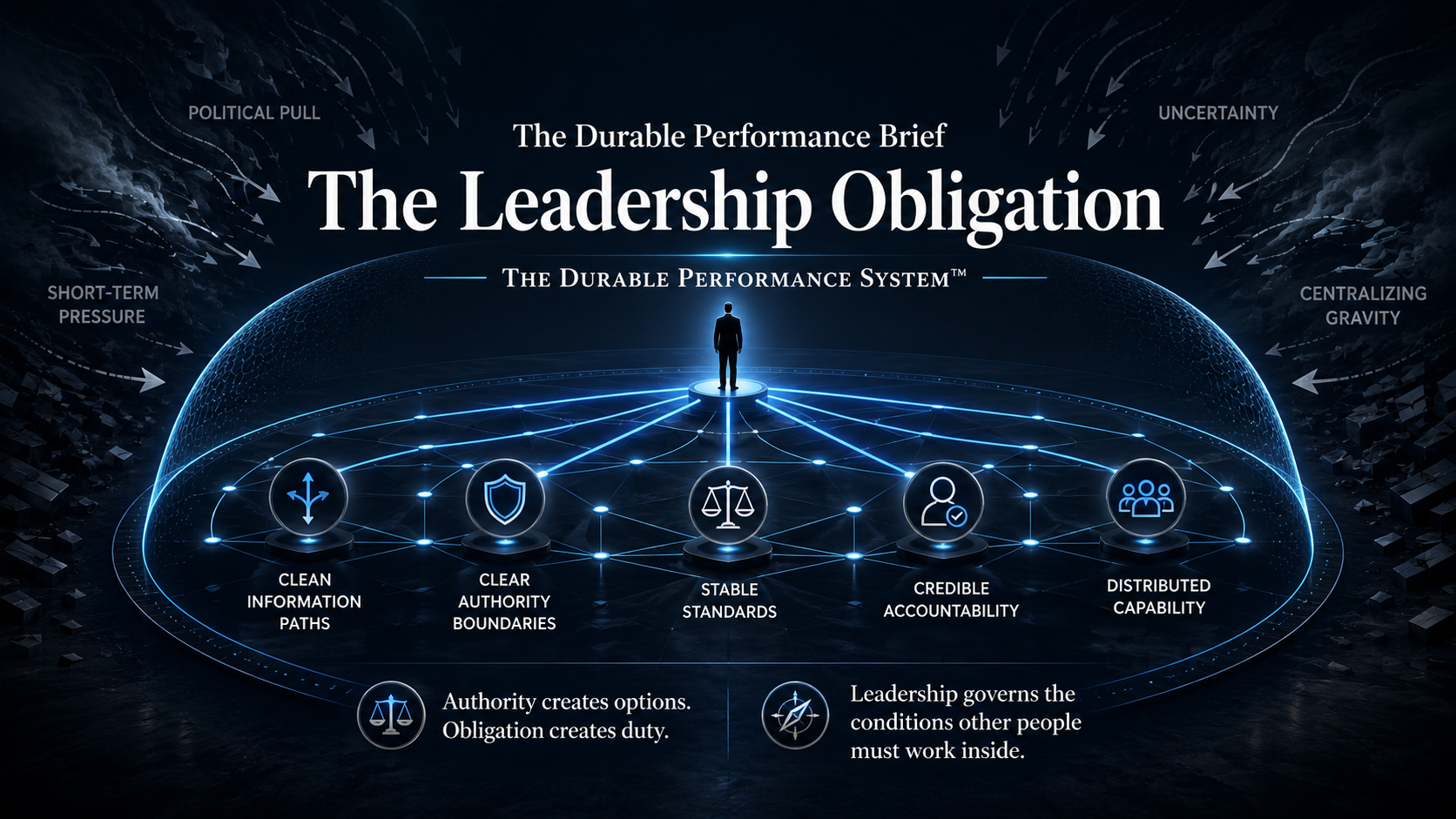
    The Leadership Obligation

    Edition 24 | September 2, 2026

    Publish: Wednesday, September 2, 2026 — 7:00 AM Mountain Time

    Leadership is often described in the language of opportunity.

    More influence.

    More scope.

    More visibility.

    More authority.

    A larger voice in what happens next.

    Those things may come with the role.

    They are not the center of it.

    The center is obligation.

    The obligation to govern conditions other people cannot fully govern for themselves. The obligation to act when structural drift is visible even when failure has not yet created enough pain to make action popular. The obligation to protect truth, standards, legitimate authority, and future capability when doing so makes the present moment harder.

    The Core Thesis

    Leadership is not a privilege arranged around authority.

    It is an obligation arranged around consequence.

    The more authority a leader holds, the more their choices shape the operating environment other people have to inhabit.

    A delayed correction teaches.

    An exemption teaches.

    An executive intervention teaches.

    A truth that cannot be spoken directly teaches.

    A manager who is asked to hold a standard but is abandoned when enforcement becomes politically difficult learns something.

    So does everyone watching.

    This is why leadership has to be understood as custodial before it is expressive.

    The role is not primarily a platform for demonstrating style, confidence, vision, charisma, or decisiveness.

    It is stewardship of the structural conditions under which other people must work.

    See how Leadership Systems turn repeated leader behavior into operating structure.

    Obligation Begins Before Failure

    One of the easiest ways to avoid leadership responsibility is to wait until the evidence becomes undeniable.

    Once the customer is lost, the manager resigns, the project fails, the numbers collapse, or the corrosive behavior becomes publicly impossible to defend, action becomes easier.

    Now there is permission.

    The danger is obvious.

    People expect intervention.

    The political cost of doing nothing becomes higher than the cost of acting.

    But durable leadership often has to move earlier.

    When the pattern is clear enough to know where the system is heading, even though the organization can still tolerate it.

    That is a different standard.

    Reaction waits for pain.

    Obligation acts when responsibility becomes sufficiently clear.

    This is particularly important with Organizational Drift. Drift rarely arrives as a single undeniable event. It advances through individually defensible accommodations that become precedent through repetition.

    The Obligation to Restrain Yourself

    Not every leadership obligation requires action.

    Some require restraint.

    That may be harder.

    A senior leader can enter a decision because they know the answer.

    They can ask for another update because uncertainty is uncomfortable.

    They can rescue a manager because watching someone struggle feels inefficient.

    They can soften a consequence because the person involved is valuable.

    They can keep a decision centralized because distributed judgment creates variance.

    Every one of those moves can feel responsible.

    Every one can also make the system more dependent on the leader.

    This is why power creates an obligation to understand your own capacity to distort.

    Sometimes leadership means acting.

    Sometimes it means refusing to recenter what should remain local.

    Refusing to rescue too soon.

    Refusing to ask for reassurance disguised as visibility.

    Refusing to convert every uncomfortable situation into executive involvement.

    Refusing to let your own need for certainty redesign the operating system around you.

    That is not passivity.

    It is disciplined authority.

    The Obligation to Protect Truth

    Truth inside organizations is fragile.

    It gets packaged.

    Sequenced.

    Softened.

    Contextualized.

    Delayed.

    Sometimes because people are dishonest.

    More often because they are rational.

    They learn how leadership responds.

    If early bad news creates blame, people wait.

    If disagreement creates political cost, people soften.

    If executive confidence matters more than operating reality, people learn to protect confidence.

    Soon leadership receives more information and less truth.

    That makes Signal Integrity a leadership obligation, not merely a communication issue.

    The leader is responsible for whether operating reality can arrive early enough, clearly enough, and safely enough to be useful.

    You cannot demand candor while punishing the conditions that produce it.

    The Obligation to the People Closest to the Work

    Leadership also owes something downward.

    Not comfort.

    Not protection from the normal difficulty of serious work.

    Something more operational.

    People closest to the work should not have to carry unnecessary distortion created above them.

    They should not be given responsibility without usable authority.

    They should not have to disguise truth to make it survivable.

    Managers should not be expected to enforce standards senior leaders will abandon when someone powerful resists.

    Disciplined people should not be required to compensate indefinitely for tolerated dysfunction.

    Local judgment should not have to survive inside permanent ambiguity.

    This is not sentimental leadership.

    It is what the book describes as operational justice: the recognition that people below cannot fully redesign the architecture above them, while leadership can.

    That asymmetry creates obligation.

    The Obligation to Future Conditions

    Weak leadership often optimizes for the current room.

    How do we keep this calm?

    How do we avoid unnecessary disruption?

    How do we protect the quarter?

    How do we preserve confidence?

    The stronger question is:

    What does this become if we repeat it?

    What precedent does this exception establish?

    What behavior does this protection finance?

    What becomes harder to correct six months from now?

    What future system are we creating by choosing present comfort?

    That is the time horizon leadership has to hold when others cannot.

    Because one of the most dangerous organizational trades is exchanging future integrity for present smoothness while calling the trade maturity.

    This is where Accountability Design becomes important. A standard is only credible when authority, evidence, correction, and consequence remain coherent when applying them becomes expensive.

    One Practical Diagnostic

    Ask this in your next leadership meeting:

    What structural duty do we already know is ours but keep postponing because acting now is expensive?

    Then ask:

    • What truth has become clear enough to act on?
    • What standard is louder in language than in consequence?
    • What authority remains centralized mainly because returning it feels risky?
    • What are people below us compensating for that they cannot redesign themselves?
    • What present accommodation is creating tomorrow’s precedent?
    • Where are we waiting for failure to create permission we already have?

    Those questions separate difficulty from obligation.

    Some difficult things are not yours to carry.

    Some obligations cannot responsibly be transferred to anyone else.

    If You Change One Thing This Week

    Identify one decision you already know leadership has an obligation to make.

    Not an idea to study.

    Not an issue to keep watching.

    Something whose structural direction is already clear.

    Then define:

    What must be named?

    What must change?

    Who must own the correction?

    What consequence or boundary makes the correction real?

    By when?

    Do not make it dramatic.

    Make it explicit.

    Leadership obligation is not measured by how severe the action appears.

    It is measured by whether the system receives the correction before drift makes that correction harder, more political, and more expensive than it needed to be.

    Go Deeper

    This issue builds on ideas from What Smart Leaders Stop Doing, part of The Durable Performance System™ series.

    Related read:
    What Smart Leaders Stop Doing examines leadership as structural responsibility rather than personal expression. Its final leadership standard moves from what leaders are responsible for, to the obligation those responsibilities create, and ultimately to the system effect by which leadership should be judged.

    Closing Thought

    Leadership is not made serious by the title.

    It becomes serious when duty becomes clearer than self-interest.

    When truth matters more than reassurance.

    When future integrity matters more than present calm.

    When the standard matters even when enforcement costs something.

    When the leader knows when to act—and when to restrain themselves.

    Authority gives leaders options.

    Obligation tells them which options they can no longer responsibly avoid.

    Question for readers: What leadership obligation in your organization is already clear but still waiting for failure to make action easier?

    Next Wednesday: The system effect of leadership.

    Part of The Durable Performance System™
    Books, field guides, and frameworks on power, incentives, authority, accountability, and execution.
    Published every Wednesday morning.
    Curtisstoaks.com – YouTube – @curtisstoaksauthor
  • What Leaders Are Actually Responsible For

    What Leaders Are Actually Responsible For

    Edition 23 | August 26, 2026

    Most leaders carry too much.

    Not necessarily too much work.

    Too much responsibility for things that were never truly theirs to govern.

    The mood in the room.

    Whether everyone approves.

    Whether every difficult decision feels comfortable.

    Whether uncertainty is visible.

    Whether people think leadership has everything under control.

    Whether every important problem eventually finds its way to them.

    Those burdens feel like leadership because they are heavy.

    But weight is not the same thing as responsibility.

    And when leaders spend too much energy carrying what is emotionally near, they often neglect what is structurally theirs.

    The Core Thesis

    Leadership responsibility is architectural.

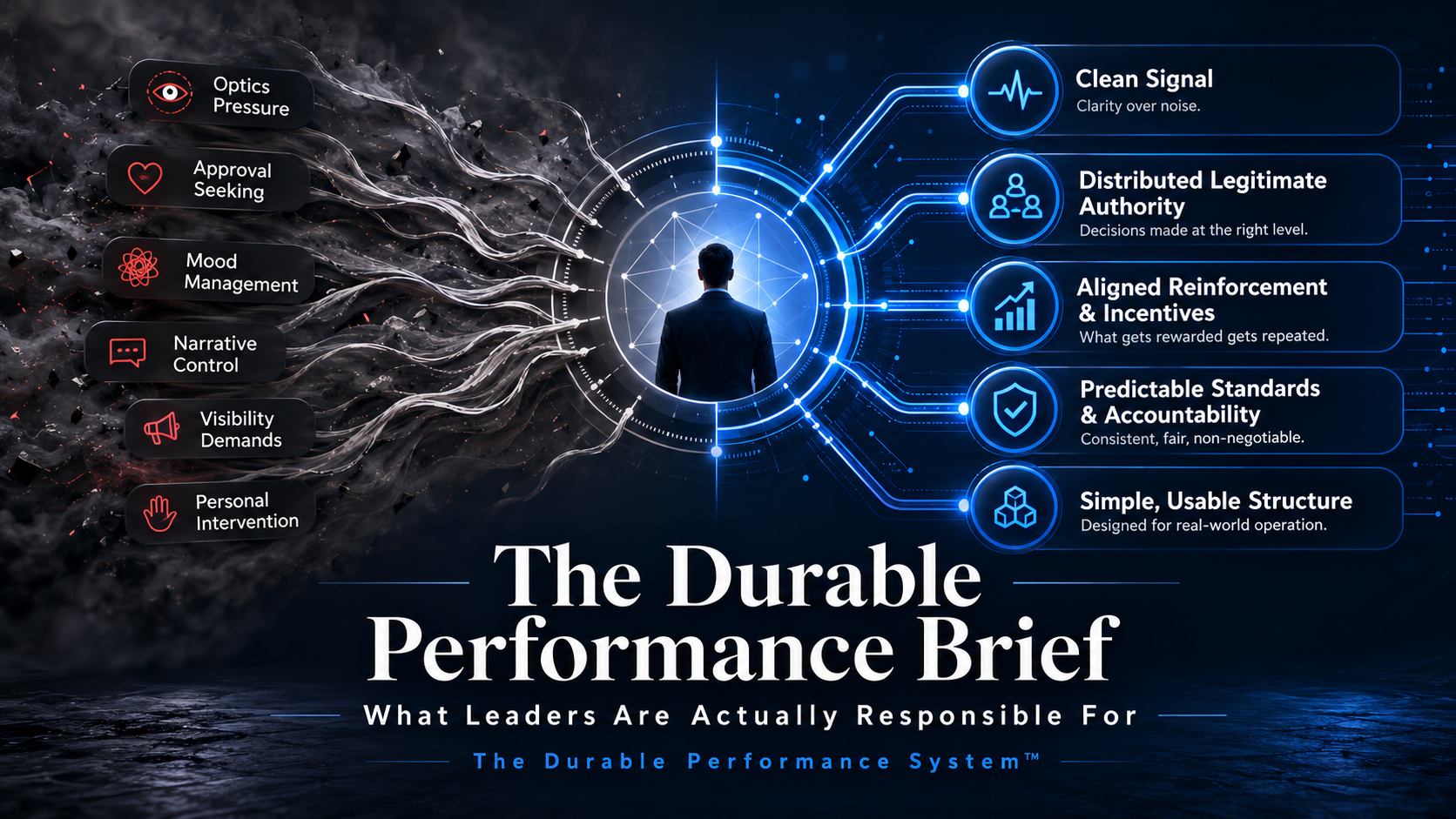
    Leaders are responsible for the conditions under which other people must operate.

    That means asking whether:

    truth can travel,

    authority sits where it should,

    incentives reinforce the right behavior,

    standards remain credible,

    and the system stays simple enough for people to think and act clearly.

    The leader’s personality matters.

    Intent matters.

    Communication matters.

    But none of them is the final test.

    The system is.

    A leader can be charismatic while authority centralizes around them.

    Supportive while accountability becomes less credible.

    Decisive while capability beneath them contracts.

    Calm while inconvenient information gets increasingly packaged before it reaches the center.

    Leadership has to be evaluated by what becomes structurally more true because that leader is there.

    See more on Leadership Systems for how repeated leadership behavior becomes operating structure rather than remaining a matter of style or personality.

    Responsibility #1: Protect the Signal

    Leaders cannot govern a system they cannot see.

    That does not mean they need every detail.

    It means important reality must be able to reach the people capable of acting on it without becoming distorted by fear, optics, hierarchy, or narrative management.

    Leaders are responsible for asking:

    Can someone tell us something we do not want to hear?

    Does bad news move quickly enough to matter?

    Are managers explaining reality—or packaging it?

    Have our reactions trained people to protect us from uncomfortable information?

    This is why Signal Integrity is a leadership responsibility.

    If truth becomes harder to transmit as it moves upward, leadership cannot blame the system alone.

    Leadership helped create the conditions under which that signal travels.

    Responsibility #2: Put Authority Where the Work Requires It

    Leaders are responsible for deciding where legitimate decision authority belongs.

    Not where it feels safest.

    Not where the smartest person sits.

    Not where political exposure can be minimized.

    Where the work requires it.

    That means clear owners.

    Real decision boundaries.

    Defined escalation thresholds.

    And enough restraint from senior leaders that local authority remains real after it has been delegated.

    If every consequential call eventually rises to the center, the leader may feel responsible.

    The organization experiences dependence.

    Explore Authority Design for the structural relationship among ownership, boundaries, consultation, approval, and escalation.

    Responsibility #3: Govern What the System Rewards

    Organizations do not behave according to what leadership prefers.

    They adapt to what actually pays.

    Who gets promoted?

    What receives praise?

    What behavior receives protection?

    What gets ignored because the person producing results is valuable?

    What does the organization fund with attention, opportunity, status, compensation, and tolerance?

    A leader who says one thing while structurally rewarding another has not merely communicated poorly.

    They have governed poorly.

    This is why leadership responsibility extends beyond stated expectations into the reinforcement system itself.

    Responsibility #4: Make the Standard Real

    A standard is not a sentence in a policy.

    It is a predictable relationship between behavior and outcome.

    Leaders are responsible for whether that relationship remains credible.

    That does not mean identical treatment in every circumstance.

    Context matters.

    Judgment matters.

    But the underlying principle must remain recognizable when enforcement becomes inconvenient.

    Does high performance purchase exemption?

    Does hierarchy purchase reinterpretation?

    Does political value buy more time?

    Does leadership enforce the line differently when the cost rises?

    This is where Accountability Design matters. Accountability works when ownership, authority, standards, evidence, correction, and consequence reinforce one another instead of separating under pressure.

    Responsibility #5: Keep the System Usable

    Weak systems accumulate.

    Another review.

    Another dashboard.

    Another approval.

    Another recurring meeting.

    Another workaround.

    Another temporary control that becomes permanent.

    Each addition may be reasonable.

    Collectively, they create weight.

    Leaders are responsible for whether complexity is removed as aggressively as it is added.

    The goal is not minimalism.

    It is usability.

    Can people still understand what matters?

    Can they make decisions without unnecessary coordination?

    Can the system absorb pressure without adding another permanent layer every time something goes wrong?

    Structural simplicity is not administrative housekeeping.

    It is part of leadership stewardship.

    What Leaders Are Not Responsible For

    This boundary matters just as much.

    Leaders are not responsible for:

    making everyone comfortable with every standard,

    keeping every relationship warm,

    personally absorbing every source of pressure,

    eliminating uncertainty,

    preserving every contributor regardless of cost,

    or maintaining a reassuring narrative after reality has contradicted it.

    Trying to own those things often distorts the responsibilities that matter more.

    Truth gets softened to preserve confidence.

    Consequence gets delayed to preserve relationships.

    Authority gets centralized to reduce uncertainty.

    Pressure gets absorbed rather than redistributed.

    Complexity gets added because carrying more feels safer than removing something.

    The result is a leader who carries more while governing less.

    That is misplaced responsibility.

    One Practical Diagnostic

    Ask yourself:

    What am I currently carrying that feels like leadership but may actually be distracting me from leadership?

    Then ask five structural questions:

    Is truth getting through?

    Does authority sit where it should?

    Are we reinforcing the behavior we actually want?

    Are standards predictable enough to trust?

    Is the system becoming simpler and stronger—or heavier and more dependent?

    Those questions are useful because they move leadership away from self-perception.

    Not:

    Do people think I am supportive enough?

    But:

    What conditions am I preserving?

    Not:

    Am I involved enough?

    But:

    Is my involvement making the system more capable?

    Not:

    How do I carry this better?

    But:

    Should this still be carried here at all?

    If You Change One Thing This Week

    Take one recurring leadership burden that consumes significant energy.

    An escalation.

    A review.

    A relationship you constantly stabilize.

    A decision category.

    A recurring conflict.

    A reporting loop.

    Then ask:

    What would have to be structurally true for this to stop requiring me?

    Perhaps authority needs to move.

    A standard needs to become explicit.

    A consequence needs to become credible.

    A manager needs legitimate backing.

    A reporting artifact needs to disappear.

    A difficult truth needs to be named.

    Do not solve for how to carry the burden more efficiently.

    Solve for why the system keeps routing it to you.

    That is the difference between performing responsibility and governing structure.

    Go Deeper

    This issue builds on ideas from What Smart Leaders Stop Doing, part of The Durable Performance System™ series.

    Related read: What Smart Leaders Stop Doing examines leadership as system effect rather than personal performance. It asks leaders to judge themselves by whether authority becomes clearer, signal becomes cleaner, standards become more predictable, ownership grows stronger, and capability expands beneath the center.

    Closing Thought

    Leadership is not proved by how much you carry.

    It is proved by what becomes stronger because you governed it well.

    Clearer authority.

    Cleaner truth.

    Better reinforcement.

    More credible standards.

    Less unnecessary complexity.

    Stronger capability below the center.

    That is the work.

    Because the organization does not ultimately experience your intent.

    It experiences the system your leadership leaves behind.

    Question for readers: What are you carrying today that feels like leadership responsibility but may actually be evidence that the system needs redesign?

    Next Wednesday: The leadership obligation.

    Part of The Durable Performance System™ Books, field guides, and frameworks on power, incentives, authority, accountability, and execution. Published every Wednesday morning. Curtisstoaks.com – YouTube – @curtisstoaksauthor
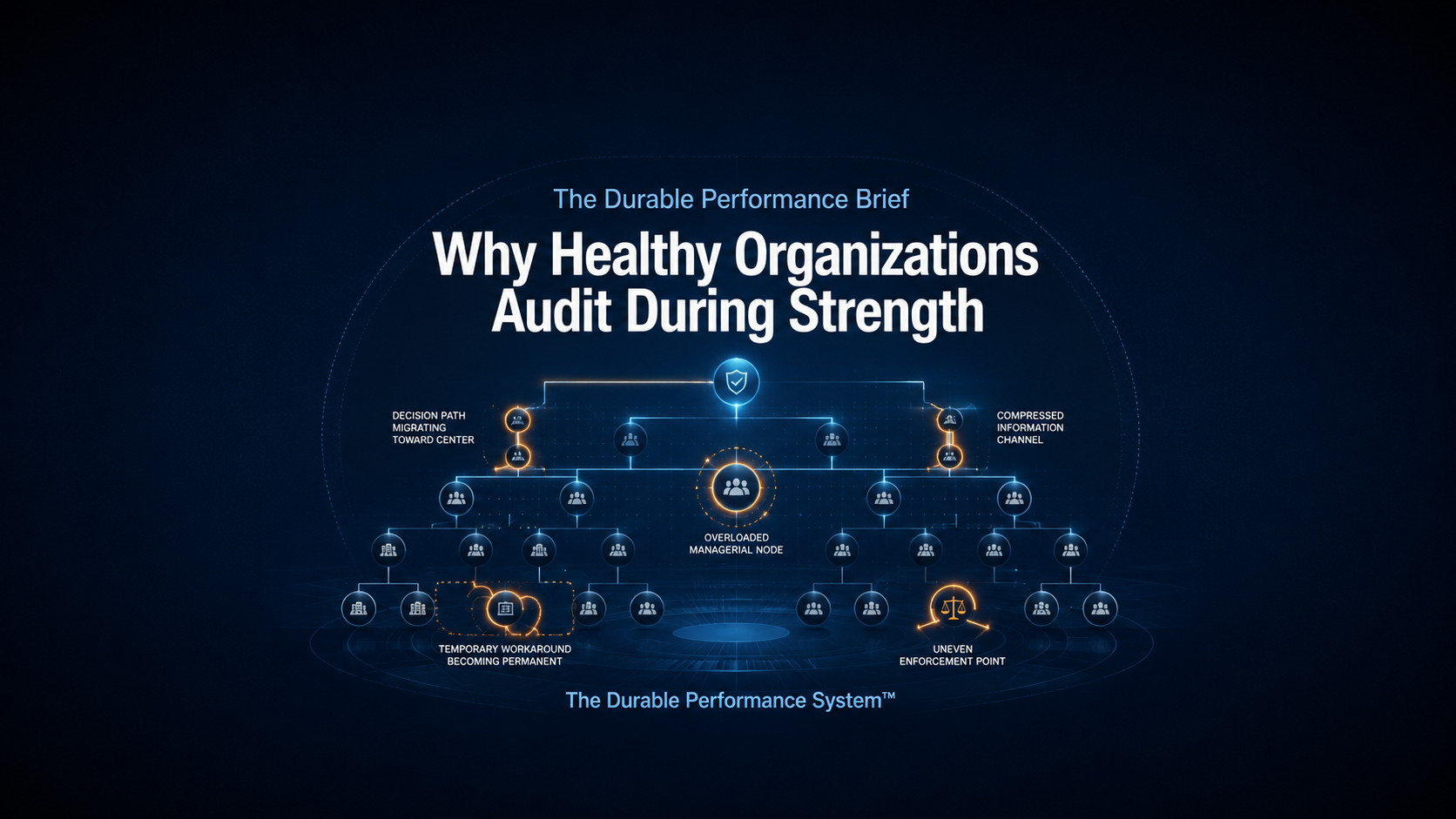
  • Why Healthy Organizations Audit During Strength

    Why Healthy Organizations Audit During Strength

    Edition 19 | July 29, 2026

    Most organizations inspect themselves when something hurts.

    A number drops.

    A customer escalates.

    Turnover rises.

    A launch fails.

    A control breaks.

    A visible miss creates enough urgency—and enough political permission—to ask structural questions that should have been asked much earlier.

    Then come the reviews, postmortems, diagnostics, process changes, and operating resets.

    That response may be necessary.

    It is also late.

    By the time failure makes structural weakness visible, the organization has usually been paying for it quietly for months or years.

    The Core Thesis

    Healthy organizations do not wait for pain to make inspection legitimate.

    They audit during strength.

    They examine authority, incentives, information flow, accountability, consequence, complexity, and capability while performance is still defensible and the system still has room to correct without panic.

    This requires discipline because success creates reassurance.

    The quarter closes.

    Customers remain stable.

    Growth continues.

    The dashboard is mostly green.

    The organization appears capable.

    Leaders naturally interpret those outcomes as evidence that the system underneath them is healthy.

    But visible performance does not reveal what is producing it.

    Strong results may come from sound structure.

    They may also come from market tailwinds, extraordinary effort, temporary workarounds, accumulated goodwill, hidden coordination labor, or a small number of capable people compensating for weaknesses no one has examined.

    Success confirms the outcome.

    It does not automatically validate the arrangement that produced it.

    That is why auditing during strength matters.

    It separates performance that is structurally durable from performance that is quietly borrowing against people, trust, speed, or future capacity.

    What This Looks Like in the Wild

    A business unit is meeting its targets.

    Nothing appears seriously broken.

    But a closer inspection reveals that more routine decisions are reaching senior leaders than they did six months ago.

    Status reporting has expanded.

    Two strong managers are carrying coordination loads that are mostly invisible.

    Bad news is being packaged carefully before it reaches executives.

    A high-output employee is receiving behavioral flexibility that others have noticed.

    None of these conditions has produced visible failure yet.

    That is precisely why this is the best time to act.

    The organization still has room to restore decision rights without crisis.

    It can reduce unnecessary reporting without appearing to abandon control.

    It can redistribute managerial load before exhaustion becomes attrition.

    It can improve signal quality before executive surprise triggers overcorrection.

    It can correct selective standards before resentment hardens into cultural truth.

    When leaders wait for visible damage, the same corrections become harder.

    Trust has weakened.

    Political positions have formed.

    Dependencies have deepened.

    People have adapted around the distortion.

    The eventual response must now overcome not only the original problem, but also the system’s accumulated accommodation to it.

    Maintenance is quieter than repair.

    It is also cheaper.

    Why Leaders Avoid It

    Auditing what appears to be working can feel unnecessary.

    It interrupts momentum.

    It may be interpreted as distrust.

    It can seem unfair to question a team producing acceptable results.

    It may also expose leadership choices that are difficult to confront.

    If authority has drifted upward, leaders may have to acknowledge that their own intervention habits helped centralize it.

    If information is overly curated, they may have to examine whether their reactions made unfiltered truth unsafe.

    If incentives are distorted, they may have to confront whom they have been rewarding.

    If standards have softened, they may have to face what they repeatedly tolerated.

    If heroics are holding the system together, they may have to admit that visible success has been borrowing from human endurance.

    This is why superficial audits are so common.

    Leadership asks questions, gathers feedback, and produces recommendations—but avoids findings that would require real redistribution, subtraction, correction, or consequence.

    The process becomes reassurance infrastructure.

    A real structural audit does not exist to confirm that the organization is generally fine.

    It exists to reveal what is becoming fragile while the organization still has enough strength to correct it cleanly.

    One Practical Diagnostic

    Ask this in your next leadership meeting:

    What are we currently trusting because it still works?

    Then inspect the arrangement beneath the result:

    Authority

    • Where are decisions actually being made compared with six months ago?
    • What now requires senior involvement that should not?

    Signal

    • What do people closest to the work know that leadership receives only after filtering?
    • Where is bad news being softened or delayed?

    Incentives

    • What behavior is currently paying off?
    • What short-term results are being purchased with long-term distortion?

    Accountability

    • Who is responsible for outcomes without controlling the main variables?
    • Where does ownership exist on paper but not in practice?

    Consequence

    • Where are standards applied differently because of hierarchy, performance, influence, or convenience?

    Capability

    • What team appears strong only because someone else keeps compensating for it?

    These questions do not measure whether results are good.

    They examine whether those results are clean enough to trust.

    If You Change One Thing This Week

    Choose one operating area that currently appears healthy.

    Do not begin with its outcomes.

    Inspect how those outcomes are being produced.

    Compare the current arrangement with six months ago:

    • escalation volume
    • approval requirements
    • reporting burden
    • decision location
    • exception patterns
    • managerial load
    • information quality
    • dependence on key individuals

    Then identify one structural change that has occurred without an explicit decision.

    Perhaps a temporary review became permanent.

    A senior leader became the default tie-breaker.

    A manager started carrying work outside the role.

    A report expanded but never contracted.

    An exception became routine.

    Correct one of those shifts while the system is still strong enough to absorb the correction without fear.

    Do not make the audit theatrical.

    Do not frame it as a search for failure.

    Frame it as maintenance: responsible inspection of the system before visible performance becomes the most expensive possible warning signal.

    Go Deeper

    This issue builds on ideas from What Smart Leaders Stop Doing and The Architecture of Durable Performance, part of The Durable Performance System™ series.

    Related reading:
    These books examine why structural decline often begins beneath acceptable results—and how disciplined review of authority, incentives, signal, accountability, and consequence can surface weakening conditions before volatility forces a more disruptive correction.

    Closing Thought

    Failure is an effective detector.

    It is also an expensive one.

    Strong leaders do not wait for pain to make structural inspection feel justified.

    They examine what looks healthy.

    They question what still works.

    They inspect strength for hidden dependence, quiet distortion, and accumulated fragility.

    Not because they distrust success.

    Because they want to know whether the system can continue producing it without borrowing against the future.

    Question for readers: What part of your organization appears healthy today but has not been structurally examined in the past year?

    Next Wednesday: Correct the system, not just the symptom.

    Part of The Durable Performance System™
    Books, field guides, and frameworks on power, incentives, authority, accountability, and execution.
    Published every Wednesday morning.

    YouTube – @curtisstoaksauthor

    Explore the books →

    Continue Through The Durable Performance System™

  • Why Smart Leaders Stop Waiting Too Long to Name What Everyone Can See

    Why Smart Leaders Stop Waiting Too Long to Name What Everyone Can See

    Edition 16 | July 8, 2026

    A lot of leaders mistake delayed naming for maturity.

    They think they are being measured.
    Fair.
    Responsible.
    Disciplined.

    Sometimes they are.

    Sometimes they are simply postponing the moment when truth has to become operational. That is the danger. A leader can privately see the pattern, discuss it indirectly, and keep asking for a little more time, a little more evidence, or a slightly cleaner moment. Meanwhile, the system keeps adapting around what remains officially unsaid.

    The Core Thesis

    Seeing clearly is not the same thing as leading clearly.

    A leader may already know a manager has lost standing, a team norm has become corrosive, an initiative is failing, a role fit has deteriorated, or a high performer is operating outside the standard. But if none of that is named clearly enough for the organization to reorient around it, the system is still living in drift. Private recognition matters. It just does not change the operating reality on its own.

    That is the structural break.

    Because once the truth is obvious to enough people but still left unofficial, the organization does not wait patiently. It builds parallel language. Side conversations. Private acknowledgments. Quiet warnings. Coded phrases. Informal workarounds. People start learning what can be said openly and what must be handled through implication. When that line forms, politics deepens, and trust in formal communication starts thinning.

    This is why delayed naming is expensive.

    The leader experiences caution.

    The organization experiences hesitation.

    Managers keep coaching around what they cannot fully say. Peers keep protecting themselves from what leadership has not made real. Disciplined people keep carrying the burden of pretending that an obvious reality is still somehow tentative. What looks like prudence at the center often becomes an interpretive burden everywhere else.

    What This Looks Like in the Wild

    An issue is discussed thematically but never plainly.

    A pattern is “being watched closely” long after everyone already knows what it is.

    A leader keeps speaking in atmospheres instead of facts because naming the truth would force a boundary, a correction, a consequence, or a decision.

    A manager keeps losing credibility while leadership continues treating the situation as though it is still too early to say clearly.

    Nothing about this usually looks reckless.

    That is why it survives.

    The leader appears calm. Thoughtful. Unreactive. Measured. They are praised for not making the moment bigger than it needs to be. But while leadership is being congratulated for composure, the system is quietly paying for the delay. The issue keeps operating. The standard keeps weakening. The person involved keeps learning that visible drift can survive without direct naming. Observers keep concluding that truth belongs in side channels before it belongs in authority.

    Managers feel this earliest and most sharply.

    They have to carry operational consequences before leadership has made the truth usable. They coach around it, compensate for it, and attempt to enforce inside a reality the formal system still refuses to settle. Over time, they stop trusting that the truth will be named while there is still enough credibility and energy left to do something clean with it. That is a major systems cost.

    Why Leaders Misread It

    Because delayed naming often sounds like restraint.

    Leaders tell themselves they are avoiding overreaction, protecting dignity, staying composed, and resisting premature judgment. Those instincts can be healthy. The problem begins when evidentiary language survives past the point where the issue is no longer unclear. At that point, the delay is often no longer about fairness. It is about the reluctance to trigger what naming will require.

    That requirement is what leaders often avoid.

    Once the real thing is said plainly, ambiguity narrows. The social room tightens. A correction, a boundary, a consequence, or a decision now has to happen. Continued observation is easier. Continued watching is easier. Continued thematic language is easier. The system still pays.

    This is also why leaders confuse internal clarity with actual leadership.

    They know what is happening, so they assume the organization is effectively governed. It is not. Systems are not changed by what leaders silently understand. They are changed by what leaders are willing to make real enough that the rest of the organization can organize around it.

    One Practical Diagnostic

    Ask this in your next leadership meeting:

    What in our system is already obvious to too many people for us to keep treating it as tentative?

    Then press harder:

    • What issue are managers already working around because leadership has delayed making it official?
    • Where are we still asking for more evidence when what we really need is more courage?
    • What conversations have become overly thematic because no one wants to say the real thing plainly?
    • Who is currently trapped inside an unspoken truth?
    • What cost is the organization already paying for our restraint?

    Those questions matter because leaders do not only teach through action.

    They also teach through the timing and clarity of what they are willing to name.

    If You Change One Thing This Week

    Pick one issue that has already become too visible to remain unofficial.

    Then say the real thing clearly enough that the system can reorient.

    Do not aim for drama.

    Aim for usability.

    That may mean naming a credibility problem, clarifying that a norm is no longer acceptable, saying that a role fit has changed, declaring that an initiative is failing, or admitting that a relationship is structurally broken and will not improve through more implication. The point is not harshness. The point is to make reality usable while there is still enough trust, energy, and authority left to correct it cleanly.

    Strong leaders do not name early for theater.

    They name on time for credibility.

    Because once people stop expecting leadership to say the real thing, before the environment becomes obviously distorted, rebuilding trust takes a long time.

    Go Deeper

    This issue builds on ideas from What Smart Leaders Stop Doing, part of The Durable Performance System™ series.

    Related read:
    What Smart Leaders Stop Doing examines how leaders weaken systems not only through what they do, but through what they delay saying plainly. When obvious reality remains unofficial too long, managers weaken, teams adapt around silence, and side-channel truth starts replacing formal clarity.

    Closing Thought

    Leadership is not only the work of seeing clearly.

    It is the work of making reality usable.

    Because once leaders wait too long to name what everyone can already see, the organization stops looking to authority for clarity.

    It starts looking everywhere else.

    Question for readers: Where in your organization is an obvious truth still being managed as an atmosphere instead of being named clearly enough to act on?

    Next Wednesday: Why smart leaders stop confusing patience with discipline.

    Part of The Durable Performance System™
    Books, field guides, and frameworks on power, incentives, authority, accountability, and execution.
    Published every Wednesday morning.

    Explore the books →

    Continue Through The Durable Performance System™

  • Why Smart Leaders Stop Praising Output While Rewarding Distortion

    Why Smart Leaders Stop Praising Output While Rewarding Distortion

    Edition 10 | May 27, 2026

    Most leaders think they know what their organization rewards.

    Many do not.

    They know what they praise.

    That is not the same thing.

    Organizations do not learn the real reward system from values statements, leadership language, or offsite talking points. They learn it from who gets protected, who gets promoted, who gets interpreted generously, who keeps winning despite the damage around them, and what kind of behavior still advances when the numbers are useful.

    That is where distortion gets normalized.

    Not when leadership says the wrong things.

    When leadership says the right things while rewarding their opposite.

    The Core Thesis

    Most reward-system corruption does not begin with open hypocrisy.

    It begins with misalignment.

    A leader praises ownership, then advances the person who manages upward well but leaves confusion below. A leader praises candor, then prefers those who package risk elegantly. A leader praises collaboration, then keeps expanding the politically forceful performer because their results are visible and defensible. The leader believes the organization is hearing the words. The organization is actually studying the outcomes. And outcomes always teach faster.

    That is the structural problem.

    Because once people see that output carries more weight than system effect, they begin adapting rationally. They stop asking what leadership says it wants and start asking what kind of winner actually rises here. If distorted winners advance, distortion becomes career logic.

    This is why output can become a shield.

    Not because output is unimportant. It is.

    But output is visible, countable, and easy to defend. The distortion around it is harder to count: the trust weakened, the peer damage normalized, the corners others learn to cut, the quieter truth, the standard bent through visible success. When leaders privilege what is measurable over what is structural, they start rewarding people for making the system weaker while making the numbers look stronger.

    What This Looks Like in the Wild

    A person who always keeps senior leaders comfortable gets described as strategic.

    A person who never brings raw problems, only polished stories, gets described as composed.

    A person who escalates relentlessly and keeps themselves covered gets described as mature.

    A person who produces output through fear, exemption, or overcontrol gets described as high-performing.

    That is how distortion hides.

    It borrows respectable language.

    The most expensive version appears in promotion decisions.

    Nothing teaches the organization faster than promotion. Not town halls. Not principles. Not posters. Promotion says: be more like this. So when leaders elevate someone whose numbers are strong but whose system effect is corrosive, the organization learns that corrosive success still counts as success. If leaders reward ambition without discipline, visibility without substance, or force without trust, distortion stops being incidental. It becomes adaptive.

    That is when the career logic begins to separate from the declared logic.

    Leadership says: own outcomes.
    Career logic says: protect yourself from exposure.

    Leadership says: tell the truth early.
    Career logic says: do not surface a problem until it is packaged.

    Leadership says: standards matter.
    Career logic says: standards matter unless your output is too important.

    That split is where cynicism starts.

    Not because people are cynical by nature.

    Because the system has become clearer than the speech.

    Why Leaders Misread It

    Because praise feels like proof.

    A leader assumes that if they praise the right things, they are rewarding the right things.

    Not necessarily.

    Praise is one signal.

    Reward is the full behavioral system around it: advancement, protection, access, tolerance, attention, exception, and consequence. Leaders often mistake verbal endorsement for structural endorsement. The organization does not. It watches who wins.

    Leaders also misread the cost because output is easier to measure than distortion.

    The number is clean.

    The side effects are diffuse.

    Under pressure, it feels responsible to privilege what is most visible and defensible. That is one reason rewarding the wrong behavior persists across average organizations: results are easier to count than judgment, restraint, trust-building, or long-term contribution. But the side effects are the main effect. They are what reshape the system over time.

    One Practical Diagnostic

    Ask this in your next leadership meeting:

    If someone studied our promotions and protections instead of our values statements, what would they conclude we actually reward?

    Then press harder:

    • Who gets ahead faster than their structural effect justifies?
    • Who receives generous interpretation because their output is strong?
    • What behavior do we praise in language while rewarding its opposite in outcomes?
    • Would we want more of the organization to behave like the people we currently elevate?
    • What do ambitious people here quietly believe they must become to win?

    Those questions matter because reward systems are always teaching.

    Especially when leadership is not paying attention.

    If You Change One Thing This Week

    Review one recent promotion, expansion-of-scope decision, or high-potential designation through a different lens:

    Did this person create output in a way we would want repeated?

    Not just:

    Did they deliver?

    Ask:

    Did they strengthen trust?
    Did they preserve clean signal?
    Did they reduce dependence?
    Did they make the operating conditions better for other people?
    Would giving them more authority make the system stronger?

    If the answer is no, do not hide behind admiration.

    Say the harder sentence:

    Not like this.

    That is not pettiness. It is architectural discipline. If leadership cannot withhold advancement from people whose results travel with distortion, then the reward system no longer belongs to leadership. It belongs to momentum. And momentum is rarely structural or durable on its own.

    Go Deeper

    This issue builds on ideas from What Smart Leaders Stop Doing, part of The Durable Performance System™ series.

    Related read:
    What Smart Leaders Stop Doing — a structural guide to the leadership behaviors that quietly redirect ambition, normalize distortion, and teach organizations to reward what makes the system weaker.

    Closing Thought

    Organizations do not become what leaders say they value.

    They become what leaders repeatedly reward, protect, excuse, and advance.

    So when leaders praise ownership but reward optics, the organization learns optics. When leaders praise candor but reward polished reassurance, the organization learns curation. When leaders praise standards but advance distorted winners, the organization learns conditionality.

    And once ambition starts serving distortion more reliably than discipline, the organization will not just tolerate the wrong behavior.

    It will manufacture more of it.

    Question for readers: What kind of winner is your organization quietly teaching ambitious people to become?

    Next Wednesday: Why smart leaders stop delaying correction because the person is valuable.

    Part of The Durable Performance System™
    Books, field guides, and frameworks on power, incentives, authority, accountability, and execution.
    Published every Wednesday morning.

    Explore the books →

    Continue Through The Durable Performance System™

  • Why Smart Leaders Stop Asking for More Visibility Than They Need

    Why Smart Leaders Stop Asking for More Visibility Than They Need

    Edition 9 | May 20, 2026

    Most leaders do not ask for more visibility because they are careless.

    They ask for it because uncertainty is uncomfortable.

    A metric moves the wrong way. A project slips. A customer issue surfaces. Confidence drops. Someone senior asks a hard question. In that moment, more dashboards, more updates, more reviews, and more detail feel like responsibility. But that instinct often produces a structural mistake: leaders ask for more reporting than they actually need, and the system starts reallocating energy away from judgment and toward presentation. That is the distinction What Smart Leaders Stop Doing makes directly: visibility is not the same thing as reporting, and the two become dangerously confused under pressure.

    The Core Thesis

    Healthy visibility helps leaders see what matters clearly enough to make sound decisions.

    Unhealthy visibility creates a growing burden of artifacts designed to reduce anxiety at the center.

    That difference matters because organizations adapt quickly. Once leaders start asking for more visibility than decision quality requires, people begin packaging work upward in polished form. Managers consolidate, frame, smooth, and anticipate. Teams spend more time feeding the visibility system and less time correcting the operating system. The leader wants clearer reality. They often end up farther from it.

    This is why more reporting is not automatically more control.

    A fuller dashboard can still carry filtered truth. A longer update can still change nothing. A standing review can still produce motion without better decisions. The hidden structural question is simple: What decision will this information change? If the answer is vague, the request is probably not about leadership signal. It is about comfort.

    That is not a minor distinction.

    When visibility expands beyond decision necessity, it starts functioning more like surveillance, reassurance, or weak-trust compensation. Then behavior changes fast. People become more careful, more performative, more update-oriented, and less candid. The organization looks attentive. It becomes less alive.

    What This Looks Like in the Wild

    You can usually see this pattern before performance fully breaks.

    Dashboards multiply while decision quality stays flat.

    Weekly updates get longer, broader, and more frequent.

    Status meetings end with alignment language instead of decisions and owners.

    The same variance gets explained repeatedly without corrective action.

    Managers spend more time shaping the update than changing the reality behind it.

    Those are not just communication annoyances. They are structural indicators of signal distortion and visibility burden. The Field Guide names the same drift patterns directly: dashboard inflation, reporting noise, metric sprawl, status meeting growth, narrative protection, late discovery, escalation for visibility, and artifact-first behavior.

    One of the highest-cost effects sits in the middle layer.

    Managers become translators.

    Instead of strengthening local judgment, they consolidate information upward. Instead of coaching teams through the work, they coach teams through how the work will be represented. Instead of preserving signal integrity, they smooth the narrative to reduce executive volatility. That turns management into reporting infrastructure, which is not a neutral use of leadership bandwidth. It is structural leakage.

    Why Leaders Misread It

    Because artifact volume feels like discipline.

    A richer dashboard feels rigorous. A longer update feels responsible. More status detail feels like care. A leader in more meetings feels engaged. But as the book argues, visible action and real leadership are not the same thing. More reviews, more oversight, and more executive visibility can feel serious while quietly teaching the organization that upward legibility matters more than operating truth.

    Leaders also misread the root problem.

    Often they ask for more visibility because they cannot trust what they already receive.

    That is real.

    But when trust is low, the answer is not automatically more reporting. Sometimes the answer is fewer metrics, cleaner definitions, sharper operating reviews, more direct exposure to the work, and more honest consequence when signal gets distorted. Many leaders choose artifacts instead because artifacts are easier than confronting the trust problem underneath. They look diligent. They do not solve the truth problem. They often bury it.

    One Practical Diagnostic

    Ask this in your next leadership meeting:

    Which recurring visibility artifacts actually change a decision?

    Then press harder:

    • Which report changes ownership, timing, resource allocation, or risk posture?
    • Which dashboard exists mainly because no one has removed it?
    • Which meeting ends with more explanation but not more correction?
    • Where are managers spending time preparing visibility upward that should be spent strengthening judgment downward?

    That gets you out of preference and into structure. The Field Guide’s Signal Distortion Audit uses exactly that discipline: inventory recurring reports, dashboards, and updates, capture the decision each one informs, and kill or consolidate the ones with low impact and high burden.

    If You Change One Thing This Week

    Kill one recurring report or status meeting that does not reliably change a decision.

    Not reduce it.

    Not rename it.

    Remove it.

    Then add one guardrail: no new recurring visibility artifact gets created without a named decision owner and an expiration date.

    That is a meaningful correction because visibility is never free. It is paid for in time, attention, behavior, and truth quality. Smart leaders do not stop caring about visibility. They stop demanding more of it than the system can carry cleanly.

    Go Deeper

    This issue builds on ideas from What Smart Leaders Stop Doing, part of The Durable Performance System™ series.

    Related read:
    What Smart Leaders Stop Doing — a structural guide to the leadership behaviors that quietly distort signal, overload managers, and teach the organization to optimize for presentation instead of operating strength.

    Closing Thought

    The danger is not that organizations stop working.

    It is that they get better at looking informed while becoming less truthful.

    When leaders ask for more visibility than they need, the system starts producing cleaner narrative instead of cleaner signal. And once upward legibility matters more than usable reality, performance gets weaker behind a more professional-looking surface.

    Question for readers: Where in your organization is reporting expanding faster than decision quality?

    Next Wednesday: Why smart leaders stop praising output while rewarding distortion.

    Part of The Durable Performance System™
    Books, field guides, and frameworks on power, incentives, authority, accountability, and execution.
    Published every Wednesday morning.

    Explore the books →

    Continue Through The Durable Performance System™

  • Why Smart Leaders Stop Solving Problems Too Close to the Surface

    Why Smart Leaders Stop Solving Problems Too Close to the Surface

    Edition 4 | April 15, 2026

    Smart leaders stop solving problems too close to the surface because recurring issues usually point to deeper structural conditions.

    Most leaders are not afraid of problems.

    They are afraid of unresolved problems.

    That sounds similar. It is not.

    A leader who can tolerate the existence of a problem long enough to understand its structure has a chance to correct it. A leader who feels compelled to fix what is visible immediately usually ends up treating symptoms as causes and activity as resolution.

    That is where this issue begins.

    Because many leadership teams do not struggle with inaction. They struggle with shallow action.

    A miss appears. A customer escalates. A team slips a date. A manager loses credibility. A meeting goes sideways.

    So leadership responds.

    They add oversight. They tighten the cadence. They ask for more reporting. They change ownership. They launch a corrective plan.

    Everything looks active.

    But the same category of problem keeps returning.

    That is the signal.

    The Structural Error

    The easiest part of a problem to see is rarely the deepest part of the system producing it.

    A missed deadline is a symptom. A customer escalation is a symptom. A weak manager can be a symptom.

    The cause is often somewhere deeper: unclear decision rights, conflicting incentives, filtered signal, softened standards, tolerance of exceptions, or authority sitting in the wrong place.

    That is why surface correction can feel responsible while extending the life of the problem underneath it. Leaders often add activity faster than they remove distortion, and the organization gets louder before it gets stronger.

    Why This Happens

    Surface solving offers emotional relief.

    It creates the feeling of momentum. It gives stakeholders something visible to point to. It protects leaders from the discomfort of deeper diagnosis.

    That is what makes it so dangerous.

    Because deeper correction is harder.

    It may require redefining authority. Removing approvals. Confronting tolerated behavior. Admitting that a prior design choice created drag. Acknowledging that a trusted leader has been preserving the wrong pattern.

    Activity is socially safer than architecture.

    So many organizations stay near the visible event and call that decisiveness.

    What This Looks Like in the Wild

    A team misses a target.

    Leadership increases the review cadence.

    The miss happens again.

    Leadership asks for more detailed reporting.

    The miss happens again.

    Leadership adds escalation thresholds or changes ownership.

    The miss happens again.

    At no point is the organization passive. At every point it is active.

    But all the activity stays close to the symptom.

    No one asks whether the target is colliding with other incentives. No one asks whether authority sits at the right level to act in time. No one asks whether the signal arriving at the review is already filtered. No one asks whether too many exceptions have already softened the standard being defended.

    That is what it means to solve too close to the surface.

    The More Dangerous Version

    This pattern becomes more expensive when it is repeated across multiple incidents.

    Because once a problem category starts recurring, you are no longer looking at isolated mistakes.

    You are looking at a structural signature.

    A missed handoff. A delayed launch. A confused meeting. A customer escalation. A manager constantly seeking approval. A team afraid to act.

    At first these look unrelated.

    Underneath, they may all be carrying the same underlying pattern: authority drift, signal distortion, incentive conflict, unclear ownership, tolerance of exceptions, or consequence inconsistency.

    The leader who sees only incidents will keep fixing incidents.

    The leader who sees patterns can redesign the system.

    One Practical Diagnostic

    Ask this in your next leadership meeting:

    What arrangement keeps producing this class of problem?

    Not: Who owns the latest failure?

    Not: What process broke this time?

    Not: How do we tighten oversight?

    Ask:

    • What is repeating here?
    • What moved before this failed?
    • Who had the information but not the authority?
    • Who had the authority but not the incentive?
    • What standard was already soft before this became visible?

    Those are structural questions.

    They are slower. Less performative. Often less satisfying in the moment.

    They are also the only questions that reliably produce durable correction.

    If You Change One Thing This Week

    Pick one recurring problem your organization keeps “fixing.”

    Then ban symptom language for one review cycle.

    Do not ask: How do we respond faster?

    Ask: What condition made this problem more likely?

    That shift matters because recurring issues are usually architectural, not personal. Fixing the person without fixing the structure often produces brief improvement followed by relapse. The system pulls behavior back toward what is rewarded and tolerated.

    Closing Thought

    Weak leaders rush to closure.

    Smart leaders stay with the problem long enough to understand its shape.

    Because every time leadership fixes the appearance of a problem while leaving the producing conditions intact, the system learns to fail more elegantly.

    And elegant failure is still failure.

    Question for readers: Where in your organization are problems being corrected at the symptom level while the producing conditions remain untouched?


    Related Books

    Primary related book: What Smart Leaders Stop Doing

    This edition connects directly to leadership behaviors that feel responsible in the moment but quietly narrow authority, distort signal, and weaken ownership over time.

    Secondary related book: The Architecture of Durable Performance

    Use this book when the issue needs to be understood through the full system: authority, incentives, information flow, accountability, consequence, and structural drift.

    Explore the books →

    Continue Through The Durable Performance System™

    Next Wednesday: Why smart leaders stop centralizing decisions to feel safe.

  • When Visibility Starts Replacing Truth

    When Visibility Starts Replacing Truth

    Edition 3 | April 8, 2026

    When visibility starts replacing truth, leaders feel closer to the business while the signal is getting worse.

    Most leaders do not ask for more visibility because they are careless.

    They ask for it because they are trying to regain control.

    That sounds responsible. It often looks responsible. But in many organizations, more visibility does not produce more truth.

    It produces more artifacts.

    More dashboards. More updates. More status meetings. More packets. More narrative.

    And once that pattern takes hold, the organization starts confusing motion with signal. The Field Guide defines signal integrity as the system’s ability to transmit reality to decision-makers without filtration, compression, or performance theater. When signal degrades, leadership compensates by asking for more visibility, and the system responds by producing more artifacts rather than more truth.

    That is the shift that matters.

    Because once visibility becomes the substitute for truth, the system starts working for reassurance instead of correction.

    How It Starts

    This pattern rarely begins with vanity.

    It usually begins after pressure.

    A miss gets attention. A forecast slips. A customer issue becomes visible. A leader loses confidence in what they are hearing. So reporting expands.

    That decision feels rational. In The Architecture of Durable Performance, entropy advances through narrow, defensible adjustments that appear proportionate in the moment: reporting is consolidated for clarity, escalation is encouraged for alignment, and temporary controls persist long after the moment that created them. Over time, those additions alter structural gravity beneath visible stability.

    No one says, “We are replacing truth with optics.”

    They say: “We need more visibility.” “We need tighter reviews.” “We need a better read on what’s happening.”

    And the system adapts.

    What the Organization Learns

    Once leaders begin rewarding visible activity over clean signal, people respond rationally.

    They explain more. They package more. They pre-defend more. They document more. They spend more time shaping the update than changing the reality behind it.

    That sequence is explicit in 10 Stupid Things Corporations Do: when explanation replaces correction, signal integrity collapses, reality is filtered before it reaches decision-makers, and the organization begins protecting narrative over outcomes. Over time, frontline truth gets softened into acceptable language and “good enough” explanation becomes the mechanism that lets drift survive.

    That is not communication improvement.

    That is signal distortion with professional language around it.

    Why Leaders Miss It

    Leaders miss this pattern because artifact volume feels like discipline.

    A fuller dashboard feels like control. A longer update feels like care. A standing review feels like rigor. A leader in more meetings feels engaged.

    But as What Smart Leaders Stop Doing argues, visible action and real leadership are not the same thing. More reviews, more oversight, more executive visibility, and more status meetings can feel serious while teaching the organization that the center matters more than the truth. When that happens, people prepare for leadership instead of correcting the work.

    The trap is simple:

    Leaders experience visibility as reassurance. The system experiences it as load.

    What It Looks Like in the Wild

    You can usually spot this pattern before it shows up as a full performance problem.

    Watch for this:

    • Dashboards multiplying while decision quality stays flat
    • Weekly updates expanding in length, audience, and frequency
    • Status meetings ending with alignment instead of decisions
    • The same variance being explained repeatedly without corrective action
    • Risks surfacing late, only after they are externally visible
    • Teams producing more artifacts to stay safe, not to improve outcomes

    Those are not isolated annoyances. The Signal Integrity chapter in the Field Guide lists the same indicators: dashboard inflation, reporting noise, metric sprawl, status meeting growth, narrative protection, late discovery, escalation for visibility, and artifact-first behavior.

    One Practical Diagnostic

    Ask this in your next leadership meeting:

    Which recurring visibility artifacts actually change a decision?

    That question matters because the Field Guide’s Signal Distortion Audit is built around exactly that discipline: inventory every recurring report, dashboard, and update; capture the decision each one informs; and mark whether it is decision-critical, decision-supporting, narrative, or unknown. The rule is blunt: if decision impact is low and the prep plus consumption time is high, it should be consolidated or killed within 30 days.

    That gets you out of preference and into structure.

    Not what feels useful. What actually changes action.

    If You Change One Thing This Week

    Kill one recurring report or status meeting that does not reliably change a decision.

    Not reduce it. Not “keep an eye on it.” Remove it.

    Stop producing any report that does not change a decision, stop adding KPIs without retiring one, stop status meetings that do not end with decisions and owners, and require decision-owner approval plus an expiration date for any new recurring artifact.

    Subtraction is not retreat.

    It is architecture under protection.

    Closing Thought

    The danger is not that organizations stop working.

    It is that they get better at looking informed while becoming less truthful.

    When visibility starts replacing truth, leaders feel closer to the business at the exact moment the signal is getting worse.

    Clean signal is a performance advantage.

    Question for readers: Where in your organization is reporting expanding faster than decision quality?


    Related Books

    Primary related book: The Durable Performance Field Guide

    This edition connects directly to the Field Guide’s applied tools for diagnosing signal distortion, auditing reporting load, removing noise, and rebuilding visibility systems that reflect outcomes instead of performance theater.

    Secondary related book: 10 Stupid Things Corporations Do

    Use this book when the issue is narrative protection, explanation without correction, or corporate habits that let performance problems survive longer than they should.

    Explore the books →

    Continue Through The Durable Performance System™

    Next Wednesday: Why smart leaders stop solving problems too close to the surface.

  • Performance Is Structural

    Performance Is Structural

    Insights on power, incentives, authority, accountability, and execution

    By Curtis Stoaks

    Edition 1 | March 25, 2026

    Performance is structural. Most organizations do not weaken because people stop caring.

    They weaken because structure shifts.

    Authority gets pulled upward. Information gets compressed. Exceptions stay longer than they should. Accountability becomes selective. Consequence softens under pressure.

    Nothing about this feels dramatic at first.

    That is why drift is so dangerous.

    It does not begin with collapse. It begins with reasonable accommodation.

    A few more approvals. A little more alignment. A little more executive visibility. A little less clarity about who can actually decide.

    And then one day, leaders are looking at slower decisions, filtered truth, cautious managers, and teams that seem busy but not especially effective.

    They call it an execution problem.

    Usually, it is not.

    It is a structural problem.

    If an outcome persists, the structure permits it.

    The First Mistake Leaders Make

    When performance wobbles, leaders often reach for action before diagnosis.

    They add reviews. They add dashboards. They add status meetings. They add oversight. They add escalation.

    All of this feels responsible.

    But motion is not correction.

    In unhealthy systems, activity is often rewarded before structural effect. More reviews can feel like diligence. More oversight can feel like care. More visibility can feel like control. But often it means the system no longer knows how to think without the center.

    That is the trap.

    Leaders experience motion as leadership while the system experiences it as drag.

    What Drift Actually Looks Like

    Drift is not a values problem.

    It is what happens when standards are no longer enforced consistently and the system adapts accordingly. People do not learn from what leadership says. They learn from what is rewarded, protected, tolerated, and corrected.

    That means drift rarely arrives as obvious misconduct.

    It looks like this:

    A strong performer gets a pass. A temporary exception becomes precedent. A manager escalates to stay safe instead of deciding. A review turns into explanation instead of correction. A dashboard expands while signal quality gets worse.

    From a distance, the organization can still look stable.

    That is what makes this phase so dangerous.

    Average organizations drift slowly because results remain defensible for longer than they should. High performers compensate. Managers smooth over friction. Leaders explain variance instead of correcting it. The system looks functional right up until it does not.

    Intent Is Not Control

    This is one of the hardest truths in leadership:

    Your intent does not govern the organization.

    Your structure does.

    Leaders often believe that because they care about accountability, quality, and long-term performance, the organization will naturally behave in ways that reflect those priorities.

    It will not.

    Organizations do not operate on intent. They operate on enforcement. Intent describes what leaders hope will happen. Enforcement determines what actually does.

    When intent conflicts with incentives, incentives win. When standards are spoken but not enforced, they become preferences. When accountability is selective, the system learns selectivity. When consequence depends on influence, trust starts to decay.

    This is why culture cannot save a structurally distorted organization.

    Culture reflects systems. It does not override them.

    The Five Forces That Decide Whether Performance Holds

    Durable performance is not built on slogans.

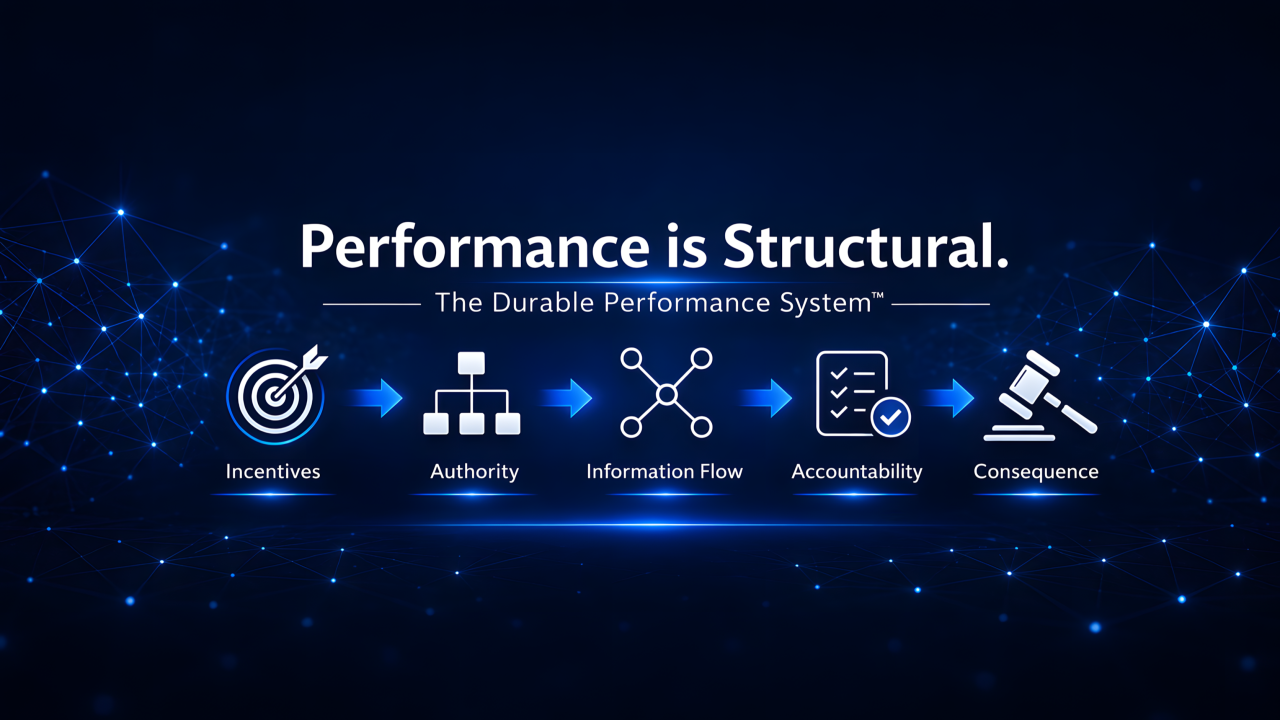
    It is built on alignment across five structural forces:

    • Incentives — what the system rewards determines direction.
    • Authority — where authority sits determines capability.
    • Information Flow — what leadership sees determines correction.
    • Accountability — what accountability enforces determines expectation.
    • Consequence — what consequence applies determines trust.

    When those five remain aligned, durability compounds.

    When they drift apart, entropy accelerates.

    That drift follows a pattern:

    When incentives tilt, authority migrates. When authority migrates, information compresses. When information compresses, accountability distorts. When accountability distorts, consequence weakens.

    That sequence is not philosophical.

    It is operational.

    A Practical Diagnostic for This Week

    Ask this in your next leadership meeting:

    What are we currently rewarding that we claim to dislike?

    Then ask four more questions:

    1. Where has decision authority moved upward in the last 90 days?
    2. What recurring report or meeting no longer changes a decision?
    3. Where are we explaining variance without corrective action?
    4. What exception is still alive after the moment that justified it passed?

    Those are structural questions.

    They matter because most correction fails when leaders tighten before understanding. The rebalancing doctrine is explicit: diagnose migration first, then restore equilibrium across incentives, authority, information flow, accountability, and consequence.

    If You Change One Thing This Week

    Remove one artifact that creates visibility but does not improve a decision.

    That could be:

    A recurring report, a standing meeting, a dashboard no one uses to decide, or an approval step that exists only because no one removed it.

    The Field Guide is clear on this point: stop producing any report that does not change a decision, stop creating new dashboards without a named decision owner and expiration date, and stop variance explanations that are not paired with corrective action within 14 days.

    Subtraction is not retreat.

    It is architecture under protection.

    Closing Thought

    Most organizations do not fail loudly.

    They soften quietly.

    They protect motion when they should protect outcomes. They preserve comfort when they should preserve clarity. They centralize authority when they should restore capability. They explain what they should correct.

    Durable performance does not come from wanting better behavior.

    It comes from designing a system that makes better behavior the most rational path.

    Performance is structural.

    Question for readers: Where is your organization rewarding motion more than truth?


    Related Books

    Primary related book: The Architecture of Durable Performance

    This edition introduces the central doctrine that performance is structural. The Architecture of Durable Performance expands that idea into the full framework of authority, incentives, information flow, accountability, consequence, and structural drift.

    Secondary related book: The Durable Performance Field Guide

    Use this book when the next step is applied diagnosis: decision rights, signal quality, accountability patterns, and friction removal.

    Explore the books →

    Continue Through The Durable Performance System™