What Are Leadership Systems?
Leadership systems are the structures, decision rules, operating routines, incentives, standards, and consequences through which leadership behavior becomes organizational behavior. They are how leaders shape organizational design and influence organizational effectiveness over time.
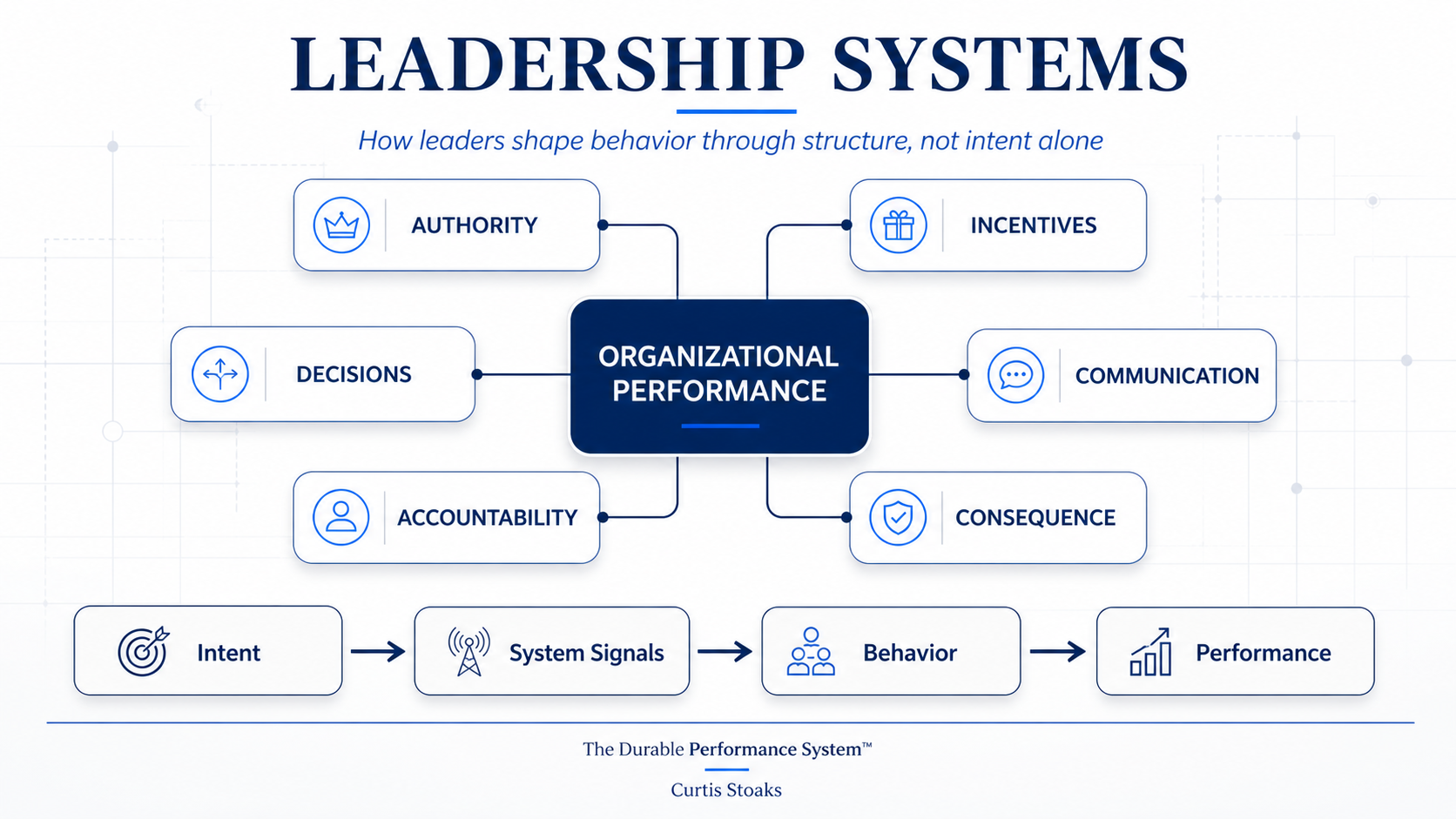
Leadership systems turn intent into operating reality.
Leadership systems are the repeatable arrangements through which leaders shape decisions, ownership, priorities, information, standards, incentives, and consequence.
They determine how the organization behaves when senior leaders are absent, when pressure rises, and when stated values compete with immediate risk.
Leadership systems are therefore part of organizational design . Their quality becomes visible through organizational effectiveness : what the organization can produce, sustain, correct, and adapt without constant senior-leader intervention.
The organization does not operate on leadership intent. It operates on reinforced behavior.
Leaders may value ownership, speed, judgment, truth, accountability, and long-term performance. Those values become operational only when decision rights, incentives, information flow, standards, and consequence reinforce them consistently.
Leadership becomes a system when behavior no longer depends on the leader being present to explain, approve, rescue, or correct every important decision.
Leadership systems shape the design and influence the result.
Leadership behavior becomes durable only when it is translated into structural arrangements that continue operating beyond the leader’s immediate presence.
Organizational Design
Organizational design includes how work, authority, information, incentives, accountability, coordination, and operating routines are arranged.
Leadership systems shape that design through repeated decisions: where leaders place authority, which matters require escalation, what receives attention, what gets rewarded, and which standards remain enforceable under pressure.
Organizational Effectiveness
Organizational effectiveness reveals whether the current system produces intended outcomes while preserving capability, clarity, adaptability, trust, and execution.
Weak leadership systems may still produce short-term results, but those results increasingly depend on oversight, rescue, personal compensation, filtered information, and central intervention.
Leadership systems are not leadership personality at scale.
Charisma, communication skill, urgency, confidence, and visibility may influence people. They do not replace the operating structure that governs behavior.
Leadership systems are
- ✓ Clear decision rights and escalation thresholds.
- ✓ Operating routines that produce decisions and correction.
- ✓ Incentives aligned with stated priorities.
- ✓ Information pathways that allow reality to travel.
- ✓ Standards and consequences applied consistently.
Leadership systems are not
- × A leader’s personality, tone, presence, or communication style.
- × More meetings, dashboards, check-ins, or executive visibility.
- × A substitute for clear authority and accountability.
- × Constant intervention by senior leaders.
- × Dependence on exceptional individuals to hold the system together.
Leadership systems teach through arrangement.
Every recurring leadership decision sends a structural signal about how the organization is expected to operate.
Decision Rights
Where leaders place authority determines whether people develop judgment, wait for permission, or escalate to avoid exposure.
Explore Authority Design →Incentives
Rewards, recognition, promotion, protection, and workload allocation teach which behaviors create advantage inside the system.
Explore Incentive Architecture →Information Flow
What leaders request, reward, challenge, and tolerate determines whether reality travels cleanly or arrives filtered for safety.
Explore Signal Integrity →Accountability
Ownership becomes credible when responsibility, authority, standards, measurement, and correction remain aligned.
Explore Accountability Design →Consequence
What follows behavior teaches more powerfully than what leaders say. Selective consequence makes every standard conditional.
Leadership Reentry
When senior leaders repeatedly override, rescue, or absorb decisions, the system learns that local ownership is temporary.
Leadership effort can hide leadership-system failure.
Leaders often respond to weak execution, slow decisions, filtered truth, and low ownership by becoming more involved.
They add reviews, request more visibility, join additional meetings, pull decisions upward, absorb pressure, and intervene before lower levels can resolve the issue.
These actions may protect an immediate outcome. Repeated often enough, they teach the organization that progress depends on the center.
The leader experiences greater control. The system experiences narrower authority, weaker ownership, and increased dependence.
Leadership-system failure follows a predictable sequence.
- 1 Leaders state the intent. They ask for ownership, urgency, candor, accountability, quality, or faster execution.
- 2 The structure teaches something else. Authority, incentives, meetings, approvals, and consequence reward caution, escalation, protection, or visible activity.
- 3 People adapt rationally. Teams wait, escalate, package information, avoid irreversible judgment, and optimize for leadership reassurance.
- 4 The design changes. Leadership habits become operating rules that reshape authority, information flow, accountability, and coordination.
- 5 Leaders see weaker performance. They interpret structural adaptation as a motivation, alignment, capability, or communication problem.
- 6 More oversight is added. Reviews, dashboards, approvals, and executive involvement expand.
- 7 Effectiveness narrows. Results require more leadership effort, coordination, escalation, and intervention to sustain.
- 8 Dependency becomes structural. Authority, judgment, truth, and capability weaken beneath the center.
How capable leaders unintentionally create weak systems
Leadership-system failures are difficult to recognize because many begin as responsible responses to legitimate pressure.
Intent is mistaken for control
Leaders assume that clearly stated priorities, values, and expectations will govern behavior without structural reinforcement.
Action is mistaken for leadership
Visible activity, intervention, meetings, reporting, and oversight create reassurance without correcting the underlying arrangement.
Authority centralizes under pressure
Leaders pull decisions upward after mistakes or uncertainty and fail to return them after the immediate risk passes.
Escalation is mistaken for alignment
Routine decisions require broader involvement because thresholds, ownership, and acceptable risk have not been defined clearly.
Visibility exceeds decision need
Leaders request more updates, reporting, dashboards, and reviews than are required to make or improve a decision.
Leaders override too early
Senior judgment replaces local judgment before the legitimate owner has enough time or space to decide.
Leaders absorb pressure personally
Instead of redistributing pressure through clearer priorities, authority, staffing, or process, leaders compensate through personal effort.
Valuable people receive exemptions
Standards and consequences change when enforcement would create short-term operational or political discomfort.
Correction is delayed
Leaders wait too long to name visible distortion, allowing behavior to become precedent before intervention occurs.
Ambiguity is preserved
Decision rights, standards, priorities, or expectations remain intentionally vague to avoid conflict or maintain flexibility.
Output is rewarded despite distortion
High results protect behaviors that weaken trust, signal, standards, or the capability of the wider system.
Leadership succession is underbuilt
The system remains dependent on the judgment, relationships, memory, or intervention of a few central leaders.
Weak leadership systems change the structure beneath performance.
The effects appear across organizational design, effectiveness, decisions, execution, accountability, information, capacity, and long-term durability.
Organizational Design Changes
Repeated leadership interventions become informal operating rules that reshape authority, information flow, accountability, coordination, and decision pathways.
Explore Organizational Design →Organizational Effectiveness Weakens
Outcomes require more leadership attention, intervention, coordination, and personal compensation to sustain.
Explore Organizational Effectiveness →Decision Velocity Slows
People hesitate because they cannot predict whether their authority will be supported after the decision is made.
Explore Decision Velocity →Approval Drag Expands
More decisions move upward for visibility, safety, alignment, or informal permission.
Explore Approval Drag →Execution Drag Increases
Meetings, reviews, escalations, rework, and leadership intervention consume capacity without increasing throughput.
Explore Execution Drag →Signal Integrity Weakens
Teams shape information around what leadership is prepared to hear, reward, or defend.
Explore Signal Integrity →Accountability Becomes Selective
Standards change according to influence, hierarchy, business pressure, personal relationships, or short-term output.
Explore Accountability Design →Leadership Capacity Compresses
Senior leaders spend more time resolving routine issues and less time designing systems, building capability, and protecting long-term direction.
Ownership Narrows
People become responsible for execution while meaningful judgment remains concentrated above them.
Explore Authority Design →Structural Complexity Grows
More meetings, reporting, approvals, and coordinating roles are added to manage dependency created by the leadership system.
Explore Structural Simplicity →Organizational Drift Accelerates
Leadership behavior gradually changes authority, incentives, information, standards, and consequence until distortion becomes normal.
Explore Organizational Drift →Leadership systems coordinate the wider operating architecture.
Performance Is Structural
Leadership performance should be evaluated by what becomes more true in the organization—not only by effort, personality, intention, or visibility.
Explore Performance Is Structural →Organizational Design
Leadership systems shape the arrangement of decision rights, information, incentives, accountability, coordination, routines, and standards.
Explore Organizational Design →Organizational Effectiveness
Leadership systems determine whether the organization can produce durable outcomes without excessive dependence on senior leaders, hidden compensation, or repeated rescue.
Explore Organizational Effectiveness →Authority Design
Leaders shape capability through where they place decision rights, which thresholds justify escalation, and when they resist reentering a decision.
Explore Authority Design →Incentive Architecture
Rewards, promotions, protection, recognition, and workload distribution reveal which leadership messages the system will actually follow.
Explore Incentive Architecture →Accountability Design
Leadership determines whether ownership is legitimate, authority matches responsibility, correction occurs promptly, and consequence remains consistent.
Explore Accountability Design →Structural Simplicity
Strong leadership systems remove unnecessary meetings, metrics, roles, approvals, and processes instead of asking people to carry accumulating complexity.
Explore Structural Simplicity →Organizational Entropy
Leadership systems must repeatedly return authority, remove expired controls, recalibrate incentives, widen signal, and restore standards as drift accumulates.
Explore Organizational Entropy →Organizational Drift
Drift reveals the accumulated structural effect of leadership decisions that appeared reasonable individually but changed the system collectively.
Explore Organizational Drift →Questions that reveal weak leadership systems
Immediate examples indicate that the organization does not only need stronger leadership communication. It needs structural redesign around how leadership operates.
Use the Drift Diagnostic →Strong leaders build systems that do not require constant rescue.
Durable leadership increases capability beneath the center instead of concentrating responsibility, decisions, and correction around the leader.
Define Decision Rights
Name who decides, what authority they hold, what input is required, and which conditions genuinely justify escalation.
Separate Visibility from Approval
Leaders can remain informed without converting awareness into another permission step.
Return Authority Deliberately
Decision rights absorbed during pressure should be redistributed after capability, standards, and risk thresholds are restored.
Align Incentives with Doctrine
Reward judgment, correction, ownership, truth, and completed outcomes rather than protection, escalation, artifact production, or visible busyness.
Protect Clean Signal
Make it safer to surface uncomfortable reality early than to defend a reassuring narrative later.
Correct Systems Before Blaming People
Repeated problems should trigger examination of authority, incentives, process, workload, standards, and information flow.
Enforce Standards Predictably
Apply consequence consistently across hierarchy, relationships, influence, and performance history.
Build Leaders Beneath the Center
Give emerging leaders legitimate decisions, visible standards, useful feedback, and enough space to develop judgment.
Audit During Strength
Examine authority migration, leadership load, escalation, reporting, exceptions, dependency, and effectiveness before visible performance declines.
Choose the next structural path.
Leadership systems become more durable when leaders examine the design they are creating, the effectiveness that design produces, and the wider structural effects of their behavior.
Organizational Design
Examine how leadership decisions arrange authority, information, incentives, accountability, routines, and coordination.
Explore Organizational Design →Organizational Effectiveness
Evaluate whether leadership systems create durable capability or increasing dependence on senior intervention.
Explore Organizational Effectiveness →Performance Is Structural
Understand why recurring outcomes should be examined through arrangement, incentives, authority, information, and consequence—not personality alone.
Explore Performance Is Structural →Organizational Drift
Examine how leadership decisions gradually change standards, authority, incentives, signal, accountability, and ownership.
Explore Organizational Drift →The Drift Diagnostic
Identify where leadership behavior may be creating authority migration, approval drag, filtered signal, weak accountability, or system dependence.
Take the Drift Diagnostic →The Durable Performance System™
See how leadership systems connect with design, effectiveness, authority, incentives, information, accountability, consequence, simplicity, and durable performance.
See the Wider System →Leadership is architecture in motion.
Strong leaders do more than communicate expectations or intervene when performance weakens. They shape organizational design through authority, incentives, information, accountability, standards, and consequence so organizational effectiveness becomes more durable—and less dependent on constant leadership rescue.