Edition 10 | May 27, 2026
Most leaders think they know what their organization rewards.
Many do not.
They know what they praise.
That is not the same thing.
Organizations do not learn the real reward system from values statements, leadership language, or offsite talking points. They learn it from who gets protected, who gets promoted, who gets interpreted generously, who keeps winning despite the damage around them, and what kind of behavior still advances when the numbers are useful.
That is where distortion gets normalized.
Not when leadership says the wrong things.
When leadership says the right things while rewarding their opposite.
The Core Thesis
Most reward-system corruption does not begin with open hypocrisy.
It begins with misalignment.
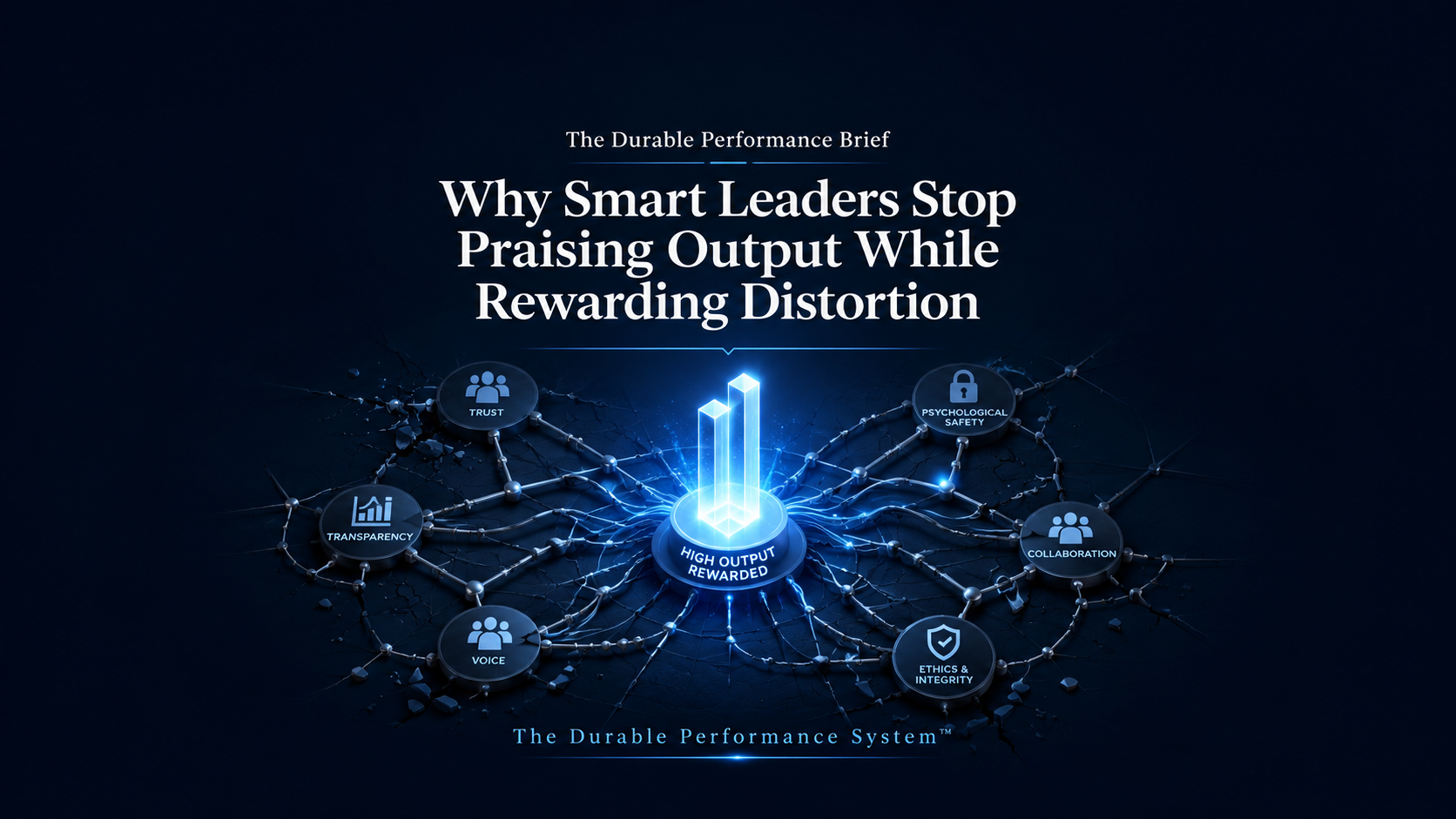
A leader praises ownership, then advances the person who manages upward well but leaves confusion below. A leader praises candor, then prefers those who package risk elegantly. A leader praises collaboration, then keeps expanding the politically forceful performer because their results are visible and defensible. The leader believes the organization is hearing the words. The organization is actually studying the outcomes. And outcomes always teach faster.
That is the structural problem.
Because once people see that output carries more weight than system effect, they begin adapting rationally. They stop asking what leadership says it wants and start asking what kind of winner actually rises here. If distorted winners advance, distortion becomes career logic.
This is why output can become a shield.
Not because output is unimportant. It is.
But output is visible, countable, and easy to defend. The distortion around it is harder to count: the trust weakened, the peer damage normalized, the corners others learn to cut, the quieter truth, the standard bent through visible success. When leaders privilege what is measurable over what is structural, they start rewarding people for making the system weaker while making the numbers look stronger.
What This Looks Like in the Wild
A person who always keeps senior leaders comfortable gets described as strategic.
A person who never brings raw problems, only polished stories, gets described as composed.
A person who escalates relentlessly and keeps themselves covered gets described as mature.
A person who produces output through fear, exemption, or overcontrol gets described as high-performing.
That is how distortion hides.
It borrows respectable language.
The most expensive version appears in promotion decisions.
Nothing teaches the organization faster than promotion. Not town halls. Not principles. Not posters. Promotion says: be more like this. So when leaders elevate someone whose numbers are strong but whose system effect is corrosive, the organization learns that corrosive success still counts as success. If leaders reward ambition without discipline, visibility without substance, or force without trust, distortion stops being incidental. It becomes adaptive.
That is when the career logic begins to separate from the declared logic.
Leadership says: own outcomes.
Career logic says: protect yourself from exposure.
Leadership says: tell the truth early.
Career logic says: do not surface a problem until it is packaged.
Leadership says: standards matter.
Career logic says: standards matter unless your output is too important.
That split is where cynicism starts.
Not because people are cynical by nature.
Because the system has become clearer than the speech.
Why Leaders Misread It
Because praise feels like proof.
A leader assumes that if they praise the right things, they are rewarding the right things.
Not necessarily.
Praise is one signal.
Reward is the full behavioral system around it: advancement, protection, access, tolerance, attention, exception, and consequence. Leaders often mistake verbal endorsement for structural endorsement. The organization does not. It watches who wins.
Leaders also misread the cost because output is easier to measure than distortion.
The number is clean.
The side effects are diffuse.
Under pressure, it feels responsible to privilege what is most visible and defensible. That is one reason rewarding the wrong behavior persists across average organizations: results are easier to count than judgment, restraint, trust-building, or long-term contribution. But the side effects are the main effect. They are what reshape the system over time.
One Practical Diagnostic
Ask this in your next leadership meeting:
If someone studied our promotions and protections instead of our values statements, what would they conclude we actually reward?
Then press harder:
- Who gets ahead faster than their structural effect justifies?
- Who receives generous interpretation because their output is strong?
- What behavior do we praise in language while rewarding its opposite in outcomes?
- Would we want more of the organization to behave like the people we currently elevate?
- What do ambitious people here quietly believe they must become to win?
Those questions matter because reward systems are always teaching.
Especially when leadership is not paying attention.
If You Change One Thing This Week
Review one recent promotion, expansion-of-scope decision, or high-potential designation through a different lens:
Did this person create output in a way we would want repeated?
Not just:
Did they deliver?
Ask:
Did they strengthen trust?
Did they preserve clean signal?
Did they reduce dependence?
Did they make the operating conditions better for other people?
Would giving them more authority make the system stronger?
If the answer is no, do not hide behind admiration.
Say the harder sentence:
Not like this.
That is not pettiness. It is architectural discipline. If leadership cannot withhold advancement from people whose results travel with distortion, then the reward system no longer belongs to leadership. It belongs to momentum. And momentum is rarely structural or durable on its own.
Go Deeper
This issue builds on ideas from What Smart Leaders Stop Doing, part of The Durable Performance System™ series.
Related read:
What Smart Leaders Stop Doing — a structural guide to the leadership behaviors that quietly redirect ambition, normalize distortion, and teach organizations to reward what makes the system weaker.
Closing Thought
Organizations do not become what leaders say they value.
They become what leaders repeatedly reward, protect, excuse, and advance.
So when leaders praise ownership but reward optics, the organization learns optics. When leaders praise candor but reward polished reassurance, the organization learns curation. When leaders praise standards but advance distorted winners, the organization learns conditionality.
And once ambition starts serving distortion more reliably than discipline, the organization will not just tolerate the wrong behavior.
It will manufacture more of it.
Question for readers: What kind of winner is your organization quietly teaching ambitious people to become?
Next Wednesday: Why smart leaders stop delaying correction because the person is valuable.
Part of The Durable Performance System™
Books, field guides, and frameworks on power, incentives, authority, accountability, and execution.
Published every Wednesday morning.