Edition 8 | May 13, 2026
The fastest way to corrupt a leadership system is not low performance.
It is selective consequence.
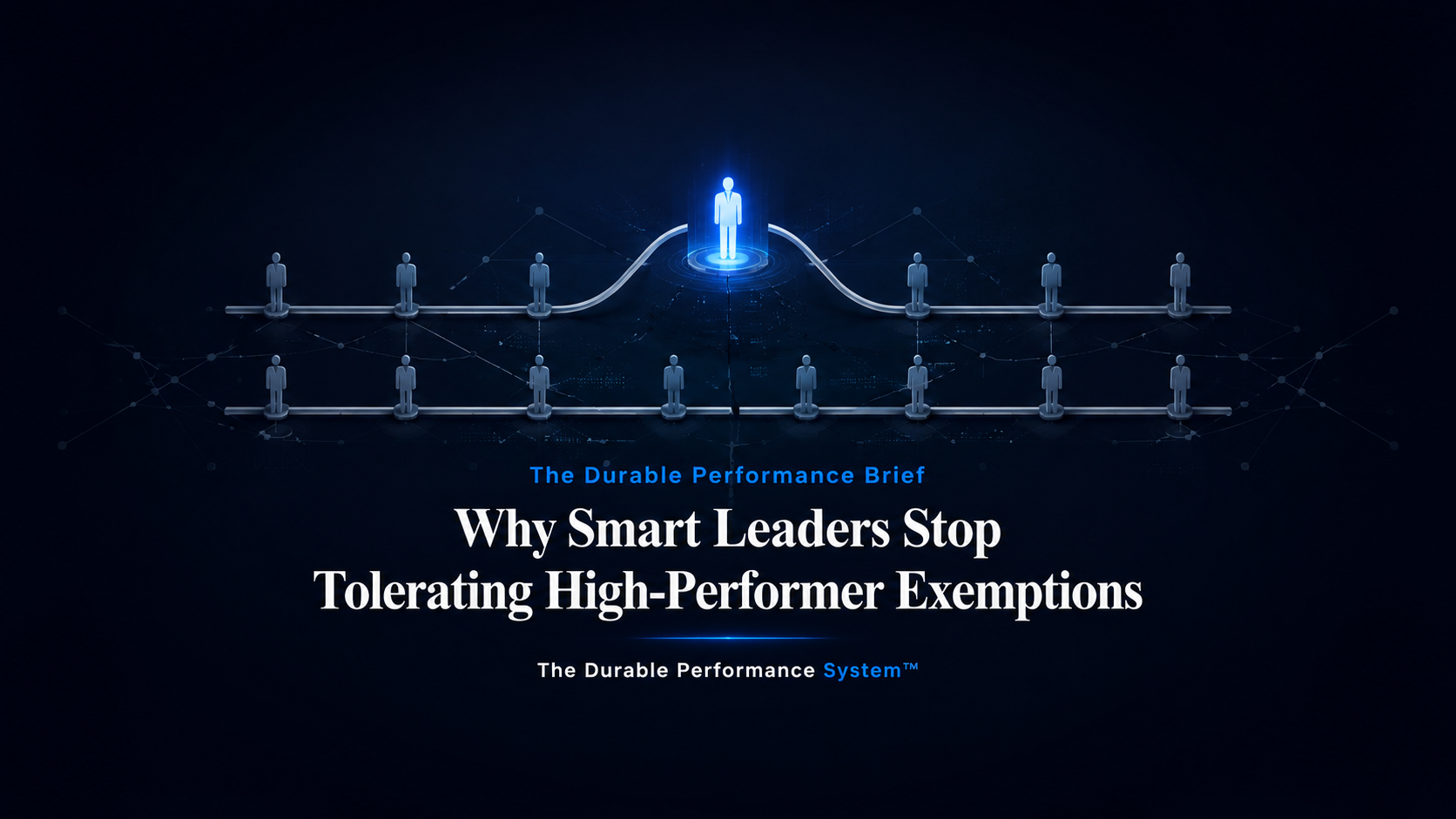
The moment people realize the standard changes depending on who is involved, the organization starts learning the wrong lesson. Not what leadership says. What leadership protects. That is why high-performer exemptions are so dangerous. They do not merely excuse one person. They retrain the system.
The Core Thesis
Most leaders do not make exceptions for high performers because they admire hypocrisy.
They do it because they feel trapped.
The person is productive. Hard to replace. Close to important customers. Politically influential. Embedded in a fragile workflow. Or simply valuable enough that correction feels expensive. So instead of enforcing the standard cleanly, leadership starts managing around the person. The language softens. The consequence delays. The issue gets reframed as nuance, timing, or complexity. The person stays valuable. The standard becomes conditional.
That is the structural break.
Because the leader believes they are making a contained exception.
The organization experiences a rule change.
Once people see that output can buy behavioral leniency, they stop treating standards as shared operating conditions. They start treating them as negotiable. The question quietly shifts from What is the standard? to Who is the standard for?
This is why selective consequence is more corrosive than many visible performance issues. Low performance is easier to name. Open confusion is easier to diagnose. Selective enforcement is harder because the organization can remain commercially productive while trust, truth, and accountability thin underneath. Drift does not need chaos. It only needs repeated tolerance applied unevenly enough to feel normal.
What This Looks Like in the Wild
A revenue producer keeps creating interpersonal damage, but the conversation stays narrow: yes, they are difficult, but they deliver.
A strong operator humiliates peers, overrides process, or destabilizes a team, but leadership keeps describing them as intense rather than unacceptable.
A high-value person misses a line others would be held to, but the consequence becomes coaching language, private patience, or one more contextual explanation.
None of this gets announced.
That is why it spreads.
People just begin noticing who gets more interpretation. Who gets more patience. Who remains “worth it” long after their structural cost should have been counted honestly. Then the organization starts adapting around the double standard. Candor drops. Managers spend more time containing than building. Disciplined contributors lower their own expectations, withdraw, or leave. Leadership keeps measuring the producer’s direct output while missing the distributed tax spreading across everyone else.
That distributed tax is the part leaders misprice.
It shows up in quieter meetings, softer truth, more cover-seeking, rising cynicism, and the loss of disciplined people who no longer trust the system to mean what it says. The Field Guide’s drift indicators name the same pattern directly: uneven standards, cover-seeking behavior, and high-performer churn risk are signals of leadership maturity breaking down.
Why Leaders Misread It
Because they use incomplete arithmetic.
They ask:
What do we lose if we confront, sideline, or remove this person?
They do not ask:
What are we already losing by protecting them?
That second question is harder because the losses are slow, social, and inconvenient. They do not appear on one dashboard. They arrive through reduced ownership, weaker truth, managerial hesitation, rework, and the erosion of trust in leadership language itself. By the time the cost becomes undeniable, the exemption has often hardened into precedent.
This is also where leaders hide behind a useful-sounding distinction.
Some difficult high performers are genuinely complex. Some need sharper management, not immediate removal. Some are intense but still coachable.
That is real.
But complexity is not exemption.
A strong leader may tailor the correction path. They may stage it differently. Sequence it differently. Protect dignity differently. But the standard still has to apply. The moment the standard becomes person-dependent, leadership is borrowing results against institutional trust.
One Practical Diagnostic
Ask this in your next leadership meeting:
Which behavior are we currently asking the rest of the organization to absorb because the person creating it is valuable?
Then make the question harder:
- Would the response be different if an average performer did the same thing?
- What managerial time is being spent containing this person?
- What truth has gotten quieter around them?
- Who has already adjusted downward because leadership has not held the line?
- What standard now sounds optional because of this one exception?
If the answer reveals a two-tier system, the problem is not talent management.
It is selective consequence.
If You Change One Thing This Week
Choose one protected behavior and remove its exemption.
Not necessarily the person.
The exemption.
Name the standard clearly. Name the breach plainly. Define the correction path. Define the consequence if it continues. Then hold the line predictably.
Do not use vague language like “needs to be easier to work with.”
Be specific.
- What behavior stops now?
- What standard applies?
- What happens if it repeats?
- Who is responsible for enforcement?
The goal is not theatrical punishment.
It is structural credibility.
Because once disciplined contributors can see that the standard means the same thing for valuable people too, trust starts returning faster than leaders expect. And once the exemption disappears, the rest of the organization stops learning the wrong lesson.
Go Deeper
This issue builds on ideas from What Smart Leaders Stop Doing, part of The Durable Performance System™ series.
Related read:
What Smart Leaders Stop Doing — a structural guide to the leadership behaviors that quietly create selective consequence, weaken trust, and make standards conditional under pressure.
Closing Thought
High performance should buy trust.
It should not buy exemption.
Because the moment a leader asks the organization to carry damage that one valuable person is allowed to create, the system stops respecting the standard and starts studying the protection.
And what leadership protects, the organization eventually becomes.
Question for readers: Where in your organization has one valuable person been allowed to teach everyone else that the standard is negotiable?
Next Wednesday: Why smart leaders stop asking for more visibility than they need.
Part of The Durable Performance System™
Books, field guides, and frameworks on power, incentives, authority, accountability, and execution.
Published every Wednesday morning.