Edition 21 | August 12, 2026
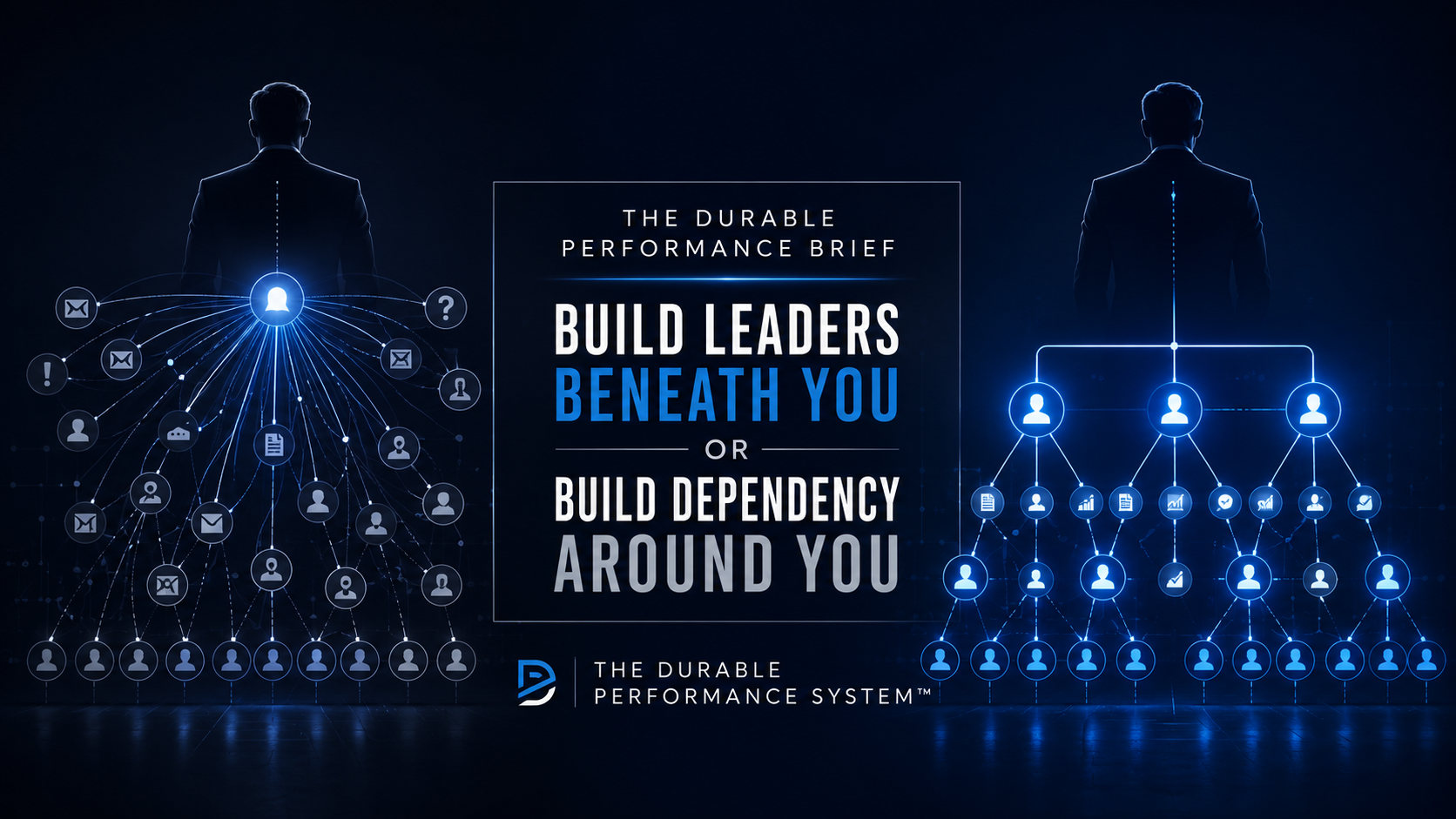
A leader can look exceptionally strong while building an exceptionally fragile organization.
They know the details.
They are pulled into important meetings.
People ask for their judgment before difficult decisions.
Escalations find them quickly.
Problems move faster when they enter the room.
From the outside, this can look like leadership at its highest level.
But there is another possibility.
The organization may not be becoming stronger.
It may simply be becoming better at depending on one person.
That distinction matters because leadership is not multiplied by how much the leader personally carries. It is multiplied by how much legitimate judgment, ownership, and pressure-bearing capacity grows beneath them.
The Core Thesis
Strong leaders expand capability.
Weak leadership systems accumulate dependence.
That does not mean the leader is weak in skill, intelligence, commitment, or judgment. In fact, the problem often becomes most pronounced around highly capable leaders.
They can solve quickly.
They see around corners.
They know the political terrain.
They can rescue an uncertain manager, reframe a difficult decision, calm a tense meeting, and improve a weak plan in minutes.
That capability is valuable.
It becomes structurally expensive when the organization learns that consequential leadership happens only when that person enters.
Then the leader is no longer simply supporting the system.
They are becoming part of its required operating infrastructure.
See more on Leadership Systems, where repeated leadership behavior is treated as operating structure rather than merely style or intent.
What This Looks Like in the Wild
A vice president has a talented director.
The director is respected, experienced, and increasingly capable.
Leadership says they want the director to step up.
But whenever an important cross-functional conflict appears, the vice president joins the meeting.
When a difficult decision has political consequences, the vice president reframes it.
When feedback becomes uncomfortable, the vice president softens the message.
When the director makes a reasonable call that differs from the vice president’s preference, the decision gets reopened.
Nothing about this looks obviously dysfunctional.
The vice president may believe they are coaching.
The director may feel supported.
The organization may even get a slightly better decision in the moment.
But the system is teaching something very specific:
You lead until the situation becomes consequential. Then real authority returns upward.
That is not leadership development.
It is conditional ownership.
And conditional ownership creates leaders who become better at anticipating the person above them rather than better at carrying the system beneath them.
This is why Authority Design matters. Real development requires more than responsibility. It requires legitimate decision rights, clear boundaries, escalation thresholds, and visible backing when those rights are exercised.
Support Is Not the Same as Substitution
This is where good leaders often get trapped.
They answer questions.
Share context.
Give advice.
Stay accessible.
Join difficult meetings.
Model good judgment.
Protect people from unnecessary political noise.
All of those things can help.
None of them guarantees that capability is actually expanding.
People become stronger leaders by doing harder things themselves:
making meaningful decisions,
holding standards when doing so creates friction,
absorbing bounded pressure,
dealing with consequence,
telling difficult truths,
and learning from legitimate mistakes without having the work pulled away from them.
That requires support.
It also requires room.
Without real room, mentoring can become a sophisticated form of dependence. The subordinate becomes extremely good at consulting the leader, preparing for the leader, and predicting the leader—without becoming substantially more capable of operating without the leader.
Why Leaders Misread This
Dependence is flattering.
It creates daily evidence that the leader matters.
People need your judgment.
They seek your input.
They bring you important issues.
They want you in the room.
Your calendar is full because your involvement appears consequential.
It is easy to interpret that as proof that leadership is working.
Sometimes it is.
But strong leaders eventually change the scorecard.
They stop asking:
How well does this team respond to me?
They start asking:
How much legitimate leadership can this team carry without me?
That is a very different standard.
A reduction in escalations can become evidence of strength rather than lost relevance.
A leader below you resolving a conflict differently than you would can become evidence of growth rather than loss of control.
A difficult meeting that succeeds without you can become a leadership win instead of a reason to wonder why you were not included.
That emotional transition matters.
Leaders who need continuous proof of their indispensability will keep organizing the system around themselves—even while talking about empowerment.
One Practical Diagnostic
Ask yourself:
If I disappeared for two weeks, what would stop working because the organization genuinely needs my authority—and what would stop merely because people have learned to wait for me?
That distinction is revealing.
Look at the leaders directly beneath you.
Can they make consequential decisions without pre-clearing them?
Can they handle cross-functional conflict without importing your authority into the room?
Can they hold a standard when the person resisting it has influence?
Can they deliver difficult feedback without expecting you to soften it afterward?
Can they make a reasonable decision differently than you would—and still trust that you will protect their legitimate authority?
Would the people below them describe their leadership as real?
These are not abstract development questions.
They are structural ones.
See how Accountability Design supports real ownership by aligning responsibility, standards, decision rights, correction, and consequence instead of separating them.
If You Change One Thing This Week
Choose one leader beneath you who is ready to carry more.
Then transfer one piece of real leadership, not just more work.
Give them a decision that matters.
Define the boundary.
Clarify what would actually justify escalation.
Coach before the moment rather than taking over inside it.
Back them publicly once the boundary is set.
Correct privately if needed afterward.
And allow enough bounded difference that they can develop judgment rather than simply imitate yours.
Do not hand off the easy part and retain every consequential part.
That teaches administration.
Not leadership.
The goal is not to disappear.
The goal is to become less structurally necessary in places where capability should already be growing beneath you.
When leaders do this consistently, dependence begins to fall.
Authority becomes more legitimate.
Judgment deepens.
Escalation becomes more selective.
And capability starts expanding instead of accumulating at the center.
Go Deeper
This issue builds on ideas from What Smart Leaders Stop Doing, part of The Durable Performance System™ series.
Related read:
What Smart Leaders Stop Doing examines why strong leadership is not proven by how indispensable a leader becomes, but by whether judgment, ownership, standards, truth, and pressure-bearing capability deepen below the center.
For the broader structural mechanism, see more on Organizational Drift. Temporary centralization can become permanent, local capability can narrow, and the organization can adapt to dependence long before anyone formally redesigns the structure.
Closing Thought
A leader should become more valuable as the organization becomes less dependent on their constant intervention.
That is not a contradiction.
It is multiplication.
The strongest leader in the system should not remain the only place consequential judgment lives.
Because leadership is not proven by how many people need you.
It is proven by what becomes strong enough not to.
Question for readers: Where are you still calling it leadership development when the person beneath you is actually being trained to depend on your involvement?
Next Wednesday: What predictable standards make possible.
Part of The Durable Performance System™
Books, field guides, and frameworks on power, incentives, authority, accountability, and execution.
Published every Wednesday morning.
Curtisstoaks.com – YouTube – @curtisstoaksauthor