Edition 23 | August 26, 2026
Most leaders carry too much.
Not necessarily too much work.
Too much responsibility for things that were never truly theirs to govern.
The mood in the room.
Whether everyone approves.
Whether every difficult decision feels comfortable.
Whether uncertainty is visible.
Whether people think leadership has everything under control.
Whether every important problem eventually finds its way to them.
Those burdens feel like leadership because they are heavy.
But weight is not the same thing as responsibility.
And when leaders spend too much energy carrying what is emotionally near, they often neglect what is structurally theirs.
The Core Thesis
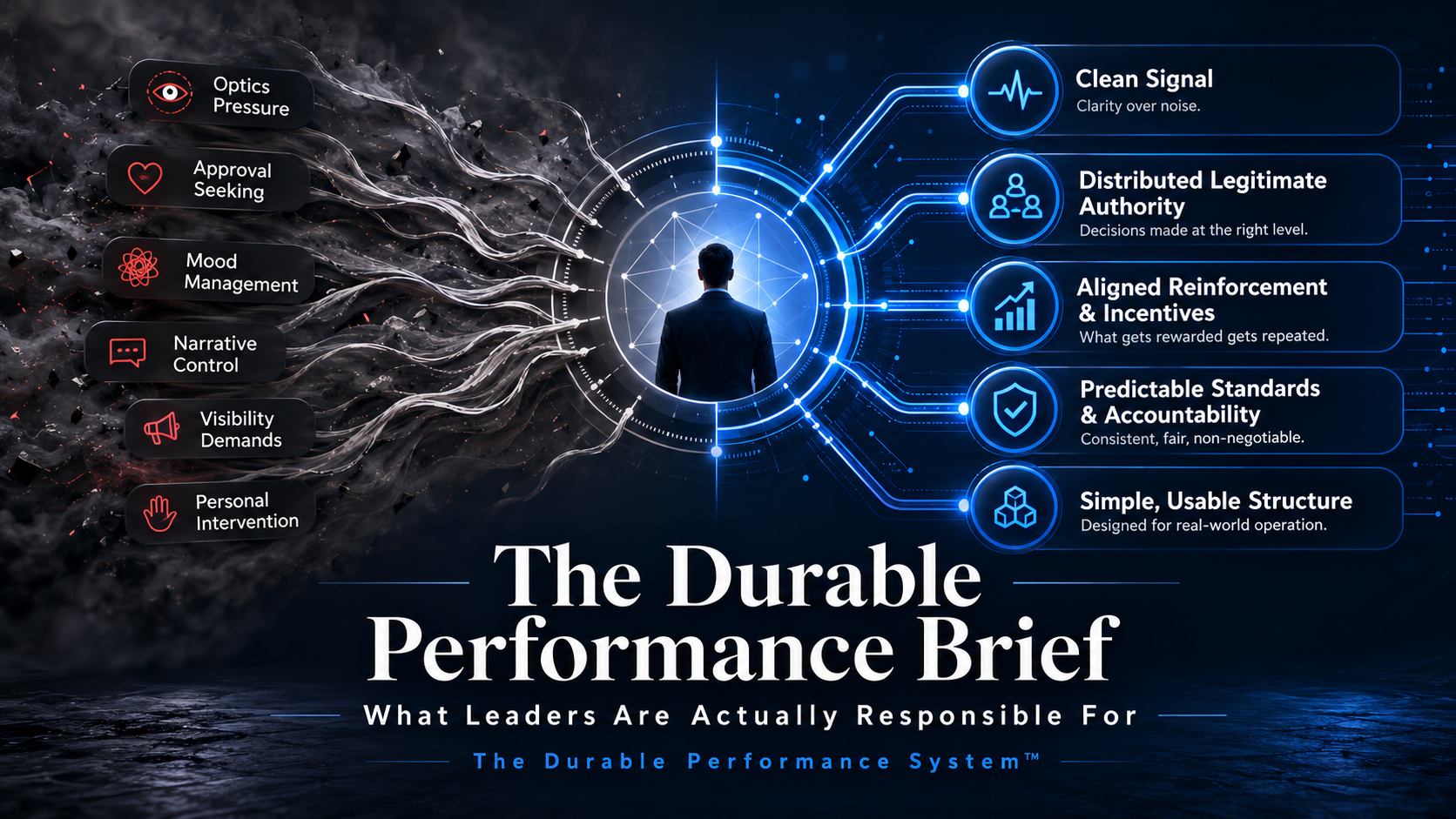
Leadership responsibility is architectural.
Leaders are responsible for the conditions under which other people must operate.
That means asking whether:
truth can travel,
authority sits where it should,
incentives reinforce the right behavior,
standards remain credible,
and the system stays simple enough for people to think and act clearly.
The leader’s personality matters.
Intent matters.
Communication matters.
But none of them is the final test.
The system is.
A leader can be charismatic while authority centralizes around them.
Supportive while accountability becomes less credible.
Decisive while capability beneath them contracts.
Calm while inconvenient information gets increasingly packaged before it reaches the center.
Leadership has to be evaluated by what becomes structurally more true because that leader is there.
See more on Leadership Systems for how repeated leadership behavior becomes operating structure rather than remaining a matter of style or personality.
Responsibility #1: Protect the Signal
Leaders cannot govern a system they cannot see.
That does not mean they need every detail.
It means important reality must be able to reach the people capable of acting on it without becoming distorted by fear, optics, hierarchy, or narrative management.
Leaders are responsible for asking:
Can someone tell us something we do not want to hear?
Does bad news move quickly enough to matter?
Are managers explaining reality—or packaging it?
Have our reactions trained people to protect us from uncomfortable information?
This is why Signal Integrity is a leadership responsibility.
If truth becomes harder to transmit as it moves upward, leadership cannot blame the system alone.
Leadership helped create the conditions under which that signal travels.
Responsibility #2: Put Authority Where the Work Requires It
Leaders are responsible for deciding where legitimate decision authority belongs.
Not where it feels safest.
Not where the smartest person sits.
Not where political exposure can be minimized.
Where the work requires it.
That means clear owners.
Real decision boundaries.
Defined escalation thresholds.
And enough restraint from senior leaders that local authority remains real after it has been delegated.
If every consequential call eventually rises to the center, the leader may feel responsible.
The organization experiences dependence.
Explore Authority Design for the structural relationship among ownership, boundaries, consultation, approval, and escalation.
Responsibility #3: Govern What the System Rewards
Organizations do not behave according to what leadership prefers.
They adapt to what actually pays.
Who gets promoted?
What receives praise?
What behavior receives protection?
What gets ignored because the person producing results is valuable?
What does the organization fund with attention, opportunity, status, compensation, and tolerance?
A leader who says one thing while structurally rewarding another has not merely communicated poorly.
They have governed poorly.
This is why leadership responsibility extends beyond stated expectations into the reinforcement system itself.
Responsibility #4: Make the Standard Real
A standard is not a sentence in a policy.
It is a predictable relationship between behavior and outcome.
Leaders are responsible for whether that relationship remains credible.
That does not mean identical treatment in every circumstance.
Context matters.
Judgment matters.
But the underlying principle must remain recognizable when enforcement becomes inconvenient.
Does high performance purchase exemption?
Does hierarchy purchase reinterpretation?
Does political value buy more time?
Does leadership enforce the line differently when the cost rises?
This is where Accountability Design matters. Accountability works when ownership, authority, standards, evidence, correction, and consequence reinforce one another instead of separating under pressure.
Responsibility #5: Keep the System Usable
Weak systems accumulate.
Another review.
Another dashboard.
Another approval.
Another recurring meeting.
Another workaround.
Another temporary control that becomes permanent.
Each addition may be reasonable.
Collectively, they create weight.
Leaders are responsible for whether complexity is removed as aggressively as it is added.
The goal is not minimalism.
It is usability.
Can people still understand what matters?
Can they make decisions without unnecessary coordination?
Can the system absorb pressure without adding another permanent layer every time something goes wrong?
Structural simplicity is not administrative housekeeping.
It is part of leadership stewardship.
What Leaders Are Not Responsible For
This boundary matters just as much.
Leaders are not responsible for:
making everyone comfortable with every standard,
keeping every relationship warm,
personally absorbing every source of pressure,
eliminating uncertainty,
preserving every contributor regardless of cost,
or maintaining a reassuring narrative after reality has contradicted it.
Trying to own those things often distorts the responsibilities that matter more.
Truth gets softened to preserve confidence.
Consequence gets delayed to preserve relationships.
Authority gets centralized to reduce uncertainty.
Pressure gets absorbed rather than redistributed.
Complexity gets added because carrying more feels safer than removing something.
The result is a leader who carries more while governing less.
That is misplaced responsibility.
One Practical Diagnostic
Ask yourself:
What am I currently carrying that feels like leadership but may actually be distracting me from leadership?
Then ask five structural questions:
Is truth getting through?
Does authority sit where it should?
Are we reinforcing the behavior we actually want?
Are standards predictable enough to trust?
Is the system becoming simpler and stronger—or heavier and more dependent?
Those questions are useful because they move leadership away from self-perception.
Not:
Do people think I am supportive enough?
But:
What conditions am I preserving?
Not:
Am I involved enough?
But:
Is my involvement making the system more capable?
Not:
How do I carry this better?
But:
Should this still be carried here at all?
If You Change One Thing This Week
Take one recurring leadership burden that consumes significant energy.
An escalation.
A review.
A relationship you constantly stabilize.
A decision category.
A recurring conflict.
A reporting loop.
Then ask:
What would have to be structurally true for this to stop requiring me?
Perhaps authority needs to move.
A standard needs to become explicit.
A consequence needs to become credible.
A manager needs legitimate backing.
A reporting artifact needs to disappear.
A difficult truth needs to be named.
Do not solve for how to carry the burden more efficiently.
Solve for why the system keeps routing it to you.
That is the difference between performing responsibility and governing structure.
Go Deeper
This issue builds on ideas from What Smart Leaders Stop Doing, part of The Durable Performance System™ series.
Related read: What Smart Leaders Stop Doing examines leadership as system effect rather than personal performance. It asks leaders to judge themselves by whether authority becomes clearer, signal becomes cleaner, standards become more predictable, ownership grows stronger, and capability expands beneath the center.
Closing Thought
Leadership is not proved by how much you carry.
It is proved by what becomes stronger because you governed it well.
Clearer authority.
Cleaner truth.
Better reinforcement.
More credible standards.
Less unnecessary complexity.
Stronger capability below the center.
That is the work.
Because the organization does not ultimately experience your intent.
It experiences the system your leadership leaves behind.
Question for readers: What are you carrying today that feels like leadership responsibility but may actually be evidence that the system needs redesign?
Next Wednesday: The leadership obligation.
Part of The Durable Performance System™ Books, field guides, and frameworks on power, incentives, authority, accountability, and execution. Published every Wednesday morning. Curtisstoaks.com – YouTube – @curtisstoaksauthor