Edition 19 | July 29, 2026
Most organizations inspect themselves when something hurts.
A number drops.
A customer escalates.
Turnover rises.
A launch fails.
A control breaks.
A visible miss creates enough urgency—and enough political permission—to ask structural questions that should have been asked much earlier.
Then come the reviews, postmortems, diagnostics, process changes, and operating resets.
That response may be necessary.
It is also late.
By the time failure makes structural weakness visible, the organization has usually been paying for it quietly for months or years.
The Core Thesis
Healthy organizations do not wait for pain to make inspection legitimate.
They audit during strength.
They examine authority, incentives, information flow, accountability, consequence, complexity, and capability while performance is still defensible and the system still has room to correct without panic.
This requires discipline because success creates reassurance.
The quarter closes.
Customers remain stable.
Growth continues.
The dashboard is mostly green.
The organization appears capable.
Leaders naturally interpret those outcomes as evidence that the system underneath them is healthy.
But visible performance does not reveal what is producing it.
Strong results may come from sound structure.
They may also come from market tailwinds, extraordinary effort, temporary workarounds, accumulated goodwill, hidden coordination labor, or a small number of capable people compensating for weaknesses no one has examined.
Success confirms the outcome.
It does not automatically validate the arrangement that produced it.
That is why auditing during strength matters.
It separates performance that is structurally durable from performance that is quietly borrowing against people, trust, speed, or future capacity.
What This Looks Like in the Wild
A business unit is meeting its targets.
Nothing appears seriously broken.
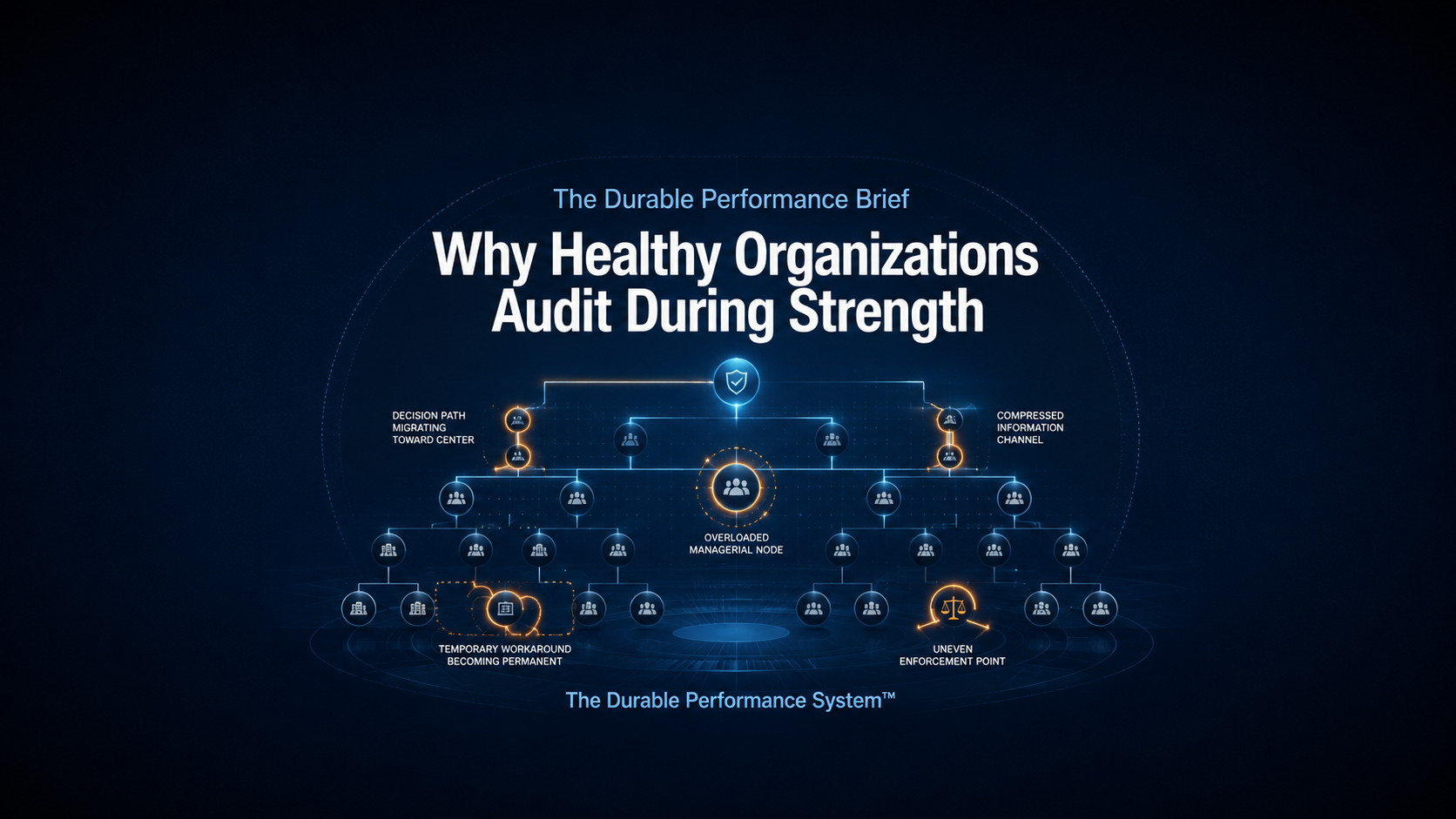
But a closer inspection reveals that more routine decisions are reaching senior leaders than they did six months ago.
Status reporting has expanded.
Two strong managers are carrying coordination loads that are mostly invisible.
Bad news is being packaged carefully before it reaches executives.
A high-output employee is receiving behavioral flexibility that others have noticed.
None of these conditions has produced visible failure yet.
That is precisely why this is the best time to act.
The organization still has room to restore decision rights without crisis.
It can reduce unnecessary reporting without appearing to abandon control.
It can redistribute managerial load before exhaustion becomes attrition.
It can improve signal quality before executive surprise triggers overcorrection.
It can correct selective standards before resentment hardens into cultural truth.
When leaders wait for visible damage, the same corrections become harder.
Trust has weakened.
Political positions have formed.
Dependencies have deepened.
People have adapted around the distortion.
The eventual response must now overcome not only the original problem, but also the system’s accumulated accommodation to it.
Maintenance is quieter than repair.
It is also cheaper.
Why Leaders Avoid It
Auditing what appears to be working can feel unnecessary.
It interrupts momentum.
It may be interpreted as distrust.
It can seem unfair to question a team producing acceptable results.
It may also expose leadership choices that are difficult to confront.
If authority has drifted upward, leaders may have to acknowledge that their own intervention habits helped centralize it.
If information is overly curated, they may have to examine whether their reactions made unfiltered truth unsafe.
If incentives are distorted, they may have to confront whom they have been rewarding.
If standards have softened, they may have to face what they repeatedly tolerated.
If heroics are holding the system together, they may have to admit that visible success has been borrowing from human endurance.
This is why superficial audits are so common.
Leadership asks questions, gathers feedback, and produces recommendations—but avoids findings that would require real redistribution, subtraction, correction, or consequence.
The process becomes reassurance infrastructure.
A real structural audit does not exist to confirm that the organization is generally fine.
It exists to reveal what is becoming fragile while the organization still has enough strength to correct it cleanly.
One Practical Diagnostic
Ask this in your next leadership meeting:
What are we currently trusting because it still works?
Then inspect the arrangement beneath the result:
Authority
- Where are decisions actually being made compared with six months ago?
- What now requires senior involvement that should not?
Signal
- What do people closest to the work know that leadership receives only after filtering?
- Where is bad news being softened or delayed?
Incentives
- What behavior is currently paying off?
- What short-term results are being purchased with long-term distortion?
Accountability
- Who is responsible for outcomes without controlling the main variables?
- Where does ownership exist on paper but not in practice?
Consequence
- Where are standards applied differently because of hierarchy, performance, influence, or convenience?
Capability
- What team appears strong only because someone else keeps compensating for it?
These questions do not measure whether results are good.
They examine whether those results are clean enough to trust.
If You Change One Thing This Week
Choose one operating area that currently appears healthy.
Do not begin with its outcomes.
Inspect how those outcomes are being produced.
Compare the current arrangement with six months ago:
- escalation volume
- approval requirements
- reporting burden
- decision location
- exception patterns
- managerial load
- information quality
- dependence on key individuals
Then identify one structural change that has occurred without an explicit decision.
Perhaps a temporary review became permanent.
A senior leader became the default tie-breaker.
A manager started carrying work outside the role.
A report expanded but never contracted.
An exception became routine.
Correct one of those shifts while the system is still strong enough to absorb the correction without fear.
Do not make the audit theatrical.
Do not frame it as a search for failure.
Frame it as maintenance: responsible inspection of the system before visible performance becomes the most expensive possible warning signal.
Go Deeper
This issue builds on ideas from What Smart Leaders Stop Doing and The Architecture of Durable Performance, part of The Durable Performance System™ series.
Related reading:
These books examine why structural decline often begins beneath acceptable results—and how disciplined review of authority, incentives, signal, accountability, and consequence can surface weakening conditions before volatility forces a more disruptive correction.
Closing Thought
Failure is an effective detector.
It is also an expensive one.
Strong leaders do not wait for pain to make structural inspection feel justified.
They examine what looks healthy.
They question what still works.
They inspect strength for hidden dependence, quiet distortion, and accumulated fragility.
Not because they distrust success.
Because they want to know whether the system can continue producing it without borrowing against the future.
Question for readers: What part of your organization appears healthy today but has not been structurally examined in the past year?
Next Wednesday: Correct the system, not just the symptom.
Part of The Durable Performance System™
Books, field guides, and frameworks on power, incentives, authority, accountability, and execution.
Published every Wednesday morning.
YouTube – @curtisstoaksauthor