What Is The Durable Performance System™?
The Durable Performance System™ is a structural doctrine for understanding how organizational design shapes organizational effectiveness, why organizations drift, why performance weakens, and how leaders can redesign authority, incentives, information flow, accountability, and consequence before decay becomes normal.
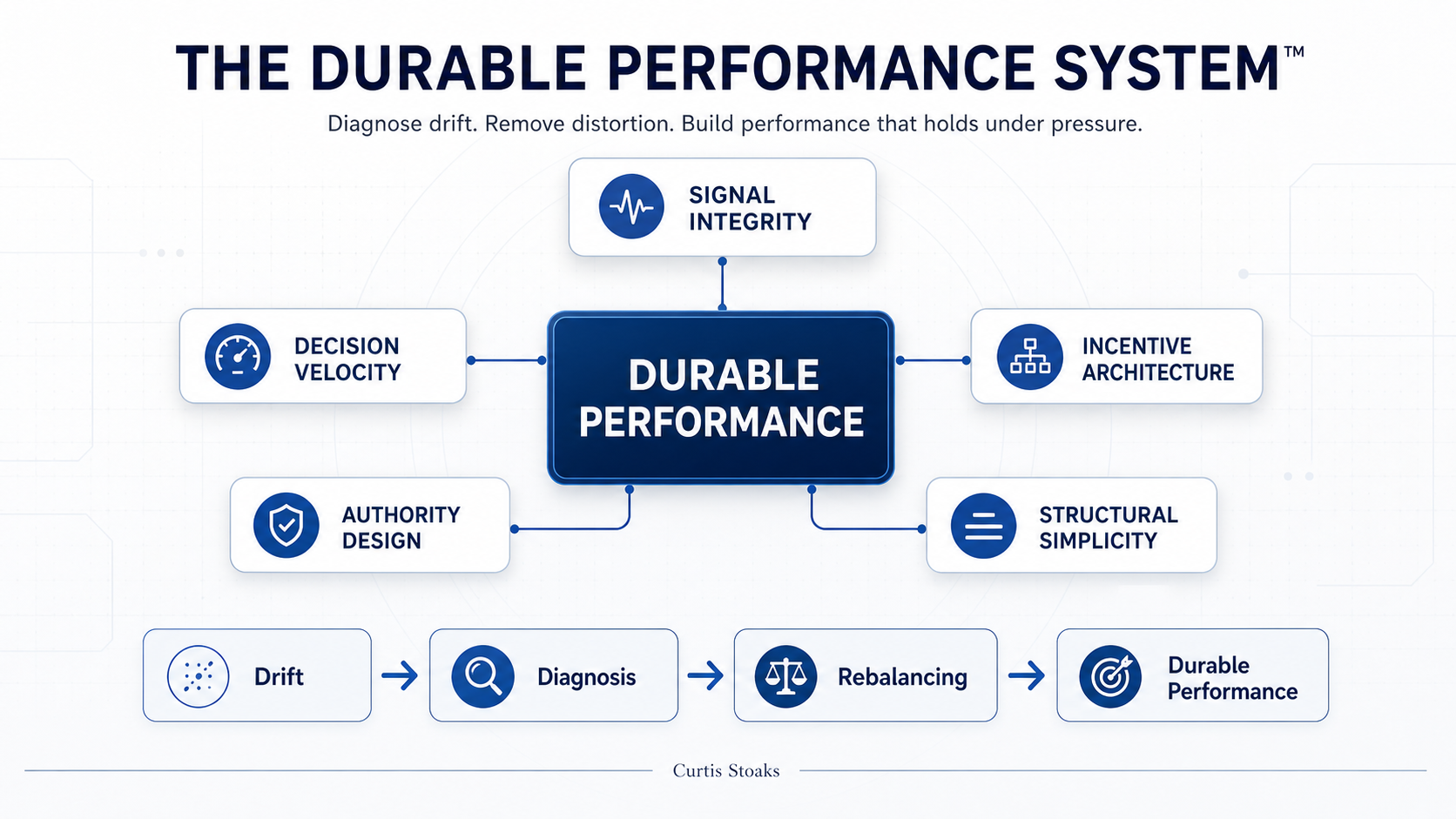
See how the system fits together
Recurring performance problems are usually structural rather than personal. This overview introduces the forces that shape organizational behavior and determine whether performance holds under pressure.
Prefer to read? Continue below for the core concepts, structural sequence, operating forces, books, and diagnostic pathways.
Begin with how the organization is arranged—or what that arrangement produces.
Organizational design and organizational effectiveness provide two familiar ways to enter the broader doctrine without replacing the specialized language of The Durable Performance System™.
Organizational Design
Organizational design is the deliberate arrangement of structure, work, decision rights, incentives, information flow, accountability, coordination, and operating mechanisms.
It determines how the organization actually works—not only how its reporting relationships appear on a chart.
Organizational Effectiveness
Organizational effectiveness is the ability to consistently produce the outcomes the organization exists to deliver while preserving the capability, trust, clarity, and adaptability required to continue performing.
It reveals whether the current design creates durable performance or depends on hidden compensation, rescue, and increasing structural load.
What The Durable Performance System™ helps leaders see
The system gives leaders language for patterns they often feel before they can name: weak organizational design, declining effectiveness, slow decisions, approval drag, accountability theater, initiative overload, filtered truth, structural complexity, and organizational drift.
Organizational Design
The deliberate arrangement of structure, work, authority, incentives, information, accountability, and coordination.
Read more →Organizational Effectiveness
The ability to produce the right outcomes while preserving the capability and adaptability required for performance to continue.
Read more →Performance Is Structural
The principle that repeated outcomes are shaped by the system around people, not effort alone.
Read more →Organizational Drift
The quiet erosion of performance discipline as standards soften, authority moves, and exceptions accumulate.
Read more →Organizational Entropy
The accumulated complexity, exceptions, approvals, weak standards, and delayed correction that make the system harder to operate.
Read more →Leadership Systems
How leaders shape behavior through authority, incentives, communication, accountability, intervention, and consequence.
Read more →Authority Design
The discipline of clarifying who decides, who approves, who gives input, and when escalation is justified.
Read more →Decision Velocity
The speed and quality with which an organization makes, owns, and executes decisions.
Read more →Approval Drag
The slowdown created when routine decisions require excessive visibility, alignment, or permission.
Read more →Execution Drag
The structural friction that slows work when priorities, meetings, approvals, reporting, handoffs, and ownership blur accumulate.
Read more →Signal Integrity
The ability of reality to reach decision-makers without filtration, narrative protection, or performance theater.
Read more →Incentive Architecture
The system of rewards, protections, consequences, and signals that teaches people what behavior actually matters.
Read more →Accountability Design
The discipline of aligning ownership, authority, standards, follow-up, and consequence so expectations hold under pressure.
Read more →Structural Simplicity
The deliberate removal of complexity that consumes attention, slows action, and hides what matters.
Read more →Organizations rarely weaken all at once.
Most organizations do not decay because people stop caring. They decay because reasonable decisions accumulate under pressure and slowly change the structure.
More visibility gets added after a miss. More approvals appear after a mistake. Exceptions remain after the moment that justified them passes. Leaders absorb authority during uncertainty and do not intentionally return it.
Those changes alter organizational design and eventually reduce organizational effectiveness .
The Durable Performance System™ gives leaders a way to see those shifts early enough to interrupt them.
The breakdown follows a predictable sequence
- 1 Pressure appears. A miss, escalation, market shift, growth stage, or leadership concern creates uncertainty.
- 2 Protection gets added. Leaders add approvals, reporting, meetings, exceptions, or oversight to stabilize the moment.
- 3 The addition survives. Temporary controls remain after the pressure passes because removal feels risky.
- 4 Behavior adapts. People learn to wait, escalate, package truth, protect themselves, and optimize for what is actually rewarded.
- 5 Performance becomes fragile. The organization still looks active, but authority, signal, accountability, capability, and speed have weakened.
The five structural forces
Durable performance depends on alignment across five forces. When they reinforce the same operating reality, performance becomes more durable. When they drift apart, distortion compounds.
Organizational design determines how these forces are arranged. Organizational effectiveness reveals what that arrangement produces.
Incentives
What the system rewards determines direction.
Read more →Authority
Where decision power sits determines capability and ownership.
Read more →Information Flow
What reaches leadership, when it arrives, and how filtered it becomes determines correction.
Read more →Accountability
What the system consistently enforces determines expectation.
Read more →Consequence
What happens after standards are met, missed, protected, or ignored determines trust.
Questions that reveal structural data
If these questions produce immediate examples, the organization already has structural data. The next move is diagnosis before addition.
Enter the system through the problem you can already see.
The five primary books do not require a fixed reading order. Each title isolates a different layer of structural performance while reinforcing the same doctrine.
10 Stupid Things Corporations Do
Failure-Pattern Awareness
Recognize the behaviors organizations tolerate before decline becomes undeniable.
What Smart Companies Stop Doing
Disciplined Subtraction
Identify and remove behaviors that appear productive while increasing structural load.
Why Organizations Drift
Drift Mechanics
Understand how enforcement weakens and reasonable accommodations become structural decay.
The Architecture of Durable Performance
Structural Architecture
See how incentives, authority, information flow, accountability, and consequence determine what endures.
The Durable Performance Field Guide
Applied Correction
Use diagnostics, scoring, worksheets, reset actions, and recurring maintenance to correct structural distortion.
What Smart Leaders Stop Doing
Apply the doctrine to leadership behaviors that centralize decisions, distort signal, weaken standards, and make the organization more dependent on the leader.
What Smart Employees Stop Doing
Apply the doctrine to career judgment, visibility, leverage, trust, reputation, and advancement inside imperfect organizational systems.
Choose the pathway that matches the need.
Move from diagnosis to deeper doctrine to recurring insight without losing the main thread.
Take the Drift Diagnostic
Identify structural drag, authority drift, signal distortion, and weak ownership.
Start the Diagnostic →Examine Organizational Design
Understand how structure, decision rights, incentives, information, accountability, and coordination are arranged.
Explore Organizational Design →Evaluate Organizational Effectiveness
Examine whether the current system produces durable results or depends on rescue, overload, and hidden structural cost.
Explore Organizational Effectiveness →Read the Books
Go deeper into organizational drift, performance architecture, disciplined subtraction, leadership, and execution.
Explore the Books →Use the Resources
Access practical tools, previews, diagnostic assets, and doctrine resources.
View Resources →Read the Brief
Follow concise structural essays on authority, incentives, accountability, consequence, leadership, and execution.
Read the Brief →Browse the Archive
Use the archive as a growing library of structural performance essays.
Browse the Archive →Stay close to the doctrine through recurring essays.
Read the current edition on CurtisStoaks.com, browse the complete archive, or subscribe through the official LinkedIn newsletter.
See the doctrine in applied form.
The Curtis Stoaks YouTube channel extends the system into shorter explanations, structural diagnostics, and long-form leadership education.
Durable performance is engineered before pressure arrives.
The earlier leaders can diagnose drift, improve organizational design, remove distortion, clarify authority, protect signal, and reduce structural load, the easier it becomes to build organizational effectiveness that does not depend on constant rescue.