What Is Organizational Design?
Organizational design is the deliberate arrangement of structure, decision rights, incentives, information flow, accountability, and operating mechanisms so an organization can execute its strategy without unnecessary friction.
Organizational design determines how the organization actually operates.
Organizational design is the work of arranging roles, responsibilities, authority, information, incentives, coordination, accountability, and operating processes so they reinforce the outcomes the organization is trying to produce.
It does not stop at reporting lines. It examines the full operating environment people experience when they decide, coordinate, escalate, measure performance, resolve conflict, and respond to pressure.
The quality of that arrangement becomes visible through organizational effectiveness : the system’s ability to produce intended outcomes without excessive delay, friction, supervision, rework, or dependence.
Design is the arrangement that makes certain behavior easier, safer, and more likely.
If decisions repeatedly rise upward, information becomes filtered, accountability remains vague, or work slows beneath growing coordination, the organization is already experiencing the consequences of its design. Those outcomes are not separate from the architecture. They are evidence of it.
Design determines the arrangement. Effectiveness reveals the result.
Organizational design and organizational effectiveness describe two connected parts of the same operating system.
Organizational Design
Organizational design determines how work, roles, authority, information, incentives, accountability, standards, coordination, and consequence are arranged.
It establishes the operating conditions within which people make decisions, interpret priorities, manage risk, and carry responsibility.
Organizational Effectiveness
Organizational effectiveness reveals whether that arrangement consistently produces intended outcomes while preserving usable capacity, adaptability, decision quality, ownership, trust, and long-term performance.
A design may look orderly on paper while producing excessive escalation, slow decisions, filtered information, overloaded leaders, or dependence on high performers.
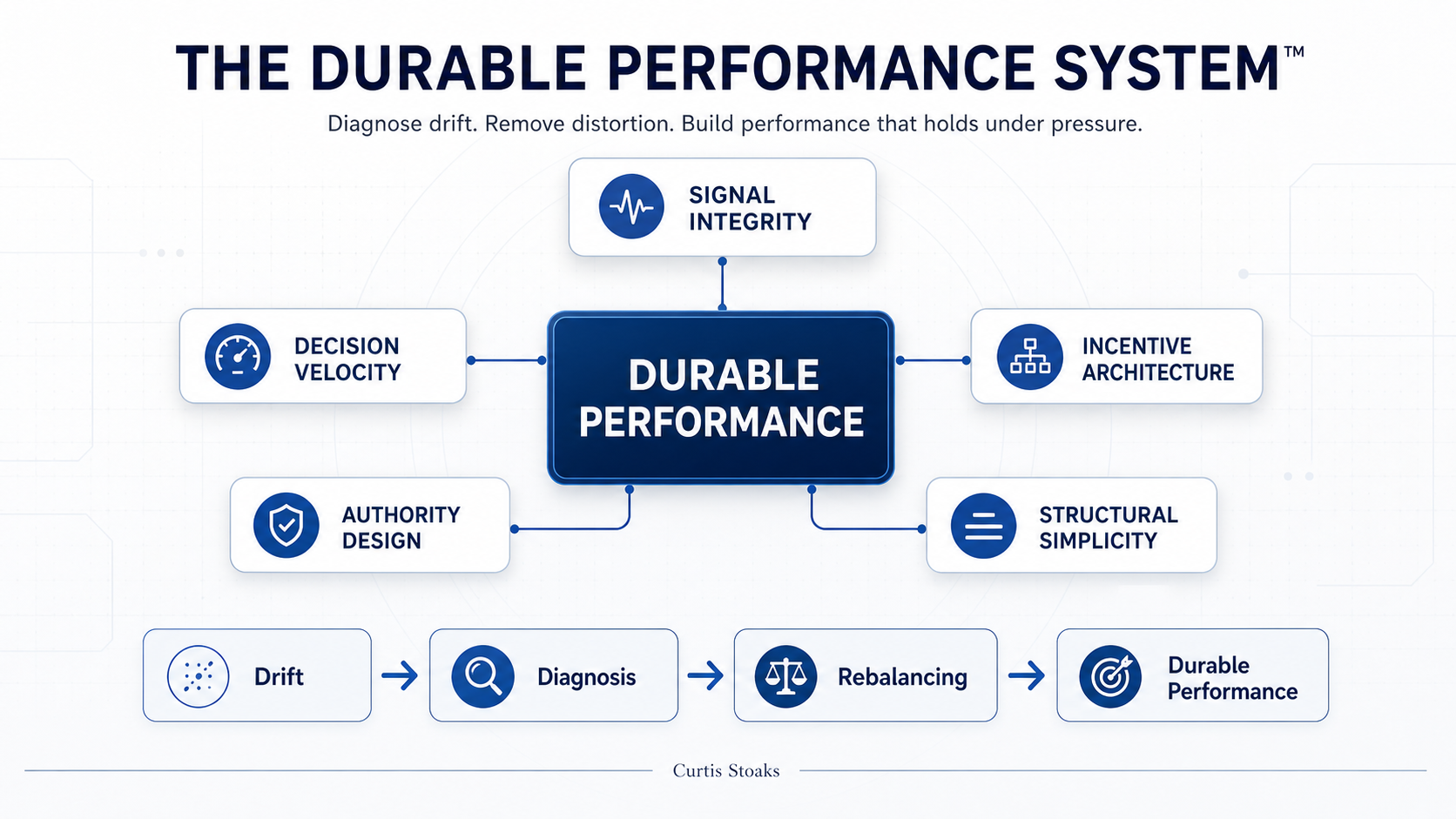
The Durable Performance System™ explains why the relationship matters.
Organizational design determines how the system is arranged. Organizational effectiveness reveals what that arrangement produces. The Durable Performance System™ explains how authority, incentives, information, accountability, consequence, execution, and entropy shape the result.
Structure is visible. Design is experienced.
A chart may show reporting relationships, but it does not fully explain how the organization makes decisions, moves information, distributes risk, rewards behavior, or corrects failure.
Formal Structure
Roles, reporting lines, departments, spans of control, management layers, and official areas of responsibility.
Operating Architecture
Decision rights, approval paths, handoffs, escalation thresholds, meeting structures, workflows, and coordination mechanisms.
Behavioral Architecture
Incentives, performance measures, promotion logic, tolerated exceptions, accountability, protection, and consequence.
What organizational design must align
Durable design requires the major operating elements to reinforce one another. Strength in one area cannot permanently compensate for contradiction elsewhere.
Work and Structure
How work is divided, grouped, sequenced, coordinated, and connected across functions, teams, markets, products, and levels.
Authority and Decision Rights
Who can decide, what they can decide, where approval is required, and which conditions legitimately justify escalation.
Explore authority design →Information Flow
How operating reality travels, who receives it, where it gets compressed, and whether decision-makers receive truth or reassurance.
Explore signal integrity →Incentives and Measures
What the organization rewards, protects, promotes, measures, and quietly teaches people to prioritize.
Explore incentive architecture →Accountability and Consequence
Whether ownership, authority, standards, follow-up, correction, and consequence remain connected and predictable.
Explore accountability design →Simplicity and Coordination
Whether the organization removes unnecessary layers, meetings, approvals, reports, controls, and inherited work as conditions change.
Explore structural simplicity →Begin with outcomes, not boxes.
- 1 Define the outcomes that must be produced. Clarify what the organization must accomplish, protect, and sustain before rearranging roles or reporting lines.
- 2 Examine the work and its interdependencies. Identify where work must remain close, where specialization matters, and where coordination is creating unnecessary load.
- 3 Place decision rights deliberately. Match authority with information, capability, responsibility, reversibility, and the real shape of risk.
- 4 Align information and incentives. Make sure people can see what they need and are rewarded for the outcomes the organization actually values.
- 5 Connect accountability to legitimate authority. Do not assign ownership while withholding the discretion, resources, access, or backing required to carry it.
- 6 Remove what no longer earns the right to remain. Retire obsolete approvals, reports, meetings, roles, safeguards, and inherited commitments before adding more structure.
- 7 Evaluate the effect of the arrangement. Test whether the design improves decisions, ownership, signal, capacity, adaptability, and the organization’s ability to sustain results.
Redesign when recurring friction has become structural.
Organizational redesign is often associated with mergers, restructures, leadership changes, new technology, rapid growth, or a major strategy shift.
Those are valid triggers, but redesign is also necessary when the current arrangement repeatedly produces delay, overload, dependency, filtered information, conflicting incentives, or accountability without authority.
The strongest signals include:
- ✓ Routine decisions repeatedly rise to senior leaders.
- ✓ Teams spend more time coordinating than completing.
- ✓ Multiple people can influence a decision but no one clearly owns it.
- ✓ Reporting volume increases while decision quality remains flat.
- ✓ High performers compensate for weaknesses the system never corrects.
- ✓ The organization adds controls faster than it removes friction.
- ✓ Results depend increasingly on leadership intervention or personal heroics.
Good design improves the organization’s ability to perform.
The purpose of design is not structural neatness. It is an operating system capable of producing results with clarity, speed, ownership, adaptability, and sustainable use of capacity.
Clearer Decisions
People understand who can decide, which guardrails apply, and when escalation is genuinely required.
Stronger Ownership
Responsibility is matched with sufficient authority, information, resources, and consequence.
Better Signal
Operating reality reaches the people responsible for decisions without excessive filtering, delay, or narrative protection.
Lower Execution Drag
Work moves with fewer unnecessary handoffs, approvals, meetings, reports, and coordination burdens.
Greater Adaptability
The organization can respond to changing conditions without centralizing every decision or abandoning standards.
More Durable Results
Performance depends less on individual heroics, constant supervision, or senior intervention.
Weak organizational design often looks responsible at first.
Most design failures begin as rational responses to pressure. Their cost becomes visible only after temporary protection hardens into the permanent operating system.
Structure Without Decision Clarity
Roles appear clear on paper, but routine decisions still require informal permission or senior intervention.
Ownership Without Authority
People are held responsible for outcomes while approval, resources, information, or corrective power remain elsewhere.
Coordination Without Consequence
Meetings, updates, and cross-functional discussion expand, but no single person must resolve the issue or carry the outcome.
Visibility Without Signal
Leadership receives more dashboards, reports, and polished updates while operating reality becomes increasingly filtered.
Growth Without Subtraction
New priorities, teams, controls, and processes accumulate without retiring the commitments created for earlier conditions.
Values Without Reinforcement
The organization communicates one standard while promotions, incentives, exceptions, and consequence teach another.
Design should make durable performance more likely.
The Durable Performance System™ examines organizational design through the structural conditions that shape judgment, ownership, truth, execution, trust, and the ability to correct before distortion compounds.
Decision Velocity
Determine whether decisions move at the speed and level their risk actually requires.
Explore decision velocity →Approval Drag
Identify approval layers that create delay, dependency, and precautionary escalation without improving judgment.
Explore approval drag →Execution Drag
Examine how overload, handoffs, coordination, ambiguity, and accumulated work weaken completion.
Explore execution drag →Leadership Systems
See how leadership behavior becomes structural through repeated operating routines, intervention, protection, and consequence.
Explore leadership systems →Organizational Drift
Understand how apparently reasonable accommodations gradually alter authority, standards, incentives, and execution.
Explore organizational drift →Organizational Entropy
Examine the accumulated complexity, tolerance, friction, and misalignment that weaken performance over time.
Explore organizational entropy →Questions that expose the current design
Related terms are not interchangeable.
Organizational structure
The formal arrangement of roles, teams, departments, reporting relationships, hierarchy, and spans of control.
Organizational design
The broader arrangement of structure, work, decision rights, incentives, information, accountability, coordination, and operating mechanisms.
Organizational development
The ongoing work of improving capability, behavior, leadership, collaboration, adaptation, and the way the organization functions over time.
Organizational effectiveness
The degree to which the total system consistently produces the outcomes it exists to deliver and remains capable of adapting without destroying long-term performance.
Explore organizational effectiveness →Move from definition into diagnosis and application.
Organizational design becomes useful when leaders can connect visible friction to the arrangement producing it and make a deliberate correction.
Organizational Effectiveness
Evaluate what the current arrangement produces across decision quality, ownership, capacity, adaptability, trust, and durable results.
Examine the result →The Durable Performance System™
See how authority, incentives, information flow, accountability, consequence, execution, design, effectiveness, and entropy fit together.
See the complete system →The Architecture of Durable Performance
Read the integrated structural framework behind authority, incentives, information flow, accountability, consequence, and durable performance.
Explore the architecture →Drift Diagnostic
Identify where authority, signal, accountability, complexity, and execution are already beginning to move.
Take the diagnostic →The Durable Performance Field Guide
Use applied diagnostics, scoring models, reset actions, stop lists, and structural-maintenance tools.
Explore the Field Guide →The Durable Performance Brief
Read shorter essays on authority, incentives, accountability, execution, leadership systems, organizational drift, and design.
Browse the Brief Archive →Do not redesign the chart while preserving the system that created the problem.
Begin by identifying where authority, information, incentives, accountability, and coordination are producing outcomes the organization no longer wants to tolerate. Then evaluate whether the corrected arrangement improves organizational effectiveness.