What Is Signal Integrity?
Signal integrity is the organization’s ability to move accurate operating reality to the people who can act on it before filtering, delay, narrative protection, or reporting noise weaken the truth.
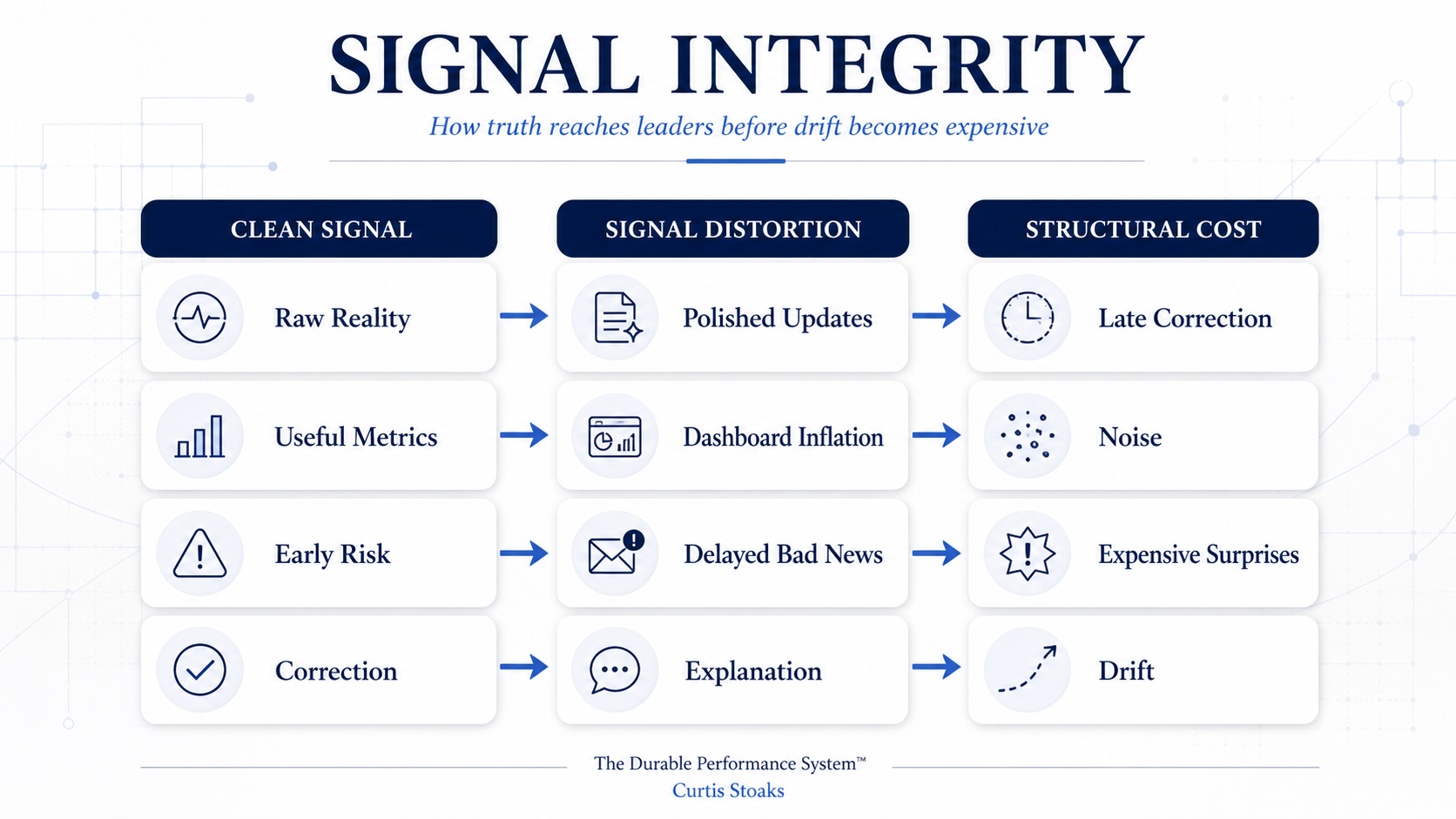
Signal integrity is the system’s ability to transmit reality.
It determines whether the right people receive accurate, timely, decision-relevant information before distortion, delay, hierarchy, or self-protection change its meaning.
Strong signal integrity allows early correction. Weak signal integrity allows avoidable problems to grow behind polished reporting.
Signal is not the same as data volume.
Reporting frequency, dashboard count, meeting cadence, and system visibility do not prove that leaders understand operating reality.
Useful signal changes a decision.
Information that creates awareness but does not improve judgment, trigger correction, or reveal risk may be visibility without signal.
Six patterns that distort operating reality.
Weak signal often appears professional. Information becomes cleaner, safer, and more polished as it moves farther from the work.
Information Compresses Through Layers
Nuance, uncertainty, disagreement, and frontline context disappear as updates move upward through summaries.
Bad News Is Softened or Delayed
Risks are reframed, contextualized, or held until they are easier to defend or impossible to ignore.
Metrics Replace Operating Truth
Leaders rely on measures that describe activity while missing context that explains quality, risk, and actual progress.
Updates Are Shaped for Approval
Teams package information to move through review paths rather than surface the cleanest version of reality.
Polished Narratives Replace Direct Evidence
Confidence, presentation quality, and explanation make weak conditions appear more controlled than they are.
Unsafe Truths Stop Traveling
Employees learn which facts create blame, reentry, scrutiny, or political cost and begin withholding them.
Weak signal integrity appears before leaders lose control.
The reporting system may look sophisticated while corrective capacity is already weakening.
Dashboards Multiply
Reporting volume increases, but recurring decisions and operating problems do not improve.
Variance Gets Explained
The organization becomes more skilled at contextualizing misses than correcting the condition beneath them.
Updates Get Polished
Information becomes safer, cleaner, and less direct before reaching decision-makers.
Meetings Replace Correction
More time is spent discussing the issue than naming what must change, who owns it, and by when.
Bad News Arrives Late
Risks become visible only after they are expensive, external, or politically unavoidable.
Artifacts Become Performance
Teams optimize the update, deck, dashboard, or status narrative instead of the operating outcome.
Visibility can feel like control.
More updates, metrics, and status detail can make leaders feel closer to the work. But proximity to artifacts is not the same as proximity to reality.
When teams learn that leadership rewards confidence, composure, and clean narratives, they respond rationally. They package truth, explain variance, and delay raw signals until those signals are easier to defend.
The system appears more controlled while becoming less correctable.
The pattern is predictable.
- 1 Uncertainty rises. A miss, delay, customer issue, or leadership concern creates demand for more visibility.
- 2 Reporting expands. More dashboards, updates, meetings, and review artifacts are added.
- 3 Narrative improves. Teams learn to explain the work more cleanly before correcting the condition.
- 4 Reality arrives later. Bad news travels carefully and reaches decision-makers after risk has grown.
- 5 Correction weakens. Leaders feel informed while the system keeps reproducing the same distortion.
Distorted information weakens the wider operating system.
Signal integrity affects the quality and timing of decisions, the credibility of accountability, the detection of risk, and the organization’s ability to correct before rework and drift compound.
Decision Quality
Leaders make reasonable decisions from incomplete, delayed, or overly protected versions of reality.
Decision Velocity
Slow, filtered, or conflicting information delays judgment and increases the need for additional review.
Explore decision velocity →Accountability
Standards and consequences become unreliable when leaders cannot see what happened, when it happened, or why.
Explore accountability design →Risk Detection
Problems remain local and manageable until delayed signal allows them to become systemic, external, or expensive.
Rework and Execution Drag
Late truth forces teams to revisit decisions, redo completed work, and absorb avoidable coordination cost.
Explore execution drag →Organizational Drift
Weak conditions become easier to explain, defend, and normalize when the full pattern is not visible.
Explore organizational drift →Signal quality is shaped by authority, incentives, and leadership response.
Authority Design
Decision owners need direct access to the truth and enough authority to act on it without routing every signal upward for protection.
Explore authority design →Incentive Architecture
If confidence, polish, optimism, or protection receive more reward than candor, the signal will be filtered.
Explore incentive architecture →Leadership Systems
Leaders determine whether bad news produces learning and correction—or blame, reentry, defensiveness, and silence.
Explore leadership systems →Questions that reveal weak signal integrity.
If these questions produce immediate examples, the organization does not need more reporting first. It needs cleaner signal.
Design reporting around decisions, not reassurance.
Identify which information changes which decision. Shorten the path between the work and the decision owner. Remove artifacts that do not trigger action. Protect early bad news. Separate explanation from correction. Review how leaders respond when reality contradicts expectation.
The goal is not radical transparency without judgment. It is accurate, timely, usable truth reaching the people responsible for action.
Examine what the system rewards people for reporting.
Signal quality will not improve if the organization continues rewarding confidence, protection, polish, or optimism more than candor and correction.
About signal integrity.
Is signal integrity the same as transparency?
Can an organization have too much reporting and still have weak signal?
What is the clearest sign of weak signal integrity?
How do incentives affect signal integrity?
How should leaders improve signal integrity?
Truth must travel before performance can correct.
The earlier leaders separate usable signal from reporting noise, narrative protection, delayed bad news, and visibility theater, the easier it becomes to improve decisions and interrupt drift before it hardens into structure.