Edition 12 | June 10, 2026
Many leaders think ambiguity keeps options open.
What it often keeps open is exposure.
That is the mistake.
Ambiguity can sound sophisticated. It can feel flexible, empowering, and strategically mature. But when leaders stay vague about ownership, standards, tradeoffs, or escalation thresholds, the system does not experience elegant nuance. It experiences interpretive burden. People closest to the work are forced to decode what leadership “really means,” what matters most right now, and what standard may later be applied after the fact. That is not clarity under complexity. It is uncertainty with organizational consequences.
The Core Thesis
Ambiguity is not neutral.
It is a structural choice.
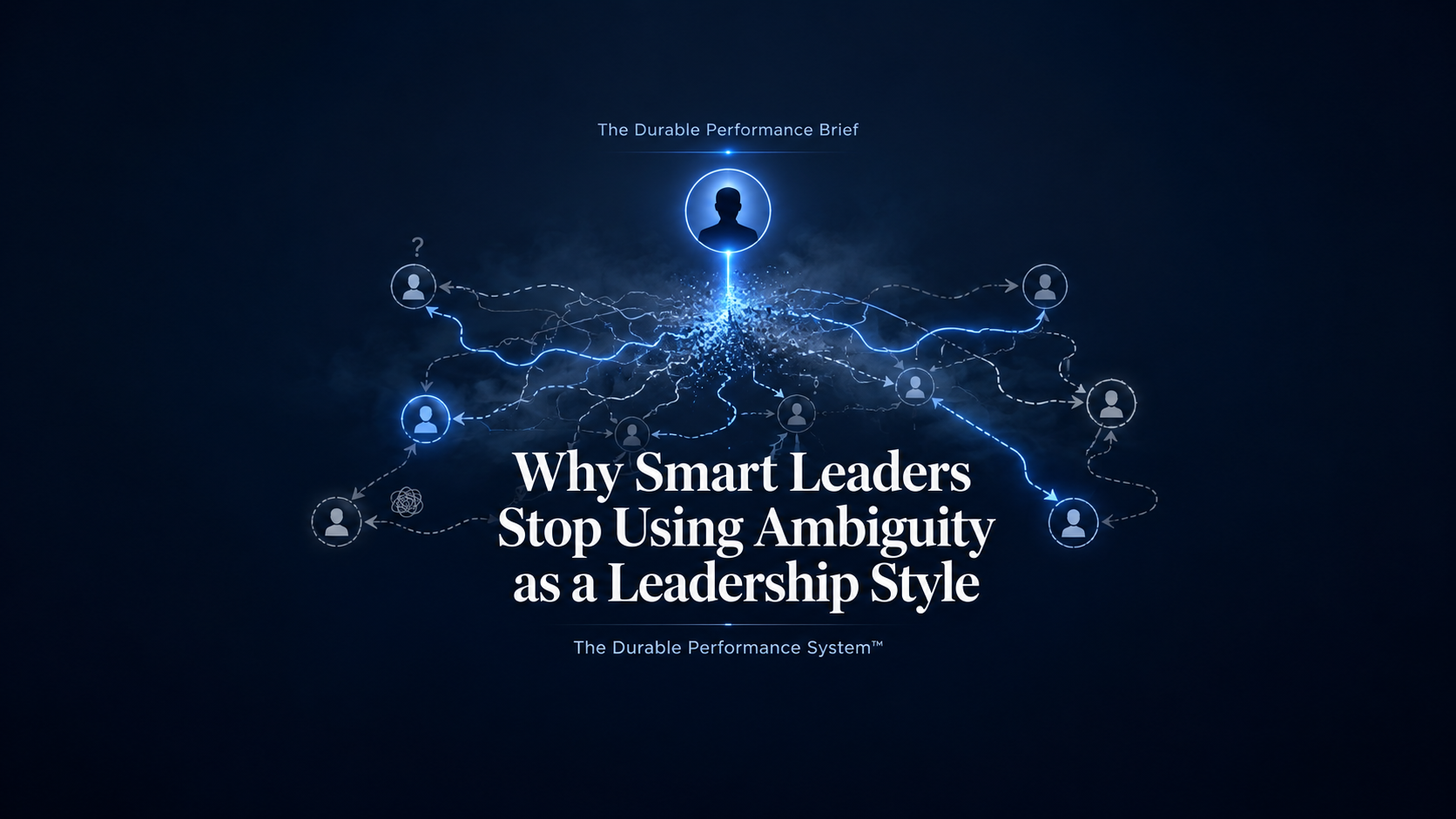
When leaders are unclear, the missing clarity does not disappear. It gets redistributed downward into the organization. Managers absorb it first. They have to translate broad executive language into actual direction, reconcile unstated priorities, and enforce work against standards that were never fully named. Teams then adapt around that uncertainty by over-consulting, escalating early, triangulating informally, and staying closer to power than to principle. When formal clarity is weak, people build “black-market clarity” through side conversations, pre-meetings, and unwritten rules.
That is why ambiguous leadership does not create freedom.
It creates alternate systems of meaning.
And alternate systems of meaning rarely favor trust. They favor politics, interpretation, and self-protection. People start asking: What counts here, really? What did they mean? What will they say they meant later? That interpretive fear is one of the clearest signs that leadership language has become atmospheric instead of operational.
This is also why ambiguity and selective accountability are closely linked.
If expectations stay broad enough, almost any outcome can be criticized later. If priorities stay fluid enough, leadership can always reinterpret what mattered most. If standards stay soft enough, almost anyone can be described as misaligned when politically useful. That is not mature flexibility. It is optionality purchased at the expense of clarity.
What This Looks Like in the Wild
A senior leader tells a cross-functional group to move faster, stay coordinated, use judgment, and keep leadership close because the work has visibility.
Everyone nods.
Almost nothing is clear.
Who owns the tradeoff? What decisions remain local? What requires escalation? What does “close” mean? What standard cannot be crossed? What would count as failure here?
Now the teams must infer.
One group escalates too early. Another moves and gets reopened later. A manager tries to enforce a standard that was never fully named. Leadership becomes frustrated that the teams are “not aligned.” But the problem is often not alignment failure. It is leadership ambiguity.
You can usually spot this pattern before any KPI fully breaks.
Managers become rigid, political, or timid. Decision quality drops because ownership, standards, and consequences all blur. Teams spend more time testing what leadership really means than acting decisively inside clear guardrails. The result is a system that is constantly active but less decisive, thoughtful but less aligned, careful but less accountable. What often gets called complexity is sometimes just the downstream effect of unclear leadership.
Why Leaders Misread It
Because vague language often sounds polished.
It feels emotionally safer to say something broad, balanced, and atmospherically intelligent than to say the operationally real thing. Ambiguity also preserves personal optionality. It postpones visible choice when stakeholders want different things. It reduces the discomfort of naming a hard boundary too early. These motives are human. None of them eliminate the structural cost.
Leaders also confuse ambiguity with empowerment.
They say: I do not want to micromanage. I want people to think. I want the team to use judgment.
Those instincts can be healthy.
But empowerment without clarity is abandonment dressed up in modern leadership language. Real empowerment requires boundaries: who decides, what matters most, what tradeoffs govern, what standards are non-negotiable, what threshold requires escalation, and what outcome would count as failure here. Without those anchors, “use your judgment” becomes stressful and political because the person acting knows the decision may later be interpreted against a standard that was never fully named.
One Practical Diagnostic
Ask this in your next leadership meeting:
Could a reasonable person act decisively from what we actually said?
Then press harder:
- Could a manager enforce from it?
- Could ownership be protected through it?
- Could someone later be held accountable without leadership having to reinterpret what was supposedly meant?
- Where are teams currently inferring guardrails that leadership never made explicit?
- What side conversations exist mainly to create clarity the formal system did not provide?
That diagnostic matters because if people cannot operate, enforce, and act from what was said, the language is not leadership. It is atmospherics.
If You Change One Thing This Week
Take one currently vague instruction and replace it with five explicit elements:
- Owner — who decides
- Boundary — what standard still holds
- Threshold — what actually requires escalation
- Time horizon — when this guidance will be reassessed
- Failure line — what outcome is unacceptable even under uncertainty
Do not aim for total certainty.
Aim for usable clarity.
Strong leaders do not eliminate nuance. They pair nuance with enough clarity that the system can move without political guesswork.
Go Deeper
This issue builds on ideas from What Smart Leaders Stop Doing, part of The Durable Performance System™ series.
Related read: What Smart Leaders Stop Doing — a structural guide to the leadership behaviors that quietly create interpretive fear, political navigation, and selective accountability by leaving too much unsaid.
Closing Thought
People can handle difficult clarity better than prolonged fog.
They can work inside a hard line, a clear owner, a real standard, and a visible consequence.
What weakens organizations is not always hard truth.
Often it is the leader’s preference for optionality over legibility.
Because once people must decode leadership like weather, politics starts replacing trust.
Question for readers: Where in your organization are people working hardest to infer what leadership meant instead of acting on what leadership clearly said?
Next Wednesday: Why smart leaders stop protecting people from consequences.
Part of The Durable Performance System™ Books, field guides, and frameworks on power, incentives, authority, accountability, and execution. Published every Wednesday morning.