See where structural drag is building.
The Drift Diagnostic helps leaders recognize early structural signals that performance is weakening beneath apparently stable results. It connects what is changing in organizational design with what those changes are beginning to produce in organizational effectiveness.
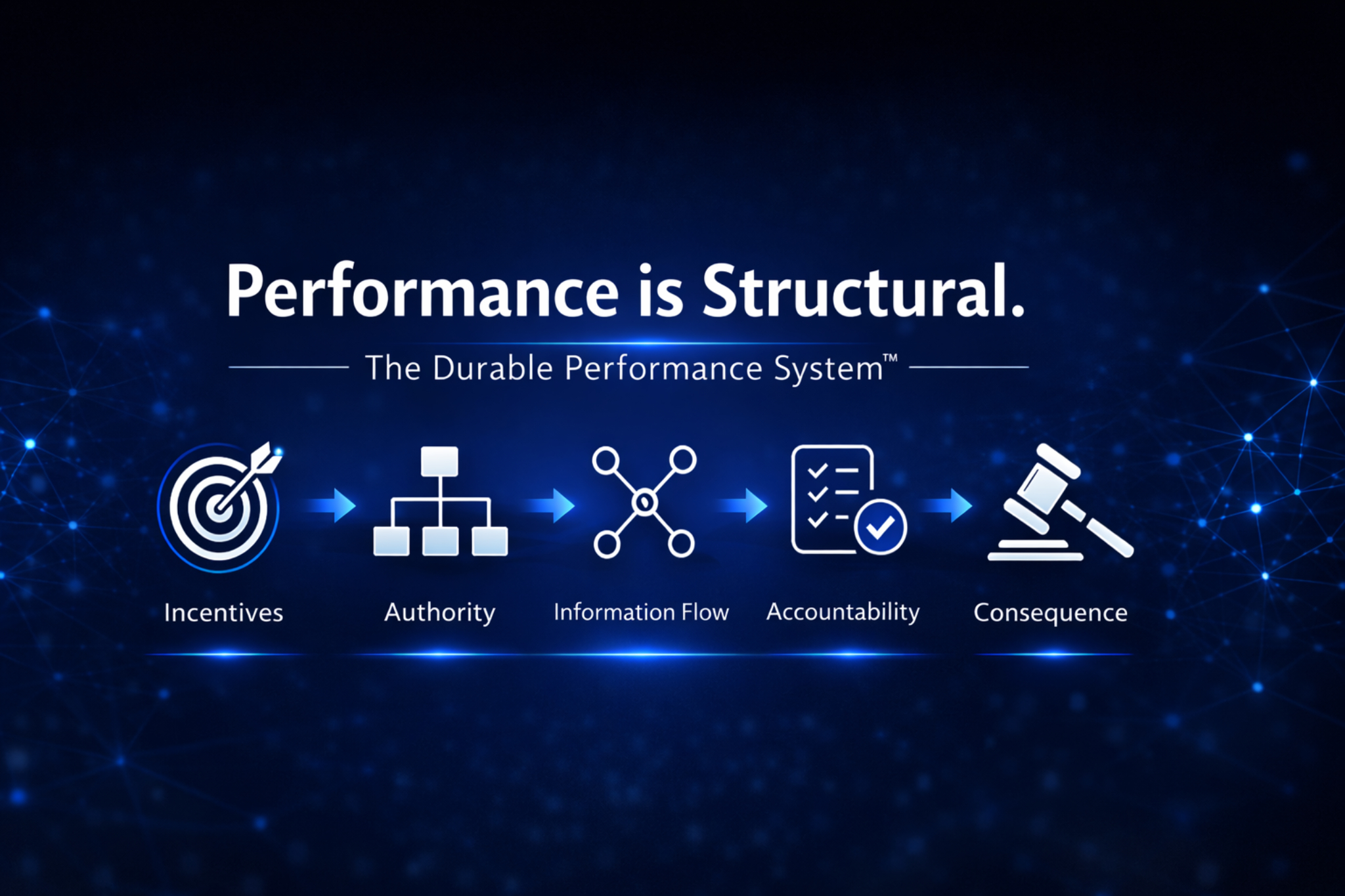
Examine how the system is arranged and what that arrangement produces.
The diagnostic is designed to help leaders move from general concern to a more specific structural reading of the organization.
Organizational Design
Organizational design includes how authority, information, incentives, accountability, priorities, coordination, standards, handoffs, and operating mechanisms are arranged.
The diagnostic helps identify where those arrangements may be drifting, accumulating friction, or producing behavior leaders did not intend.
Organizational Effectiveness
Organizational effectiveness reveals whether the system converts effort, information, decisions, authority, and resources into intended outcomes without excessive friction or dependence.
The diagnostic helps surface early evidence that decision quality, ownership, trust, adaptability, throughput, or correction capacity may already be weakening.
Recognize the signals before they become normal.
Use the diagnostic when the organization feels heavier, slower, less trustworthy, or more dependent than it should, but the pattern still lacks clean language.
Design Distortion
See where temporary workarounds, added controls, unclear roles, or accumulated processes are changing how the organization operates.
Explore organizational design →Effectiveness Decline
Identify where more effort, supervision, coordination, or recovery is required to produce the same or weaker result.
Explore organizational effectiveness →Authority Drift
See where decision rights are rising upward, ownership is narrowing, and escalation is becoming routine.
Explore authority design →Incentive Misalignment
Identify what the system is rewarding, protecting, promoting, or tolerating that may conflict with stated priorities.
Explore incentive architecture →Signal Distortion
Spot where reporting volume is increasing while clarity, speed, candor, and correction are becoming weaker.
Explore signal integrity →Accountability Distortion
Examine where responsibility, authority, standards, measurement, correction, and consequence no longer remain aligned.
Explore accountability design →Execution Friction
Identify drag that is being created, absorbed, and normalized until slower execution begins to feel ordinary.
Explore execution drag →Organizational Drift
Recognize where repeated tolerance, delayed correction, softened standards, or lingering exceptions are changing the operating norm.
Explore organizational drift →Turn vague concern into structural data.
Leaders often feel that something is weakening before they can name it precisely. The diagnostic helps separate visible symptoms from the structural patterns beneath them.
That matters because vague frustration rarely produces disciplined correction. Clear diagnosis can.
The goal is not to label the organization as healthy or unhealthy. It is to identify where closer examination is warranted before the pattern becomes harder to reverse.
Built for people carrying operating responsibility.
Use it if you lead a team, own outcomes, manage across functions, or need to understand why performance is becoming harder to sustain even while effort remains high.
It is especially useful when the issue feels broader than one person, one department, one quarter, or one isolated process.
It can also support a leadership discussion by giving the group a shared language for patterns that may otherwise be explained as motivation, culture, communication, or personality.
Use the diagnostic with candor.
Treat it as the start of a clearer reading process, not as a score to defend or a verdict to announce.
Answer for Current Reality
Read each section for what is happening now, not what leadership intends, has announced, or hopes is happening.
Look for Repetition
Give greater weight to patterns that recur across people, teams, periods, initiatives, or leadership changes.
Separate Symptom From Structure
Ask whether the visible issue is an isolated event or evidence of a condition the system continues to reproduce.
Mark the Strongest Signals
Pay attention to recurring exceptions, slow decisions, filtered truth, uneven accountability, incentive conflicts, and expanding drag.
Discuss the Pattern
Use the results to guide a leadership conversation about the arrangement producing the strain—not only the people experiencing it.
Choose the Next Step
Use the strongest signals to select a concept page, book, Field Guide exercise, or structural correction path.
Read the organization as a system.
These questions help distinguish temporary pressure from a structural pattern that may already be changing performance.
Immediate examples do not prove a single cause. They identify where disciplined structural diagnosis should begin.
Structural ideas behind the diagnostic.
These pages explain the language used throughout the diagnostic and provide logical next steps after a pattern becomes visible.
Organizational Design
How authority, information, incentives, accountability, priorities, roles, coordination, and operating mechanisms are arranged.
Read more →Organizational Effectiveness
How the arrangement converts available effort and capability into intended, adaptable, and durable outcomes.
Read more →Organizational Drift
How standards, authority, accountability, and execution discipline erode before failure becomes obvious.
Read more →Authority Design
How decision rights, approval paths, escalation thresholds, and ownership shape execution.
Read more →Incentive Architecture
How rewards, promotion, protection, measurement, tolerance, and consequence teach behavior.
Read more →Signal Integrity
How truth reaches decision-makers without filtration, narrative protection, or performance theater.
Read more →Accountability Design
How ownership, authority, standards, measurement, correction, and consequence must remain aligned.
Read more →Execution Drag
How friction, overload, reporting, meetings, approvals, and unclear ownership slow work down.
Read more →Organizational Entropy
How accumulated complexity, tolerance, exceptions, and delayed correction weaken the system.
Read more →See how the patterns fit together.
The Durable Performance System™ connects organizational design, organizational effectiveness, authority, incentives, information flow, accountability, consequence, simplicity, and structural performance into one operating framework.
Use the system page when the diagnostic reveals several connected patterns rather than one isolated condition.
Use the Field Guide after the diagnosis.
The Durable Performance Field Guide turns structural patterns into scoring, worksheets, correction choices, guardrails, and recurring maintenance.
Use it when the diagnostic has helped identify the area of strain and the next need is disciplined examination and correction.
Use the format that fits the next question.
Continue through the books, recurring essays, or video explanations after the diagnostic helps clarify the strain.
Books
Use five primary entry points and two related works to go deeper into the structural pattern you identified.
Explore the catalog →The Durable Performance Brief
Read concise structural essays and use the archive as a growing doctrine library.
YouTube
Watch applied explanations of organizational design, authority, drift, signal, incentives, accountability, and execution drag.
Visit the channel →Request the Drift Diagnostic.
Use the form below to receive the PDF by email and begin identifying the structural patterns behind the strain.
Enter your name and email below.
Your information will be handled according to the Privacy Policy .