What Is Organizational Entropy?
Organizational entropy is the structural tendency of complex organizations to move toward misalignment over time. Unless leaders deliberately maintain the system, accumulation gradually alters organizational design, weakens organizational effectiveness, and increases performance fragility.
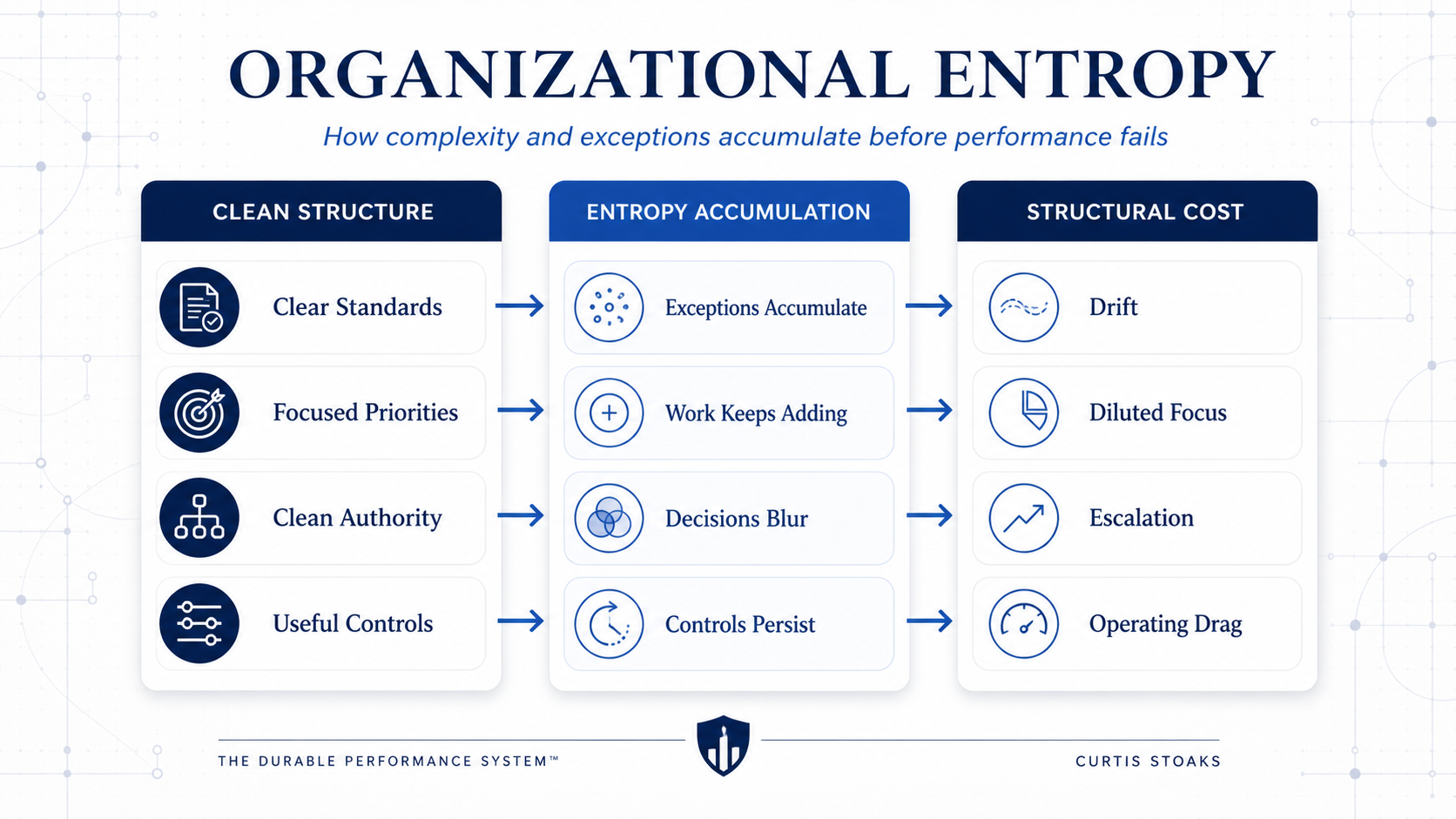
Organizational entropy is the default direction of an unmanaged system.
Complex organizations do not remain structurally aligned on their own. Authority migrates. Incentives tilt. Information narrows. Standards soften. Exceptions accumulate. Processes expand. Each change may appear reasonable, temporary, and proportionate to the moment that created it.
Over time, those changes interact. The organization becomes slower, narrower, less truthful, more dependent on the center, and less capable of correcting itself.
Entropy does not require incompetence. It requires accumulation.
Organizational entropy is the structural tendency of complex organizations to accumulate misalignment over time. Without deliberate and recurring maintenance, authority concentrates, incentives distort, consequence softens, information compresses, and performance fragility accumulates beneath visible strength.
Entropy cannot be eliminated permanently. It must be managed through correction, subtraction, redistribution, enforcement, and recurring structural review.
Entropy changes the design before it weakens the result.
Organizational entropy connects accumulated structural change with the gradual decline in the organization’s ability to perform reliably.
Organizational Design
Organizational design determines how work, authority, incentives, information, accountability, coordination, and operating mechanisms are arranged.
Entropy changes that arrangement through accumulated approvals, lingering exceptions, expanding reporting, centralized decisions, contextual standards, and processes that survive beyond their original purpose.
Organizational Effectiveness
Organizational effectiveness reveals whether the current system reliably produces intended outcomes while preserving capability, clarity, trust, adaptability, and execution.
As entropy grows, the organization consumes more oversight, coordination, attention, and personal compensation to sustain the same or weaker outcomes.
Entropy describes direction, not moral failure.
The concept explains how systems change when structural maintenance is weaker than accumulated pressure.
Organizational entropy is
- ✓ The gradual accumulation of structural misalignment.
- ✓ A predictable direction inside complex systems.
- ✓ The combined effect of many small, rational adjustments.
- ✓ A maintenance problem before it becomes a performance crisis.
- ✓ A condition that can advance while visible results remain strong.
Organizational entropy is not
- × A claim that organizations behave exactly like closed physical systems.
- × Another word for chaos, disorder, or poor morale.
- × A sudden event or isolated execution failure.
- × Evidence that leaders or employees stopped caring.
- × A prediction that decline is unavoidable or irreversible.
Organizational entropy follows identifiable structural laws.
Entropy becomes easier to diagnose when leaders stop searching for a single failure and examine the direction of the system over time.
1. Entropy is incremental
Structural deterioration advances through accumulation rather than collapse. One approval, exception, reporting requirement, or escalation path may appear harmless. Repetition transforms it into structure.
2. Entropy is rational
Leaders add oversight to reduce risk. Managers escalate to avoid exposure. Executives centralize decisions to create certainty. Each decision may make sense locally while producing distortion systemically.
3. Entropy accelerates during success
Strong results reduce structural vigilance. Growth, revenue, and positive dashboards can conceal rising escalation, thicker approvals, weakened standards, and narrowing capability.
4. Entropy centralizes authority
Under pressure, decision rights move toward the center because centralization creates immediate certainty. Without deliberate redistribution, authority rarely moves outward again on its own.
5. Entropy compounds through time
Structural distortions reinforce one another. Incentive tilt affects authority. Authority migration compresses information. Compressed signal weakens accountability. Selective consequence further changes incentives.
The result is multiplicative
The organization does not weaken in a straight line. Small distortions interact until volatility exposes fragility that appeared to arrive suddenly but had been accumulating for months or years.
Entropy usually looks responsible at the point of entry.
A mistake creates another approval. A difficult quarter produces more reporting. A high performer receives an exception. A customer escalation moves authority upward. A growth initiative becomes another permanent priority.
None of these decisions are introduced as structural deterioration. They are described as protection, alignment, diligence, visibility, flexibility, or temporary support.
That language makes entropy difficult to detect. The intent remains responsible while the cumulative structural effect becomes corrosive.
Leaders evaluate the benefit of each addition individually. The organization experiences their combined weight.
The entropy cycle is predictable.
- 1 Pressure appears. Growth, volatility, scrutiny, a mistake, or performance variance creates uncertainty.
- 2 A protective adjustment is made. Leaders add oversight, reporting, approval, tolerance, escalation, or control.
- 3 The adjustment survives. The original pressure subsides, but the structural addition remains.
- 4 The design changes. Authority, information flow, accountability, coordination, and operating expectations begin moving away from their intended arrangement.
- 5 Behavior adapts. People escalate sooner, package information more carefully, wait for permission, and work around the added friction.
- 6 Distortions reinforce one another. Authority, incentives, information, accountability, consequence, and simplicity move further out of alignment.
- 7 Effectiveness narrows. The organization consumes more effort and control to sustain the same or weaker result.
- 8 Volatility reveals the weakness. What appears to be a sudden execution problem is actually accumulated structural fragility.
Entropy becomes visible through patterns before outcomes fail.
No single signal proves systemic decline. Repeated movement in the same structural direction indicates that maintenance is falling behind accumulation.
Escalation rises without new risk
Decisions that were once local begin moving upward for visibility, alignment, or protection.
Approval layers thicken
More people become involved in routine decisions without a corresponding improvement in clarity or quality.
Executive calendars become operational
Senior leaders spend more time adjudicating routine matters and less time designing the system.
Reporting expands
Dashboards, pre-reads, reviews, and updates multiply while decision quality remains flat.
Exceptions remain active
Temporary accommodations survive without an owner, review date, expiration, or formal decision to continue.
Standards become contextual
Enforcement changes according to role, influence, performance, relationships, or short-term business pressure.
Priorities outnumber capacity
New commitments are added without explicit tradeoffs, removal, completion, or resource reallocation.
Workarounds become permanent
Manual compensation and informal coordination preserve results while the underlying structural problem remains.
Stability depends on compensation
High performers and experienced managers absorb growing friction, making structural weakness look manageable.
Entropy moves through the entire operating system.
Structural forces are interdependent. Distortion in one area changes the conditions surrounding the others.
Organizational Design
Accumulated controls, exceptions, reporting, and authority migration gradually change how the organization actually operates.
Explore Organizational Design →Organizational Effectiveness
Outcomes require more effort, intervention, coordination, and oversight as structural alignment weakens.
Explore Organizational Effectiveness →Signal Integrity
As layers and political exposure increase, information becomes slower, narrower, safer, and more packaged before reaching decision-makers.
Explore Signal Integrity →Decision Velocity
More escalation, review, coordination, and approval increases the distance between recognizing a problem and acting on it.
Explore Decision Velocity →Incentive Architecture
People learn that escalation reduces exposure, narrative protects credibility, and visible activity may be safer than independent judgment.
Explore Incentive Architecture →Authority Design
Decision rights move toward the lowest perceived risk point—usually the center—while responsibility remains distributed below it.
Explore Authority Design →Accountability Design
People remain accountable for outcomes while losing the discretion needed to influence them. Reporting replaces correction.
Explore Accountability Design →Structural Simplicity
Meetings, metrics, roles, controls, priorities, and processes accumulate faster than the organization removes them.
Explore Structural Simplicity →Approval Drag
Temporary safeguards teach precautionary escalation. Routine work increasingly waits for permission from higher levels.
Explore Approval Drag →Execution Drag
Accumulated coordination, meetings, reporting, handoffs, and unclear priorities consume capacity without improving output.
Explore Execution Drag →Organizational Drift
Entropy becomes visible as standards soften, authority migrates, exceptions harden, and temporary adjustments become normal operating behavior.
Explore Organizational Drift →Organizational entropy and organizational drift are related, but not identical.
Organizational entropy describes the governing direction: complex systems naturally accumulate misalignment unless leaders apply recurring structural maintenance.
Organizational drift describes the visible movement that results: standards soften, authority migrates, information compresses, incentives tilt, and exceptions become precedent.
Entropy explains why drift keeps returning. Drift reveals where entropy is currently changing the system.
The distinction matters because correcting one visible symptom does not manage the underlying direction. Durable organizations install an operating rhythm that repeatedly detects and reverses structural migration.
Strong results do not prove structural alignment.
Revenue can rise while approvals accumulate. Headcount can expand while decision rights narrow. Customer satisfaction can remain acceptable while high performers absorb growing friction.
Success creates cover because accumulated trust, capability, market conditions, and employee compensation can preserve outcomes after the underlying architecture begins to weaken.
This is why organizational effectiveness must be evaluated through more than visible output. Leaders must also examine the structural cost and durability of the result.
Waiting for performance to decline converts preventive maintenance into disruptive repair.
Durable organizations apply recurring structural maintenance.
Entropy management is not a one-time simplification initiative. It is the deliberate application of energy to preserve alignment as conditions, scale, pressure, and leadership behavior change.
Review temporary measures
Revisit approvals, controls, reporting requirements, escalation paths, and exceptions after the pressure that created them subsides.
Redistribute absorbed authority
Return decision rights intentionally once capability, standards, and risk thresholds support local judgment.
Remove accumulated friction
Use Structural Simplicity to retire meetings, metrics, reports, roles, processes, and priorities that no longer justify their operating cost.
Recalibrate incentives
Examine whether the system rewards protection, escalation, optics, activity, or political safety more than ownership and correction.
Restore clean signal
Reduce filtration, artifact dependence, and narrative protection so reality reaches decision-makers early enough to matter.
Revisit organizational design
Examine whether the current arrangement of authority, information, incentives, accountability, coordination, and work still supports the intended strategy and operating environment.
Correct small distortions early
Early correction is less disruptive than reversing years of precedent. Time magnifies both distortion and discipline.
Questions that reveal organizational entropy
Immediate examples indicate that entropy is no longer theoretical. Structural maintenance is falling behind accumulation.
Use the Drift Diagnostic →Interrupt entropy before accumulated distortion becomes identity.
Healthy systems do not avoid all drift. They detect migration early, correct it deliberately, and prevent temporary arrangements from becoming permanent architecture.
Audit during strength
Examine authority, incentives, information, accountability, consequence, complexity, and effectiveness while outcomes remain favorable.
Track structural direction
Measure changes in escalation, approval volume, decision latency, reporting load, exceptions, calendar density, and local discretion.
Review additions collectively
Evaluate the aggregated effect of new controls instead of defending each addition independently.
Install expiration dates
Temporary controls, approvals, exceptions, and reporting requirements should not survive without deliberate renewal.
Pair addition with subtraction
New priorities, meetings, metrics, processes, and recurring responsibilities should identify what will stop or shrink.
Rebalance before tightening
When performance weakens, diagnose structural migration before adding more oversight that may deepen the distortion.
Choose the next structural path.
Organizational entropy becomes actionable when leaders examine how the design has changed, what the system now produces, where drift is visible, and which accumulated conditions should be removed.
Organizational Design
Examine how accumulated approvals, exceptions, reporting, authority migration, and coordination have changed the operating system.
Explore Organizational Design →Organizational Effectiveness
Evaluate whether intended outcomes remain durable or increasingly depend on oversight, compensation, and intervention.
Explore Organizational Effectiveness →Organizational Drift
Examine how standards, authority, incentives, accountability, and execution discipline gradually move away from their intended design.
Explore Organizational Drift →Structural Simplicity
Learn how disciplined removal reduces meetings, approvals, processes, metrics, priorities, and accumulated operating weight.
Explore Structural Simplicity →The Drift Diagnostic
Identify where authority migration, weak signal, inconsistent standards, approval drag, or accumulated friction may already be changing the system.
Take the Drift Diagnostic →The Durable Performance System™
See how entropy connects with design, effectiveness, authority, incentives, information, accountability, consequence, simplicity, and durable performance.
See the Wider System →Entropy is constant. Architecture must be deliberate.
Durable organizations assume that authority will migrate, incentives will tilt, information will compress, standards will soften, and complexity will accumulate. They make recurring correction, subtraction, redistribution, and redesign part of how organizational effectiveness is protected.