What Is Accountability Design?
Accountability design is the deliberate alignment of ownership, authority, standards, measurement, correction, and consequence so people can act responsibly—and expectations continue to hold when pressure rises. It is a core part of organizational design and a direct influence on organizational effectiveness.
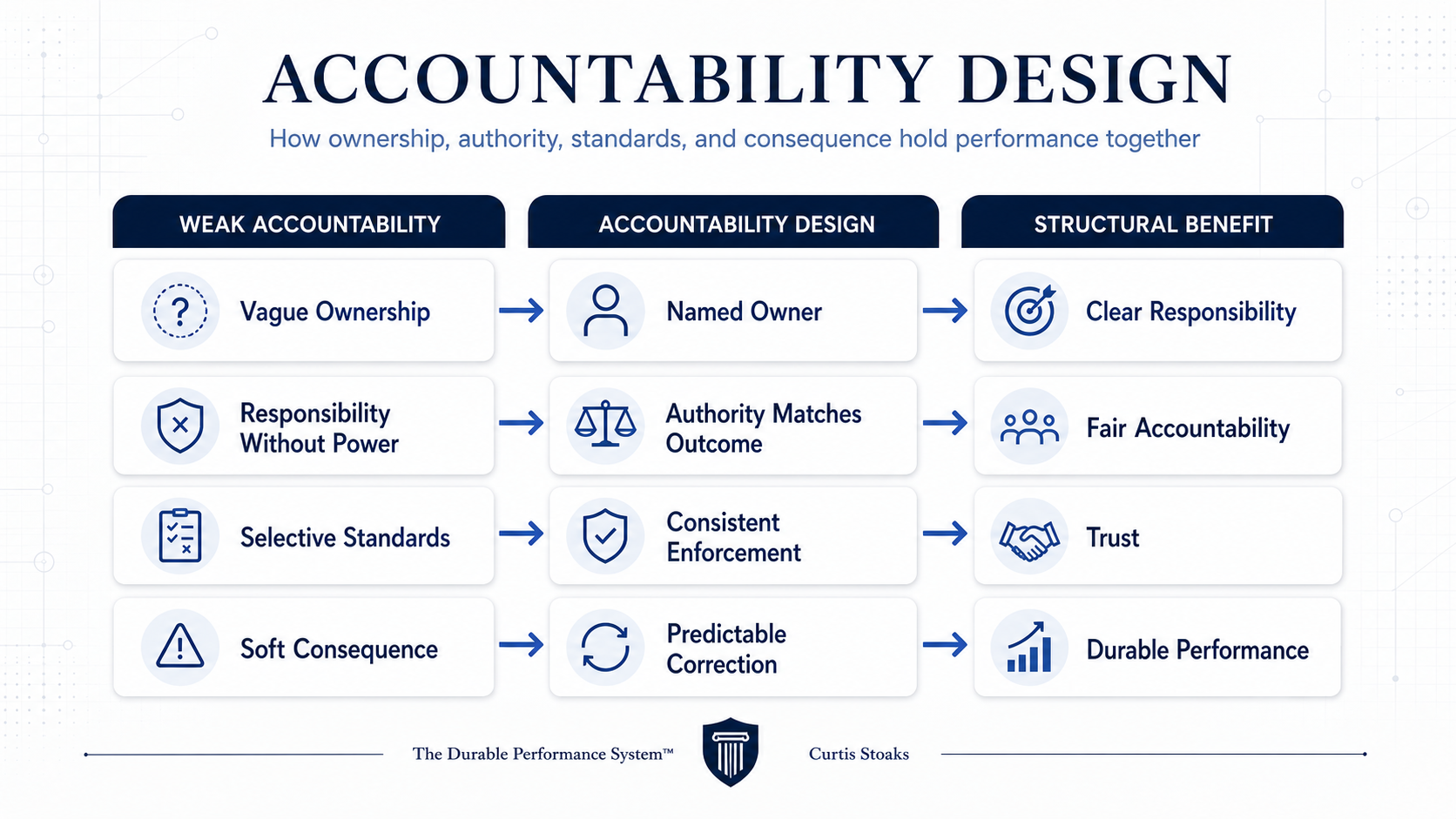
Accountability design makes responsibility operational.
Accountability is not a conversation leaders have after performance slips. It is the operating structure that determines who owns an outcome, what authority they hold, how performance is evaluated, when correction occurs, and what follows when a standard is met or missed.
As part of organizational design , accountability determines how ownership, authority, standards, measurement, follow-up, correction, and consequence are arranged.
Accountability without authority becomes punishment. Accountability without consequence becomes theater.
Naming an owner is not enough. The person must have legitimate influence over the conditions producing the outcome. Standards must also be enforced consistently enough that the organization knows they are real.
When responsibility, authority, measurement, and consequence separate, people learn to explain outcomes rather than change them.
Accountability connects structural arrangement with operating results.
Accountability is credible only when the organization has deliberately designed who owns the result, what power accompanies that ownership, how standards are measured, and what happens when performance varies.
Organizational Design
Organizational design includes how work, authority, information, incentives, accountability, coordination, and operating mechanisms are arranged.
Accountability design determines who owns the decision, result, and correction; what authority the owner can exercise; which standards apply; how performance is evaluated; and where consequence sits.
Organizational Effectiveness
Organizational effectiveness reveals whether responsibility produces timely decisions, reliable ownership, consistent standards, prompt correction, and durable outcomes.
Weak accountability reduces effectiveness by creating escalation, defensive reporting, repeated variance, delayed correction, selective enforcement, and dependence on leadership intervention.
Accountability is structural clarity, not pressure applied after the fact.
Strong accountability creates legitimate ownership before work begins. Weak accountability assigns blame after the system has already failed.
Accountability design is
- ✓ A clearly named owner for the decision, outcome, and correction.
- ✓ Authority sufficient to influence the expected result.
- ✓ Observable standards and defined measures of completion.
- ✓ Timely correction when meaningful variance appears.
- ✓ Predictable consequence applied consistently across hierarchy.
Accountability design is not
- × Blaming the person closest to a structurally produced failure.
- × Adding more follow-up, inspection, or reporting.
- × Holding someone responsible without matching authority.
- × Using punishment, embarrassment, or emotional pressure.
- × Applying standards differently based on status, influence, or output.
Weak accountability often looks like a people problem.
A deadline is missed. A handoff fails. A customer issue repeats. A manager does not correct the problem quickly enough. Leadership responds by restating expectations, increasing follow-up, or asking for greater ownership.
Those responses may address visible behavior without correcting the arrangement underneath it.
The owner may be unclear. The person may lack authority to change policy, staffing, process, priority, or resources. Measures may be symbolic. Multiple leaders may be able to reopen the decision. Consequence may depend on who is involved.
In that environment, stronger accountability language produces more pressure—but not more control.
Accountability distortion follows a predictable sequence.
- 1 An expectation is stated. Leaders define a result, standard, deadline, or behavior.
- 2 Ownership remains incomplete. Several people participate, but final responsibility is not unmistakable.
- 3 Authority remains elsewhere. The named owner cannot change the conditions producing the outcome.
- 4 Measurement becomes symbolic. Performance is tracked and discussed without reliably triggering a decision or correction.
- 5 Variance produces explanation. Reviews focus on context, activity, obstacles, and narrative rather than correction.
- 6 Consequence becomes selective. Standards change according to status, influence, timing, or political value.
- 7 Effectiveness narrows. Issues repeat, decisions escalate, and leaders spend more time supervising outcomes the structure should govern.
- 8 The system adapts. People protect themselves, escalate earlier, document more, and take less legitimate ownership.
How accountability becomes theater.
Accountability weakens when leaders preserve the language of ownership while the structure makes ownership difficult, unsafe, or impossible.
Ownership Without Authority
A person is assigned responsibility but cannot change the policy, process, staffing, resources, priority, or decision producing the outcome.
Shared Ownership Without a Final Owner
Multiple functions contribute, but no single person holds the final call. Collaboration expands while responsibility becomes difficult to locate.
Symbolic Measurement
Metrics are tracked and discussed but do not reliably trigger a decision, correction, resource change, or consequence.
Selective Enforcement
Standards vary according to title, influence, performance history, revenue contribution, relationships, or organizational dependence.
Delayed Correction
Leaders wait until variance becomes undeniable. By the time correction arrives, the behavior has already become precedent.
Exceptions Without Expiration
Temporary accommodation survives without an owner, review date, or clear decision to renew or close it.
Reporting Replaces Correction
Owners become responsible for producing updates, explanations, and recovery narratives instead of changing the conditions driving repeat variance.
Leaders Absorb Consequence
Senior leaders protect teams or individuals from the natural result of missed decisions, weakened standards, or repeated avoidance.
Process Substitutes for Trust
Additional reviews, approvals, documentation, and controls are added because leadership no longer trusts judgment—but the source of that mistrust is not corrected.
Weak accountability changes how the organization behaves.
Accountability design changes the wider organizational design and determines whether responsibility contributes to organizational effectiveness or produces escalation, delay, and defensive behavior.
Organizational Design
Ownership rules, decision boundaries, measures, reviews, exceptions, and consequences become permanent parts of how the organization operates.
Explore organizational design →Organizational Effectiveness
Weak accountability increases repeated variance, supervision, rework, escalation, and coordination while reducing reliable ownership and durable results.
Explore organizational effectiveness →Authority Becomes Less Credible
People are told they own the outcome while meaningful decisions remain elsewhere. Formal ownership becomes ceremonial.
Explore authority design →Decision Velocity Slows
People escalate to avoid exposure because they cannot predict whether legitimate judgment will be supported after the fact.
Explore decision velocity →Signal Integrity Weakens
Information becomes defensive. Teams package variance carefully because accountability feels political rather than procedural.
Explore signal integrity →Execution Drag Increases
Managers spend more time chasing updates, mediating ownership disputes, reopening decisions, and correcting repeat issues.
Explore execution drag →Trust Becomes Conditional
Employees stop asking what the standard is and start asking who the standard applies to. Consistency gives way to political interpretation.
Organizational Drift Accelerates
Exceptions, delayed correction, symbolic ownership, and selective consequence gradually rewrite the actual operating standard.
Explore organizational drift →Accountability depends on the wider operating system.
Organizational Design
Accountability is part of the wider arrangement of work, authority, information, incentives, coordination, standards, and consequence.
Explore Organizational Design →Organizational Effectiveness
Accountability quality becomes visible through ownership, decision quality, consistency, correction speed, trust, repeat variance, and durable operating results.
Explore Organizational Effectiveness →Authority Design
Responsibility must be paired with the ability to influence the result. Where authority and accountability separate, ownership produces explanation instead of correction.
Explore Authority Design →Incentive Architecture
Rewards, promotions, protections, workload allocation, and informal status determine whether people benefit from meeting the standard—or from navigating around it.
Explore Incentive Architecture →Signal Integrity
Fair accountability requires clean information about what happened, what conditions shaped the outcome, and what correction is necessary.
Explore Signal Integrity →Structural Simplicity
Clear ownership and decision boundaries reduce the need for excess follow-up, overlapping roles, duplicate reporting, and committee-based accountability.
Explore Structural Simplicity →Leadership Systems
Leaders determine whether standards are enforced consistently, exceptions expire, difficult corrections occur promptly, and consequence applies upward as well as downward.
Explore Leadership Systems →Questions that expose accountability distortion.
Immediate examples indicate that the organization does not need stronger accountability language first. It needs ownership, authority, standards, and consequence realigned.
Use the Drift Diagnostic →Accountability must be built before it can be enforced.
Durable accountability comes from repeatable operating rules—not from increasing pressure whenever performance becomes difficult.
Name One Accountable Owner
Input can be broad. Contribution can be shared. Final ownership for the decision, result, and correction must remain unmistakable.
Match Authority to the Outcome
Identify the policy, process, staffing, resource, measurement, and priority decisions the owner must be able to influence.
Define the Standard in Observable Terms
Clarify what completion, quality, timing, behavior, escalation, and acceptable variance actually mean.
Separate Variance From Failure
Not every miss requires punishment. Every meaningful variance does require diagnosis, ownership, correction, and follow-through.
Correct Faster Than Explanation Spreads
Timely, proportional correction interrupts precedent before the organization learns that the standard is optional.
Apply Consequence Consistently
Examine consistency rather than severity. Influence, hierarchy, relationships, and output should not quietly rewrite the standard.
Give Every Exception an Expiration
Record the owner, reason, start date, review cadence, expiration date, and decision to renew or close.
Correct Repeat Issues Structurally
When the same category of failure repeats, examine the decision rights, process, incentives, handoffs, capacity, and standards producing it.
Audit Accountability Across Hierarchy
Review whether senior leaders, high performers, protected functions, and influential employees are held to the same operating standard.
Choose the next structural path.
Accountability becomes durable when leaders examine how ownership is arranged, what the accountability system produces, and whether authority, standards, measurement, correction, and consequence remain aligned.
Organizational Design
Examine how ownership, authority, standards, measurement, correction, exceptions, and consequence are arranged.
Explore Organizational Design →Organizational Effectiveness
Evaluate whether accountability produces reliable ownership, timely correction, consistent standards, trust, and durable results.
Explore Organizational Effectiveness →Authority Design
Examine whether decision rights, escalation thresholds, responsibility, and operating power are aligned.
Explore Authority Design →Incentive Architecture
Determine whether rewards, protections, tolerance, and consequence support or contradict the accountability standard.
Explore Incentive Architecture →The Drift Diagnostic
Identify where weak ownership, authority mismatch, inconsistent standards, symbolic measurement, or soft consequence may be creating structural strain.
Take the Drift Diagnostic →The Durable Performance System™
See how accountability connects with design, effectiveness, authority, incentives, signal, consequence, simplicity, and durable performance.
See the Complete System →About accountability design.
Is accountability design the same as holding people accountable?
Why must authority match accountability?
How does accountability design relate to organizational design?
How does accountability design affect organizational effectiveness?
What is the clearest sign of weak accountability design?
Does accountability always require punishment?
How should leaders improve accountability design?
Accountability holds when the structure holds.
Healthy accountability does not depend on fear, personality, or constant supervision. It improves organizational design by aligning ownership, authority, standards, measurement, correction, and consequence—and strengthens organizational effectiveness by making responsible action the most rational path.