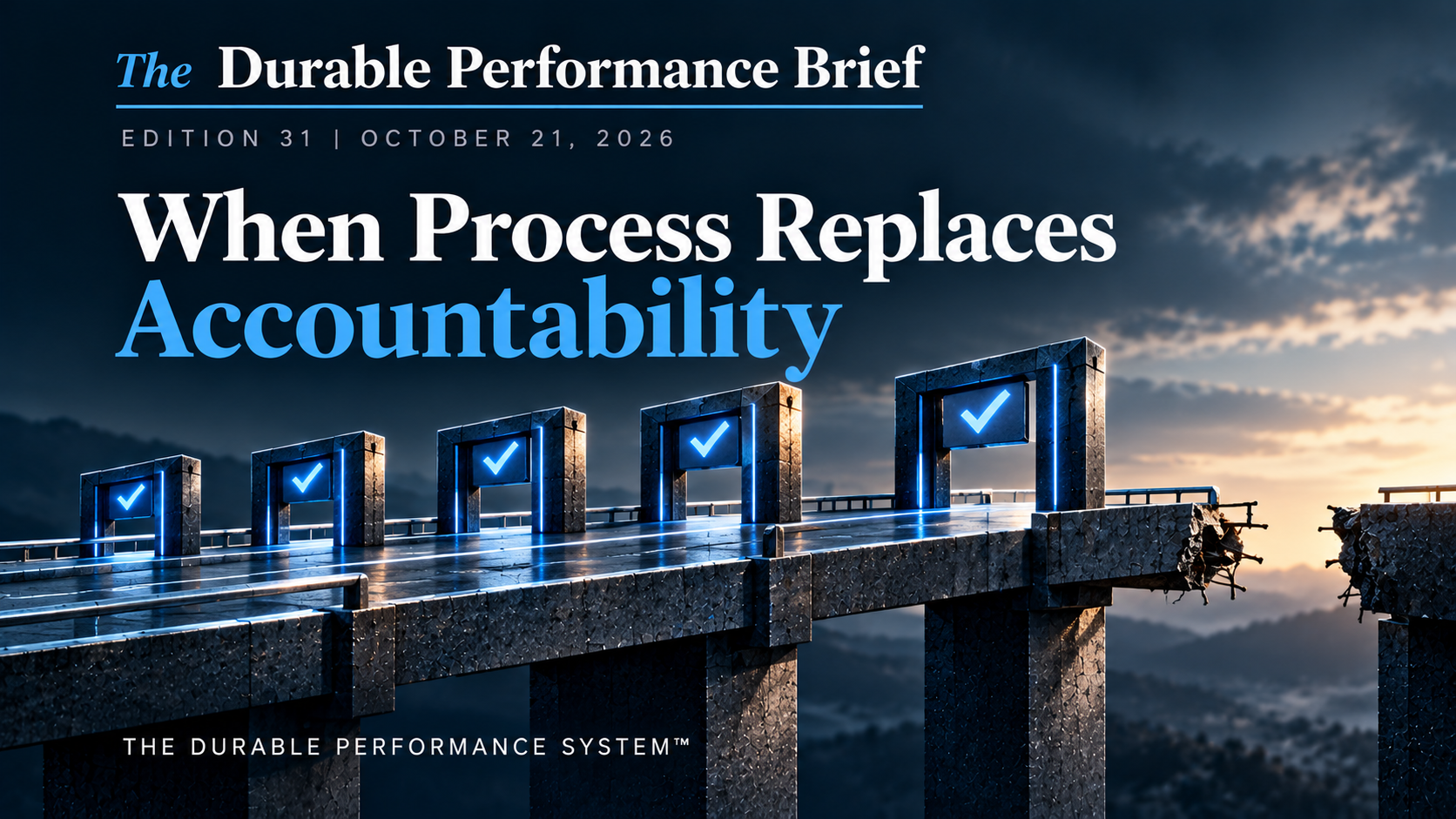
The Durable Performance Brief · Edition 31 · October 21, 2026
The review was completed.
The required documentation was submitted. The appropriate stakeholders were consulted. The issue was escalated through the correct channels. Every procedural requirement was satisfied.
Three weeks later, the same problem happened again.
Leadership reviewed the situation and found no obvious procedural violation. Everyone had followed the established steps.
The process worked exactly as designed.
The outcome did not improve.
That distinction reveals one of the more persistent weaknesses in organizational systems: the gradual substitution of procedural compliance for genuine accountability.
Completing the Process Is Not the Same as Owning the Outcome
Organizations need processes.
They establish consistency, protect against preventable errors, coordinate work, and preserve institutional knowledge. In regulated or safety-critical environments, documented compliance can also be an essential obligation.
But a process is a mechanism for producing or protecting an outcome. It is not the outcome itself.
The distinction begins to disappear when organizations evaluate performance primarily through procedural completion.
A manager demonstrates that every required step was followed. A department confirms that its responsibilities were discharged. A review establishes that the appropriate approvals were obtained.
Yet the underlying problem remains.
The organization has verified activity without establishing whether the activity produced the intended result.
This is where accountability design becomes important.
Accountability requires a clear relationship among ownership, authority, standards, evidence, correction, and consequence. Procedural compliance can support that relationship, but it cannot replace it.
Someone must remain responsible for determining whether the system actually worked.
How Responsibility Disappears Into Procedure
Consider a recurring customer complaint.
The customer contacts the organization about a service failure. The representative documents the issue and follows the established escalation procedure.
The supervisor reviews the complaint and forwards it to the appropriate department.
That department investigates, documents its findings, and closes its assigned task.
Every participant completes the required work.
The customer experiences the same failure again.
The problem is not necessarily that anyone neglected their responsibilities. It may be that responsibility was divided into procedural steps without establishing clear ownership of the underlying outcome.
Each person was accountable for a transaction.
Nobody was clearly accountable for eliminating the recurring failure.
That is a structural problem.
As organizations become more specialized, responsibilities are increasingly distributed across departments, systems, and reporting relationships. That distribution can improve efficiency, but it also creates opportunities for accountability to fragment.
One team owns intake. Another owns investigation. Another owns resolution. Another owns reporting.
If no one owns the complete result, every part of the process can succeed while the overall system continues to fail.
The organization becomes very good at moving problems through its structure.
It becomes less effective at removing them.
When Documentation Becomes Defense
A second distortion develops when documentation begins serving primarily as protection against accountability.
The purpose of a record should be to preserve useful information: what happened, what was known, what was decided, and what correction followed.
But in an environment where procedural compliance is the dominant measure of performance, documentation can become evidence that an individual or department fulfilled its obligations.
The emphasis shifts.
Instead of asking whether the problem was corrected, people focus on demonstrating that the appropriate actions were taken.
Instead of examining why the failure recurred, the review concentrates on whether the required procedure was followed.
Instead of improving the operating system, leadership may add another documentation requirement.
The organization accumulates increasingly detailed evidence of its activity without necessarily improving its ability to act.
This is one way signal integrity can weaken.
The information reaching leadership may be accurate in a narrow procedural sense. The review occurred. The form was completed. The deadline for submitting the report was met.
But those facts do not necessarily describe the condition leadership needs to understand.
The system is reporting compliance while the underlying operating problem remains unresolved.
Why More Process Often Feels Like Correction
When a recurring failure becomes visible, leadership understandably wants a response.
A new checklist is introduced. An approval requirement is added. A reporting cadence is increased. A review committee is established.
These actions are visible, measurable, and relatively easy to communicate.
They also create the appearance of stronger control.
Sometimes they are exactly what the organization needs.
A poorly designed procedure can create errors. Missing controls can expose the business to unnecessary risk. Clearer documentation can improve execution.
But additional process is not automatically additional accountability.
If the original failure resulted from unclear ownership, inadequate authority, conflicting incentives, or a standard that was not enforced, adding procedural steps may leave those conditions unchanged.
It may even make correction harder.
More handoffs create additional opportunities for responsibility to fragment. More approvals can separate decisions from the people with the best information. More reporting can consume the capacity needed to correct the work.
The organization experiences increasing execution drag while believing it has strengthened oversight.
That is the central mistake.
Leadership adds mechanisms for observing and processing the problem without necessarily changing the conditions that produce it.
Accountability Must Survive the Handoff
A durable system distinguishes responsibility for completing a task from accountability for producing an outcome.
Multiple people may contribute to a result.
Several departments may perform necessary work.
A process may require sequential handoffs, reviews, and approvals.
None of that eliminates the need for clear ownership.
The accountable owner must know what result is expected, what authority is available to influence it, what evidence demonstrates success, and what happens when the result is not achieved.
That does not mean every failure should produce punishment.
Meaningful accountability requires diagnosis before consequence.
Sometimes a failure reflects an individual decision. Sometimes it reflects insufficient resources, conflicting priorities, unrealistic standards, or a process that prevents people from exercising reasonable judgment.
Accountability becomes stronger when the organization can distinguish among those conditions and correct the one actually producing the problem.
It becomes weaker when procedural compliance ends the investigation.
One Practical Diagnostic
Select a recurring problem that has already been reviewed, documented, or escalated more than once.
Then ask:
Who is accountable for ensuring this problem stops recurring—not merely for completing the next required step?
Examine the answer carefully.
- Can one accountable owner be identified?
- Does that person have authority to change the conditions producing the problem?
- Is success measured through the operating result or completion of procedural tasks?
- What evidence would demonstrate that the underlying problem has been corrected?
- If the problem happens again, who must initiate structural correction?
If the answers lead primarily to departments, committees, reporting procedures, or escalation pathways, accountability may already have been absorbed by process.
If You Change One Thing This Week
Choose one recurring issue that has survived multiple procedural responses.
Assign one accountable owner for the operating outcome.
Do not simply assign responsibility for the next report, meeting, or corrective-action document.
Define the result that must change. Identify the authority the owner needs to influence that result. Establish the evidence that will demonstrate whether the correction worked.
Keep the procedural controls that serve a legitimate purpose.
But make one distinction explicit:
The process is complete when its required steps are finished. Accountability remains open until the outcome has been evaluated and the necessary correction has been made.
That distinction restores the relationship between action and result.
It also prevents the organization from treating completed paperwork as evidence that an unresolved problem has been solved.
Go Deeper
Why Organizations Drift examines how organizations gradually substitute procedure for judgment, correction, and enforcement.
The deeper lesson is that durable performance requires more than reliable activity. It requires operating structures that preserve responsibility for results even as work moves across departments, processes, and organizational boundaries.
Closing Thought
A process can be followed perfectly and still fail to produce the intended outcome.
That does not necessarily make the process useless.
It means procedural compliance and accountability are different things.
One establishes whether the required steps occurred.
The other establishes whether the organization fulfilled its responsibility for the result.
When those concepts become interchangeable, organizations can become increasingly disciplined about activity while remaining ineffective at correction.
The paperwork closes.
The problem survives.
And the system learns to call that accountability.
Question for readers: Where in your organization does completing the required process allow an unresolved operating problem to be treated as closed?
Part of The Durable Performance System™
Books, field guides, and frameworks on power, incentives, authority, accountability, and execution.
Published every Wednesday morning.
Curtisstoaks.com – YouTube – @curtisstoaksauthor