What Is Authority Design?
Authority design determines who can decide, who provides input, who may approve, when escalation is required, and who carries the consequence of the decision. It is a central part of organizational design and a direct influence on organizational effectiveness.
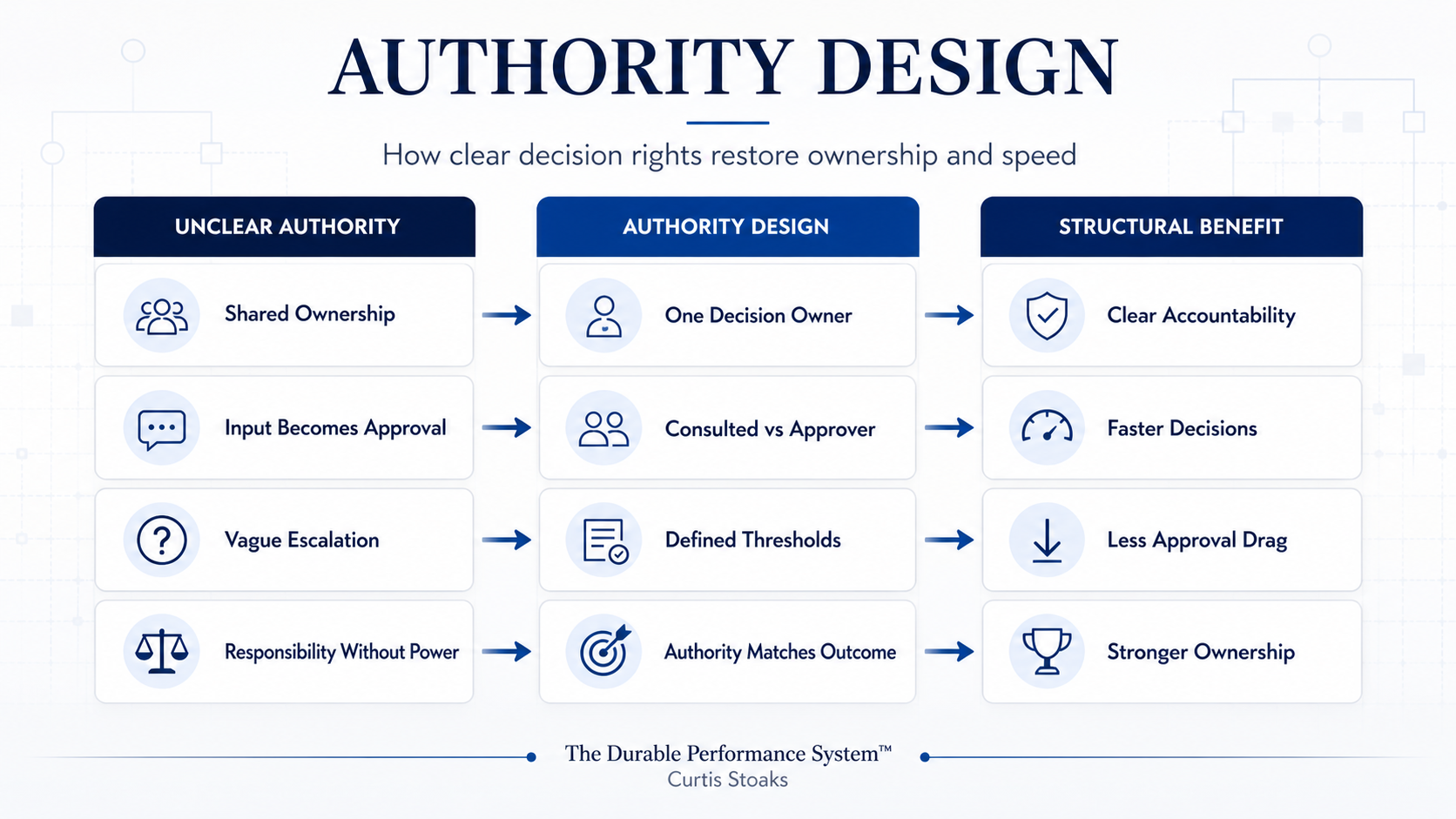
Authority design aligns responsibility with decision power.
Authority design is the deliberate placement of decision rights, approval rights, consultation roles, escalation thresholds, and consequence inside an organization.
It is not simply delegation. It defines where judgment should live and the boundaries within which it can be exercised.
As part of organizational design , authority design determines how power, responsibility, risk, and judgment are distributed through the operating system.
If no one owns the decision, everyone owns the delay.
Vague authority creates meeting inflation, escalation dependence, political caution, and weak accountability.
Authority must be explicit, bounded, and consequential.
The organization should be able to name who decides, what limits apply, which input is required, what triggers escalation, and how the decision will be reviewed.
Authority shapes the design and changes the result.
Where decision rights sit affects how work moves, how quickly people act, how accountability operates, and how much intervention the organization requires.
Organizational Design
Organizational design includes how work, authority, information, incentives, accountability, coordination, and operating mechanisms are arranged.
Authority design determines who can convert information into action, which roles may block or redirect a decision, where risk thresholds sit, and whether ownership remains close to the work or migrates toward the center.
Organizational Effectiveness
Organizational effectiveness reveals whether the current system produces intended outcomes while preserving speed, capability, clarity, accountability, adaptability, and leadership capacity.
Weak authority design makes results increasingly dependent on escalation, coordination, senior intervention, repeated approval, and personal compensation from experienced employees.
Authority is often confused with adjacent roles.
Clear design requires separating the right to decide from title, influence, consultation, and accountability.
Authority Is Not Title
A senior title does not mean every decision should rise to that role. Authority should follow context and risk, not hierarchy alone.
Authority Is Not Influence
People may shape a decision through expertise or credibility without owning the final call.
Authority Is Not Consultation
Being asked for input does not automatically create approval rights or veto power.
Authority Is Not Accountability
Accountability evaluates ownership and results. Authority provides the decision rights needed to shape them.
Six ways authority design breaks.
Weak authority design usually appears as delay, over-alignment, poor follow-through, or unfair accountability. The structural cause is misplaced or incomplete decision power.
Responsibility Without Decision Rights
People remain answerable for outcomes while lacking control over the decisions, resources, timing, or conditions shaping them.
Shared Ownership Without a Final Decision-Maker
Multiple stakeholders carry partial responsibility, but no one has clear authority to resolve disagreement and act.
Routine Decisions Pushed Upward
Decisions move toward senior leaders because local authority feels unclear, exposed, or easily reversed.
Input Treated as Veto Power
Consulted stakeholders become informal approvers, creating additional permission points and political negotiation.
Authority Without Clear Limits
People are told to decide but receive no boundaries for cost, risk, policy, customer impact, or escalation.
Leaders Reclaim Decisions After Delegating Them
Repeated reentry teaches teams that apparent authority is temporary and waiting for senior direction is safer.
Structural caution is often mistaken for hesitation.
Leaders may conclude that teams lack confidence, urgency, ownership, or accountability.
But people escalate when authority is unclear. They wait when consequences are uncertain. They seek alignment when ownership feels unsafe. They protect themselves when delegated decisions are routinely reclaimed.
The behavior is often rational inside the authority structure employees actually experience.
The authority failure pattern is predictable.
- 1 Decision rights remain unclear. Ownership, approval, input, awareness, and escalation are not distinguished.
- 2 People seek protection. Teams ask for alignment, visibility, review, and permission before acting.
- 3 Authority moves upward. Routine decisions climb toward leaders who were meant to support rather than own the work.
- 4 The operating design changes. Escalation, review, and leadership involvement become normal parts of the decision path.
- 5 Local judgment contracts. People stop practicing decisions the center repeatedly reclaims.
- 6 Accountability distorts. Teams remain responsible for outcomes without controlling the decisions required to produce them.
- 7 Effectiveness weakens. Decisions take longer, leadership load increases, and outcomes require more coordination and intervention.
Clarify the roles surrounding each important decision.
Authority becomes durable when the organization distinguishes decision ownership, approval, consultation, awareness, boundaries, and escalation.
Decision Owner
The person or role with authority to make the final call and carry the result.
Approver
A role with legitimate veto power because a material governance or risk threshold requires it.
Consulted Input
People whose expertise should inform the judgment without converting them into approvers.
Informed Audience
People who need visibility after the decision but do not need to shape it before action.
Decision Boundaries
The financial, policy, legal, safety, customer, quality, or strategic limits within which the owner can act.
Escalation Threshold
The explicit condition that justifies moving the decision to a different authority level.
Authority design shapes the wider operating system.
When decision rights are unclear or misplaced, the effects spread through organizational design, effectiveness, speed, accountability, execution, information flow, and leadership capacity.
Organizational Design
Repeated escalation and approval gradually reshape how work, authority, information, and coordination actually operate.
Explore organizational design →Organizational Effectiveness
Outcomes require more time, senior attention, coordination, and intervention as legitimate decision ownership weakens.
Explore organizational effectiveness →Decision Velocity
Clear decision rights allow judgment to move into action without unnecessary delay or escalation.
Explore decision velocity →Approval Drag
Unclear ownership creates shared review, permission loops, and unnecessary veto points.
Explore approval drag →Accountability Design
Accountability becomes credible only when people control the decisions and conditions attached to their outcomes.
Explore accountability design →Execution Drag
Unresolved ownership creates more meetings, handoffs, escalations, delays, and rework.
Explore execution drag →Leadership Dependence
Senior leaders become operating bottlenecks when routine judgment repeatedly returns to the center.
Organizational Drift
Temporary centralization becomes permanent, local capability narrows, and the organization adapts to slower decisions.
Explore organizational drift →Authority depends on design, information, and leadership behavior.
Organizational Design
Authority design is one part of the wider arrangement of work, information, incentives, accountability, coordination, and operating mechanisms.
Explore organizational design →Organizational Effectiveness
The quality of authority design becomes visible through decision speed, ownership, leadership dependence, coordination cost, and the durability of outcomes.
Explore organizational effectiveness →Signal Integrity
Decision owners need direct, timely operating truth rather than information packaged for senior approval.
Explore signal integrity →Leadership Systems
Leaders shape organizational capability through where they place authority, how they respond to mistakes, and when they reenter decisions.
Explore leadership systems →Questions that reveal weak authority design.
If these questions produce immediate examples, the issue is not merely slow execution. The authority structure needs redesign.
Use the Drift Diagnostic →Restore ownership before adding more control.
Name the decision owner. Limit true approvers. Separate consultation from permission. Define decision boundaries. Write down escalation thresholds. Protect sound judgment made within those limits.
The goal is not uncontrolled autonomy. It is authority that is explicit, bounded, reviewable, and matched to consequence.
Match authority to accountability.
Decision ownership cannot remain credible when responsibility, authority, standards, and consequence are separated.
Choose the next structural path.
Authority design becomes actionable when leaders examine the wider arrangement, evaluate the effects of misplaced authority, and restore legitimate decision ownership.
Organizational Design
Examine how authority connects with work, information, incentives, accountability, coordination, and operating structure.
Explore Organizational Design →Organizational Effectiveness
Evaluate whether current decision rights support speed, ownership, capability, adaptability, and durable outcomes.
Explore Organizational Effectiveness →Decision Velocity
Examine the distance between recognizing a decision and taking legitimate action.
Explore Decision Velocity →Accountability Design
Align ownership, authority, standards, measurement, correction, and consequence.
Explore Accountability Design →The Drift Diagnostic
Identify where authority migration, approval drag, weak ownership, or senior dependence may already be changing the system.
Take the Drift Diagnostic →The Durable Performance System™
See how authority connects with design, effectiveness, incentives, signal, accountability, consequence, and execution.
See the Complete System →About authority design.
Is authority design the same as delegation?
Can more than one person own a decision?
How does authority design affect accountability?
How does authority design relate to organizational design?
How does authority design affect organizational effectiveness?
When should a decision be escalated?
How can leaders avoid reclaiming delegated authority?
Authority must be designed before accountability can be trusted.
The earlier leaders can name who decides, who approves, who gives input, what limits apply, and when escalation is justified, the easier it becomes to improve organizational design, restore ownership, increase decision velocity, and strengthen organizational effectiveness.