What Is Approval Drag?
Approval drag is the delay, coordination cost, and weakened ownership created when decisions require more permission, visibility, or senior involvement than the underlying risk justifies. It is a structural feature of organizational design that can quietly reduce organizational effectiveness.
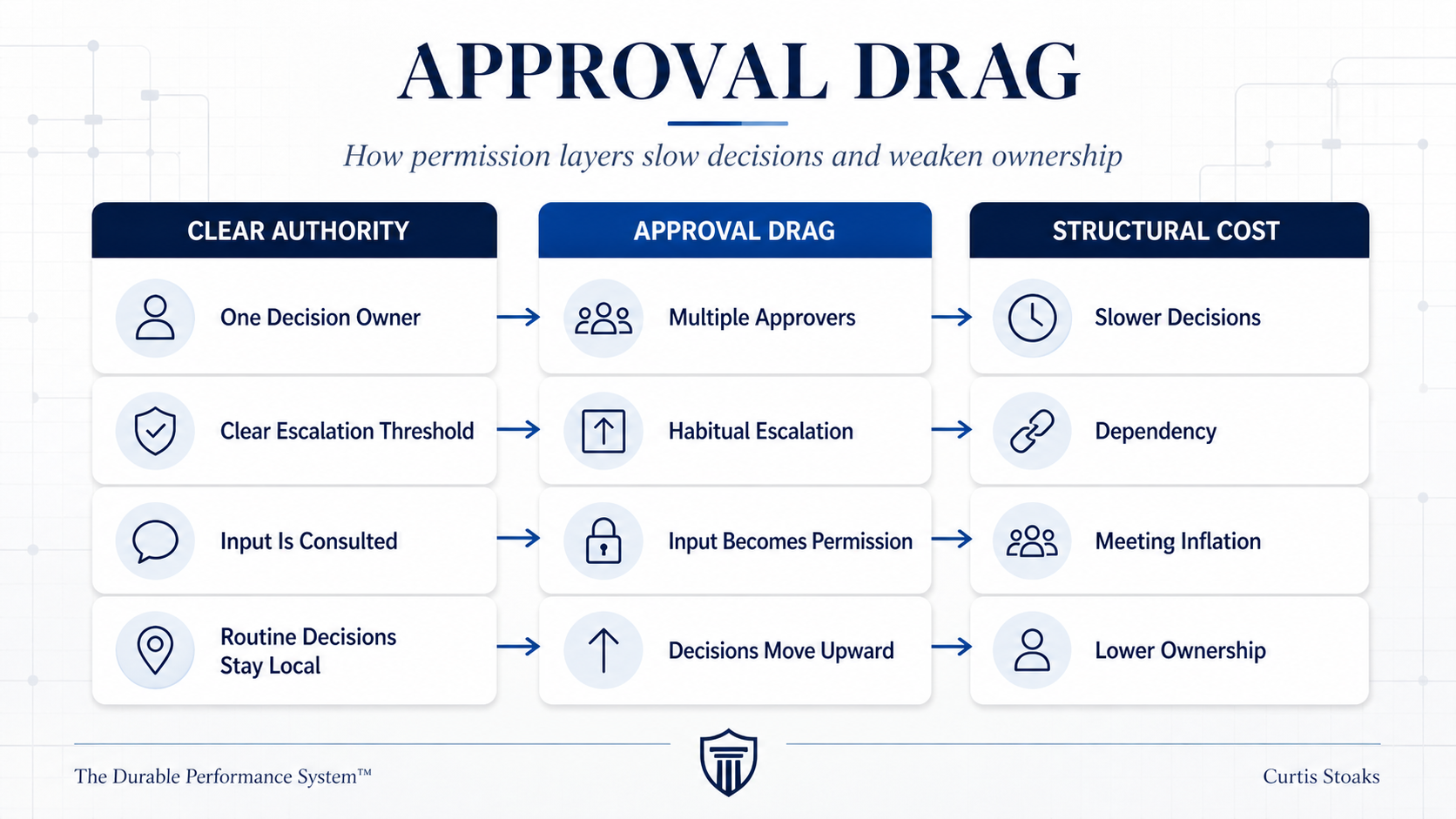
Approval drag is friction disguised as discipline.
Legitimate review protects the organization from material risk. Approval drag begins when routine decisions enter unnecessary permission loops that add waiting, packaging, handoffs, and senior dependence without meaningfully improving the decision.
The visible cost is delay. The deeper cost is lost judgment close to the work.
As part of organizational design , approval drag reveals how permission, visibility, risk, authority, and escalation have been arranged around decisions.
Not every approval is unnecessary.
Some decisions deserve formal review because they involve significant financial, legal, safety, reputational, quality, or strategic exposure.
The test is whether the approval changes the risk.
A useful approval adds expertise, protects a real threshold, or clarifies consequence. Approval drag adds permission without changing the underlying exposure.
Approval pathways reveal how the system is arranged and what it produces.
Approval drag is not only a workflow problem. It is evidence of how authority, risk, information, coordination, and decision rights have been designed.
Organizational Design
Organizational design includes how work, authority, information, incentives, accountability, coordination, and operating mechanisms are arranged.
Approval drag appears when visibility becomes permission, consultation becomes veto power, temporary controls become permanent, or decisions move upward without a meaningful change in risk.
Organizational Effectiveness
Organizational effectiveness reveals whether the operating system converts judgment and information into intended outcomes with appropriate speed, ownership, clarity, and discipline.
Approval drag reduces effectiveness by increasing decision time, coordination load, senior dependence, information packaging, and the effort required to produce the same result.
Six structural causes of accumulated permission.
Approval drag rarely comes from one deliberately bad process. It grows through reasonable additions that remain after their value has expired.
Controls Added After Isolated Failures
A single miss creates a permanent review step even when the added control does not address the root cause.
Visibility Treated as Permission
Leaders who only need awareness become required participants in the decision.
Vague Escalation Thresholds
Teams escalate broadly because no one can explain which risks truly require higher-level review.
Senior Reentry Into Routine Work
Leaders continue touching decisions that should have been returned to the appropriate operating level.
Fear of Reversal
People seek approval because a locally made decision may be overturned without clear learning or protection.
Expired Controls That Never Leave
Temporary reviews survive because removal feels riskier than continuation, even after the original condition has passed.
Approval drag becomes visible before performance fails.
The language still sounds responsible, but the system begins spending more energy on permission than judgment.
Decisions Move Upward
Calls that were once local now require director, executive, or cross-functional approval.
Input Turns Into Permission
People who should contribute perspective gain de facto veto authority.
Meeting Load Increases
Unclear authority produces more preparation, socialization, review, and follow-up meetings.
Ownership Weakens
People stop fully owning judgment when they expect the final call to be reviewed or reversed elsewhere.
Truth Gets Packaged
Teams shape information for the approval path instead of surfacing direct operating reality.
Delay Becomes Defensible
Waiting is treated as maturity even when the decision is routine and the risk is known.
Good intent can still create structural drag.
A mistake occurs. A customer escalation becomes visible. A leader loses confidence in a local decision. More visibility or approval is added.
That response may be reasonable in the moment. The problem begins when the added layer survives after the moment that justified it.
Leaders feel safer because more decisions touch the center. Teams move slower because more decisions require permission.
The pattern is predictable.
- 1 A visible mistake creates pressure. Leadership wants to reduce recurrence and exposure.
- 2 An approval layer gets added. The new step feels temporary, prudent, and responsible.
- 3 The layer becomes normal. Removing it feels riskier than keeping it.
- 4 The operating design changes. Review, visibility, escalation, and senior involvement become expected parts of the decision path.
- 5 Teams adapt to permission. People escalate earlier, package decisions carefully, and wait longer.
- 6 Ownership weakens. The decision pathway receives more attention than the quality of the judgment itself.
- 7 Effectiveness narrows. Decisions require more time, coordination, leadership attention, and organizational effort.
- 8 Capability contracts. The organization appears safer while local judgment and independence weaken.
Permission loops reshape the wider operating system.
Approval drag does more than delay a single decision. It changes organizational design, reduces organizational effectiveness, weakens ownership, alters information flow, increases coordination cost, and expands leadership dependence.
Organizational Design
Repeated approvals become permanent parts of how authority, information, risk, and coordination are arranged.
Explore organizational design →Organizational Effectiveness
The organization spends more time, attention, coordination, and leadership capacity to produce the same or weaker result.
Explore organizational effectiveness →Decision Velocity
Every extra approval adds waiting, coordination, and handoff time before judgment becomes action.
Explore decision velocity →Accountability Design
People remain responsible for outcomes while authority over timing and decisions moves elsewhere.
Explore accountability design →Local Judgment
Capability contracts when people stop practicing decisions the approval structure has centralized.
Coordination Cost
More people spend more time preparing, attending, reviewing, updating, and interpreting the same decision.
Leadership Dependence
Senior leaders become the operating bottleneck while believing their involvement is preserving control.
Execution Drag
Work waits, priorities age, handoffs expand, and friction accumulates before execution can begin.
Explore execution drag →Organizational Drift
Temporary controls become permanent, authority moves upward, and slower permission-heavy behavior becomes normal.
Explore organizational drift →Approval drag rarely operates alone.
Organizational Design
Approval pathways are part of the wider arrangement of authority, information, accountability, risk, coordination, and work.
Explore organizational design →Organizational Effectiveness
Approval drag affects how quickly the organization can decide, respond, correct, adapt, and produce durable outcomes.
Explore organizational effectiveness →Authority Design
When decision rights are unclear, decisions drift into shared review and senior permission.
Explore authority design →Decision Velocity
Permission layers increase the distance between recognizing a decision and converting judgment into action.
Explore decision velocity →Signal Integrity
Approval paths often reward safer narratives and polished updates instead of cleaner operating truth.
Explore signal integrity →Organizational Drift
Temporary controls become permanent, authority moves upward, and the organization adapts to slower operating conditions.
Explore organizational drift →Questions that reveal approval drag.
If the same approval points appear repeatedly, the problem is not isolated delay. It is decision design.
Use the Drift Diagnostic →Remove permission without removing discipline.
Improving approval flow does not mean eliminating review. It means reserving formal approval for decisions where it materially changes risk, quality, legality, safety, or strategic exposure.
Name the decision owner. Separate input from approval. Define escalation thresholds. Set expiration dates for temporary controls. Protect sound local judgment. Review the rule instead of entering every decision.
Clarify authority before asking for more speed.
Approval drag is difficult to remove when decision ownership, input roles, risk thresholds, and escalation boundaries remain vague.
Choose the next structural path.
Approval drag becomes actionable when leaders examine how permission has been designed, what those pathways now produce, and which controls can be removed without weakening legitimate discipline.
Organizational Design
Examine how authority, permission, information, risk, accountability, and coordination are arranged.
Explore Organizational Design →Organizational Effectiveness
Evaluate whether approval pathways protect real risk or create preventable delay, dependence, and coordination cost.
Explore Organizational Effectiveness →Authority Design
Clarify who decides, who provides input, what limits apply, and when approval or escalation is justified.
Explore Authority Design →Decision Velocity
Examine how quickly sound judgment can move into action without unnecessary delay or senior permission.
Explore Decision Velocity →The Drift Diagnostic
Identify where permission loops, authority migration, filtered signal, weak ownership, or leadership dependence may already be changing the system.
Take the Drift Diagnostic →The Durable Performance System™
See how approval drag connects with design, effectiveness, authority, signal, accountability, consequence, and execution.
See the Complete System →About approval drag.
Is every approval step a form of approval drag?
What is the clearest sign of approval drag?
How does approval drag weaken accountability?
How does approval drag relate to organizational design?
How does approval drag affect organizational effectiveness?
Why do approval layers remain after the original problem is resolved?
How should leaders reduce approval drag?
Approval drag is accumulated permission.
The earlier leaders can distinguish approvals that protect real risk from those that preserve habit, the easier it becomes to improve organizational design, restore ownership and decision velocity, and strengthen organizational effectiveness.