Tag: Authority Design

Posts about decision rights, ownership, escalation thresholds, approval structures, and the placement of authority inside organizations.

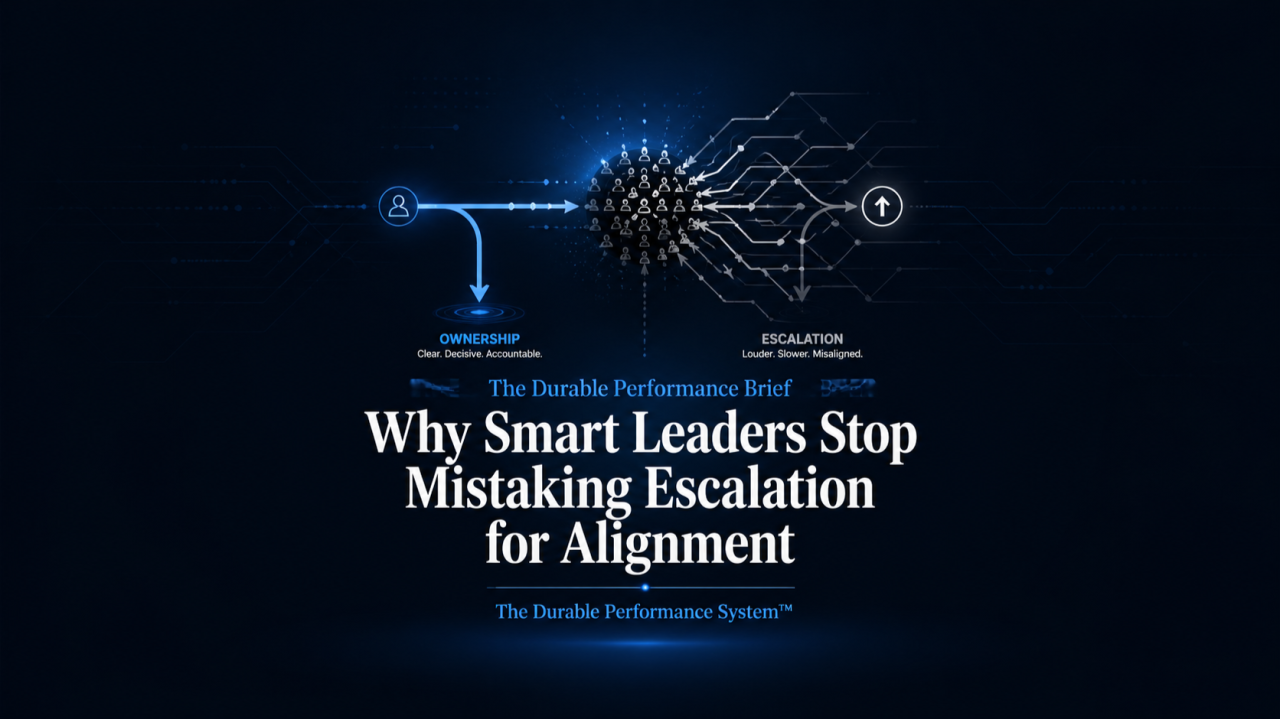
  • Why Smart Leaders Stop Mistaking Escalation for Alignment

    Why Smart Leaders Stop Mistaking Escalation for Alignment

    Edition 6 | April 29, 2026

    Smart leaders stop mistaking escalation for alignment because alignment should clarify ownership, not transfer every difficult decision upward.

    Most organizations do not drown in bad decisions first.

    They drown in transferred decisions.

    That is the distinction leaders miss when escalation starts sounding like discipline.

    Alignment is supposed to clarify who carries the call.

    Escalation transfers the call upward.

    Those are not the same thing.

    But in many organizations, they slowly become indistinguishable. A manager raises something “for visibility.” A director wants to “stay close.” A cross-functional tension gets pushed higher “just to be safe.” An executive team tells itself it is protecting quality.

    What it is often protecting is discomfort.

    And once discomfort starts getting treated like material risk, escalation rises for the wrong reasons.

    That is where decision velocity begins to collapse.

    The Core Thesis

    Leaders usually misread escalation as evidence of seriousness.

    It is often evidence of structural ambiguity.

    A healthy system does not eliminate escalation. It makes it legible. People know what belongs locally, what requires consultation, what crosses a real threshold, and what truly needs higher-level ownership.

    An unhealthy system does something else.

    It treats uncertainty, visibility, stakeholder sensitivity, and personal discomfort as reasons to elevate. That feels prudent in the moment. It also teaches the organization the wrong operating logic.

    People stop asking:

    Who should own this?

    They start asking:

    Who do we need to involve so no one gets exposed?

    That is not alignment.

    That is authority drift with professional language around it.

    The cost is larger than delay.

    When escalation becomes default, three things happen at once.

    • Ownership weakens because local leaders learn that serious decisions do not really belong to them.
    • Signal gets curated because anything moving upward now has to be packaged carefully.
    • The center gets crowded because senior leaders start adjudicating routine complexity instead of designing better systems.

    By the time executives feel buried, the structural lesson has already been taught.

    If the center keeps touching the work, the edge stops trusting its own judgment.

    What This Looks Like in the Wild

    You can usually see this pattern before any KPI turns visibly red.

    Routine tradeoffs start getting elevated because someone more senior “may have an opinion.”

    Cross-functional teams spend more time socializing decisions than making them.

    People ask for approval when what they really need is clarity.

    Leaders say they want ownership, but local calls get reopened once they create any visible discomfort.

    Escalation volume rises without a corresponding rise in actual risk.

    The room still feels disciplined.

    That is why this pattern survives.

    Nothing about it looks irresponsible. The calendars are full. The updates are thoughtful. The language is measured. Everyone appears collaborative.

    But beneath that professionalism, the organization is relearning where authority really lives.

    And once people believe the safest path is elevation, they adapt quickly.

    • They escalate sooner.
    • They recommend instead of decide.
    • They manage upward instead of resolving tension close to the work.
    • They optimize for survivable judgment, not durable judgment.

    That is how strong organizations become cautious without announcing it.

    Why Leaders Misread It

    Because escalation often arrives wearing the costume of maturity.

    Leaders hear words like alignment, coordination, visibility, and risk management.

    All of those sound reasonable.

    But reasonable language can hide weak architecture.

    Real alignment does not require constant elevation.

    It requires clear decision rights, explicit thresholds, visible tradeoffs, and trustworthy consequence. People need to know when they are deciding, when they are consulting, when they are informing, and when they are truly crossing into a higher-risk category that justifies escalation.

    Without that clarity, escalation becomes emotional rather than structural.

    People elevate because the issue is sensitive.

    Because a stakeholder is loud.

    Because a miss would be embarrassing.

    Because waiting feels safer than acting.

    Because no one trusts that a local call will survive if someone more senior disagrees later.

    That is not a communication problem.

    It is an authority design problem.

    One Practical Diagnostic

    Ask this in your next leadership meeting:

    Which decisions are being escalated repeatedly without a real change in risk?

    Then force a harder distinction:

    • Which escalations crossed a true threshold?
    • Which escalations happened because ownership was unclear?
    • Which happened because people feared being reopened later?
    • Which happened because “alignment” has quietly become permission?

    If a decision category keeps rising without new materiality, the system is not being careful.

    It is being trained to wait.

    If You Change One Thing This Week

    Pick one recurring decision category that keeps reaching higher than it should.

    Then define four things in writing:

    • Decision owner: Who can make the call without permission?
    • Consulted: Whose input matters before the call is made?
    • Informed: Who needs visibility after the call?
    • Escalation threshold: What specifically changes the level of ownership?

    Do not use vague language.

    Not “important.” Not “high visibility.” Not “sensitive.”

    Define the actual threshold.

    Revenue exposure above a certain level. Regulatory risk. Irreversible customer impact. Cross-functional tradeoff above a named boundary.

    Anything less precise teaches politics.

    Anything less precise turns alignment into delay.

    Closing Thought

    Alignment clarifies ownership.

    Escalation transfers ownership.

    When leaders confuse the two, they do not build a more disciplined organization.

    They build a more cautious one.

    And cautious systems rarely fail all at once.

    They just keep sending the decision upward until nobody below feels allowed to carry it.

    Question for readers: Where in your organization is “alignment” still being used to justify escalation that no longer serves the work?


    Related Books

    Primary related book: What Smart Leaders Stop Doing

    This edition connects directly to leadership behaviors that feel diligent in the moment but quietly centralize authority, distort signal, and make organizations more dependent on the center.

    Secondary related book: The Durable Performance Field Guide

    Use this book when the next step is to define decision ownership, escalation thresholds, authority clarity, and practical redesign steps.

    Explore the books →

    Continue Through The Durable Performance System™

    Next Wednesday: Why smart leaders stop overruling too early.

  • Why Smart Leaders Stop Centralizing Decisions to Feel Safe

    Why Smart Leaders Stop Centralizing Decisions to Feel Safe

    Edition 5 | April 22, 2026

    Smart leaders stop centralizing decisions to feel safe because short-term certainty often creates long-term dependency.

    Few leadership errors feel more responsible in the moment than pulling a decision upward.

    A call needs to be made. Risk feels elevated. Confidence in local judgment drops. The stakes look too visible, too political, too expensive, or too exposed.

    So leadership steps in.

    Not recklessly. Usually calmly. Usually with good intent.

    “Let’s look at this one.” “Bring this up for visibility.” “We should align before we move.” “Given the sensitivity here, route it through me.”

    Each move sounds prudent.

    That is what makes the pattern so dangerous.

    Most decision centralization does not begin as ego. It begins as caution.

    Why It Happens

    Leaders centralize because certainty feels safer than distributed judgment.

    When pressure rises, centralization creates immediate reassurance. It feels cleaner. More controlled. More disciplined.

    But the structural problem is that short-term certainty often produces long-term dependency.

    The Durable Performance System™ is explicit on this point: authority absorbs pressure during uncertainty and is often not intentionally returned. Over time, ownership narrows, decision velocity slows, escalation increases, and trust thins beneath visible stability.

    That is the trade leaders often fail to see.

    The system feels safer now. Then it gets slower. Then narrower. Then more political. Then more dependent on the center than it should ever be.

    What the System Learns

    Once leaders repeatedly pull decisions upward, people stop practicing judgment at the edge.

    They begin waiting. They begin escalating earlier. They begin packaging decisions instead of making them. They begin asking what will be approved rather than what is right.

    That adaptation is rational.

    People learn from consequence, not leadership aspiration. When standards, authority, and enforcement move inconsistently, behavior recalibrates toward safety. Systems adapt to what is enforced, not what is intended.

    This is why decision centralization is so expensive.

    It does not merely change where decisions happen. It changes what kind of organization people believe they are in.

    The Part Leaders Miss

    Many leaders think they are temporarily protecting quality.

    Sometimes they are.

    But temporary controls have a way of surviving long after the moment that justified them has passed. In the architecture of durable performance, incremental additions are one of entropy’s most reliable vehicles: approval layers remain, escalation becomes precautionary, and executive calendars slowly absorb work that should have stayed distributed.

    That is the invisible shift.

    No formal announcement occurs. No major redesign is declared. The language stays the same.

    But structure has already moved.

    What This Looks Like in the Wild

    You can usually spot this pattern before performance visibly weakens.

    Watch for this:

    • Routine decisions needing director or executive visibility
    • Managers escalating to reduce personal exposure, not because new risk exists
    • More approvals without clearer outcomes
    • Meetings expanding around calls that used to be made locally
    • Leaders spending more time adjudicating than designing
    • Teams preparing recommendations more often than exercising judgment

    Those are not isolated annoyances.

    They are structural indicators that authority is migrating upward and local capability is contracting. The architecture of drift is directional: distributed authority becomes centralized authority, wide information becomes compressed information, and consistent consequence becomes selective tolerance.

    One Practical Diagnostic

    Ask this in your next leadership meeting:

    Which decisions are now escalated that would have been handled locally six months ago?

    Then ask:

    • What changed?
    • Was the new control meant to be temporary?
    • What risk still justifies centralization?
    • What authority was absorbed and never returned?
    • What capability have we quietly taught the system not to build?

    That is the real issue.

    Because if escalation rises without a true rise in underlying risk, authority has drifted upward. And when authority drifts upward, decision latency, coordination load, and political behavior usually rise with it.

    If You Change One Thing This Week

    Pick five decision types that create recurring heat.

    For each one, define:

    • Who decides
    • Who approves
    • Who is consulted
    • Who is informed
    • What threshold actually justifies escalation
    • When temporary executive visibility expires

    That is consistent with the Field Guide’s emphasis on explicit decision ownership, escalation thresholds, and structural removal of ambiguity. Ownership without authority converts correction into reporting, and diffused authority breeds politics.

    Closing Thought

    The point of leadership is not to make yourself the safest place for every important decision.

    It is to build a system where good decisions can happen at the right level, under real guardrails, without unnecessary dependence on the center.

    Because once people stop deciding, they do not become more aligned.

    They become more cautious.

    And caution, repeated often enough, becomes structural dependency.

    Question for readers: Where in your organization has decision-making moved upward in ways that now feel normal?


    Related Books

    Primary related book: What Smart Leaders Stop Doing

    This edition connects directly to leadership behaviors that feel diligent in the moment but quietly narrow authority, distort signal, and weaken ownership over time.

    Secondary related book: The Durable Performance Field Guide

    Use this book when the next step is to define decision ownership, escalation thresholds, authority clarity, and practical redesign steps.

    Explore the books →

    Continue Through The Durable Performance System™

    Next Wednesday: Why smart leaders stop mistaking escalation for alignment.

  • Why Smart Leaders Stop Solving Problems Too Close to the Surface

    Why Smart Leaders Stop Solving Problems Too Close to the Surface

    Edition 4 | April 15, 2026

    Smart leaders stop solving problems too close to the surface because recurring issues usually point to deeper structural conditions.

    Most leaders are not afraid of problems.

    They are afraid of unresolved problems.

    That sounds similar. It is not.

    A leader who can tolerate the existence of a problem long enough to understand its structure has a chance to correct it. A leader who feels compelled to fix what is visible immediately usually ends up treating symptoms as causes and activity as resolution.

    That is where this issue begins.

    Because many leadership teams do not struggle with inaction. They struggle with shallow action.

    A miss appears. A customer escalates. A team slips a date. A manager loses credibility. A meeting goes sideways.

    So leadership responds.

    They add oversight. They tighten the cadence. They ask for more reporting. They change ownership. They launch a corrective plan.

    Everything looks active.

    But the same category of problem keeps returning.

    That is the signal.

    The Structural Error

    The easiest part of a problem to see is rarely the deepest part of the system producing it.

    A missed deadline is a symptom. A customer escalation is a symptom. A weak manager can be a symptom.

    The cause is often somewhere deeper: unclear decision rights, conflicting incentives, filtered signal, softened standards, tolerance of exceptions, or authority sitting in the wrong place.

    That is why surface correction can feel responsible while extending the life of the problem underneath it. Leaders often add activity faster than they remove distortion, and the organization gets louder before it gets stronger.

    Why This Happens

    Surface solving offers emotional relief.

    It creates the feeling of momentum. It gives stakeholders something visible to point to. It protects leaders from the discomfort of deeper diagnosis.

    That is what makes it so dangerous.

    Because deeper correction is harder.

    It may require redefining authority. Removing approvals. Confronting tolerated behavior. Admitting that a prior design choice created drag. Acknowledging that a trusted leader has been preserving the wrong pattern.

    Activity is socially safer than architecture.

    So many organizations stay near the visible event and call that decisiveness.

    What This Looks Like in the Wild

    A team misses a target.

    Leadership increases the review cadence.

    The miss happens again.

    Leadership asks for more detailed reporting.

    The miss happens again.

    Leadership adds escalation thresholds or changes ownership.

    The miss happens again.

    At no point is the organization passive. At every point it is active.

    But all the activity stays close to the symptom.

    No one asks whether the target is colliding with other incentives. No one asks whether authority sits at the right level to act in time. No one asks whether the signal arriving at the review is already filtered. No one asks whether too many exceptions have already softened the standard being defended.

    That is what it means to solve too close to the surface.

    The More Dangerous Version

    This pattern becomes more expensive when it is repeated across multiple incidents.

    Because once a problem category starts recurring, you are no longer looking at isolated mistakes.

    You are looking at a structural signature.

    A missed handoff. A delayed launch. A confused meeting. A customer escalation. A manager constantly seeking approval. A team afraid to act.

    At first these look unrelated.

    Underneath, they may all be carrying the same underlying pattern: authority drift, signal distortion, incentive conflict, unclear ownership, tolerance of exceptions, or consequence inconsistency.

    The leader who sees only incidents will keep fixing incidents.

    The leader who sees patterns can redesign the system.

    One Practical Diagnostic

    Ask this in your next leadership meeting:

    What arrangement keeps producing this class of problem?

    Not: Who owns the latest failure?

    Not: What process broke this time?

    Not: How do we tighten oversight?

    Ask:

    • What is repeating here?
    • What moved before this failed?
    • Who had the information but not the authority?
    • Who had the authority but not the incentive?
    • What standard was already soft before this became visible?

    Those are structural questions.

    They are slower. Less performative. Often less satisfying in the moment.

    They are also the only questions that reliably produce durable correction.

    If You Change One Thing This Week

    Pick one recurring problem your organization keeps “fixing.”

    Then ban symptom language for one review cycle.

    Do not ask: How do we respond faster?

    Ask: What condition made this problem more likely?

    That shift matters because recurring issues are usually architectural, not personal. Fixing the person without fixing the structure often produces brief improvement followed by relapse. The system pulls behavior back toward what is rewarded and tolerated.

    Closing Thought

    Weak leaders rush to closure.

    Smart leaders stay with the problem long enough to understand its shape.

    Because every time leadership fixes the appearance of a problem while leaving the producing conditions intact, the system learns to fail more elegantly.

    And elegant failure is still failure.

    Question for readers: Where in your organization are problems being corrected at the symptom level while the producing conditions remain untouched?


    Related Books

    Primary related book: What Smart Leaders Stop Doing

    This edition connects directly to leadership behaviors that feel responsible in the moment but quietly narrow authority, distort signal, and weaken ownership over time.

    Secondary related book: The Architecture of Durable Performance

    Use this book when the issue needs to be understood through the full system: authority, incentives, information flow, accountability, consequence, and structural drift.

    Explore the books →

    Continue Through The Durable Performance System™

    Next Wednesday: Why smart leaders stop centralizing decisions to feel safe.

  • When Alignment Starts Hiding Dependency

    When Alignment Starts Hiding Dependency

    Edition 2 | April 1, 2026

    When alignment starts hiding dependency, authority has already started moving upward.

    Most leaders say they want alignment.

    That sounds responsible. It sounds mature. It sounds disciplined.

    But in many organizations, “alignment” is no longer about shared understanding.

    It is about permission.

    That shift matters.

    Because once alignment becomes shorthand for approval, authority has already started moving upward. In The Durable Performance System™, authority drift usually does not look dramatic. Decisions move upward, sideways, into committee, into pre-alignment, and into executive visibility loops until ownership becomes ceremonial.

    That is not coordination.

    That is dependency with better language.

    How It Starts

    Authority rarely migrates upward because someone announces a structural redesign.

    It usually begins after pressure.

    A visible miss. A reorg. A customer issue. A bad call that embarrassed someone important. A season where leaders decide to get “closer to decisions.”

    The instinct feels understandable.

    More oversight. More reviews. More approvals. More executive visibility.

    It all looks disciplined.

    But drift often disguises itself as control. More approvals feel responsible, more reporting feels structured, and more oversight feels protective, even while capability declines underneath.

    The Phrase to Watch

    There is one phrase that often signals the drift:

    “We just want alignment.”

    In The Architecture of Durable Performance, the sequence is explicit: when incentives tilt toward optics protection and visible risk reduction, managers absorb less discretion, escalation becomes precautionary, and “alignment” becomes shorthand for approval. Within weeks, managers start forwarding decisions preemptively and ownership narrows before performance visibly declines.

    That is the real danger.

    The room still looks calm. The updates still sound clean. The process still looks professional.

    But the organization is quietly relearning where authority really lives.

    What the System Learns

    Once authority moves upward often enough, people stop asking:

    Who should decide this?

    They start asking:

    Who do we need to involve so no one gets exposed?

    That is a structural turning point.

    Because at that moment, the system is no longer optimizing for judgment.

    It is optimizing for safety.

    And safety, in the wrong form, teaches dependency.

    The doctrine is blunt on this: centralization teaches caution, caution teaches escalation, escalation teaches dependency, and dependency teaches more centralization. Once that loop takes hold, authority rarely flows back down on its own.

    Why Leaders Miss It

    Leaders miss this pattern because the motive usually sounds responsible.

    They are trying to reduce risk. Protect quality. Avoid surprises. Preserve trust. Keep things tight.

    But the system does not adapt to what leaders mean.

    It adapts to what leaders repeatedly cause. A leader can be well-intentioned and still create a system that becomes slower, narrower, more political, more dependent, and less truthful under pressure.

    That is why this is not a character question.

    It is a system effect question.

    If executive load shifts from design to adjudication, gravity has centralized.

    What It Looks Like in the Wild

    You can usually spot authority drift before it shows up in a KPI.

    Watch for this:

    • Decisions that used to be local now need director or executive input
    • Managers asking for “alignment” before making routine calls
    • More meetings for the same decisions than six months ago
    • Escalation volume rising without any real increase in underlying risk
    • Clean dashboards paired with informal reports of friction
    • Leaders spending more time resolving than designing

    Those are not random irritants.

    They are structural indicators.

    One Practical Diagnostic

    Ask this in your next leadership meeting:

    Which decisions are being escalated repeatedly without new risk?

    The Field Guide gives a clean rule: if a decision is repeatedly escalated without new risk, authority has drifted upward and must be returned or redesigned. It also recommends mapping the hottest decisions with explicit D/A/C/I roles, thresholds, escalation triggers, and a 30-day escalation audit.

    That is the kind of diagnostic that surfaces reality quickly.

    Not who is loudest. Not who is smartest. Not who is most persuasive.

    Just where the authority actually lives.

    If You Change One Thing This Week

    Pick 10 decision types that create the most heat in your organization.

    For each one, define:

    • Who decides
    • Who approves
    • Who is consulted
    • Who is informed
    • What threshold actually justifies escalation

    That is straight from the Authority Clarity Checklist and Decision Rights Blueprint in the Field Guide. The point is not paperwork. The point is to collapse committee drift and make decision ownership explicit again.

    Because vague authority does not create flexibility.

    It creates politics.

    Closing Thought

    When organizations say they want ownership, they often mean they want better recommendations.

    Real ownership is harder than that.

    It means authority sits where the work is. It means lower layers are allowed to decide within real guardrails. It means leaders resist reentering simply because they could improve the call marginally.

    That is durable performance.

    Not endless visibility. Not precautionary escalation. Not alignment theater.

    When alignment starts hiding dependency, performance gets slower long before it gets weaker.

    Question for readers: Where in your organization has “alignment” quietly become a permission system?


    Related Books

    Primary related book: The Architecture of Durable Performance

    This edition connects directly to the system’s authority and decision-velocity doctrine. The Architecture of Durable Performance explains how authority, incentives, information flow, accountability, and consequence determine whether performance holds or drifts.

    Secondary related book: What Smart Leaders Stop Doing

    Use this book when the issue is leadership behavior that unintentionally creates dependency, over-escalation, or decision bottlenecks.

    Explore the books →

    Continue Through The Durable Performance System™