What Is Decision Velocity?
Decision velocity is the organization’s ability to move sound judgment into action at the right level without unnecessary delay, escalation, or approval drag.
Approval drag teaches teams to wait.
Routine decisions slow when visibility becomes permission. This video explains how unnecessary approvals weaken ownership, increase escalation, and turn caution into structural dependency.
Prefer to read? Continue below for the definition, causes, effects, decision sequence, and diagnostic questions.
Decision velocity is speed with ownership.
Decision velocity is not urgency for its own sake. It is the ability to make an appropriate decision at the correct level with enough information, authority, and consequence to move work forward.
A fast but poorly owned decision creates rework. A careful decision that arrives too late creates delay. Decision velocity requires both sound judgment and timely movement.
Judgment must move faster than friction.
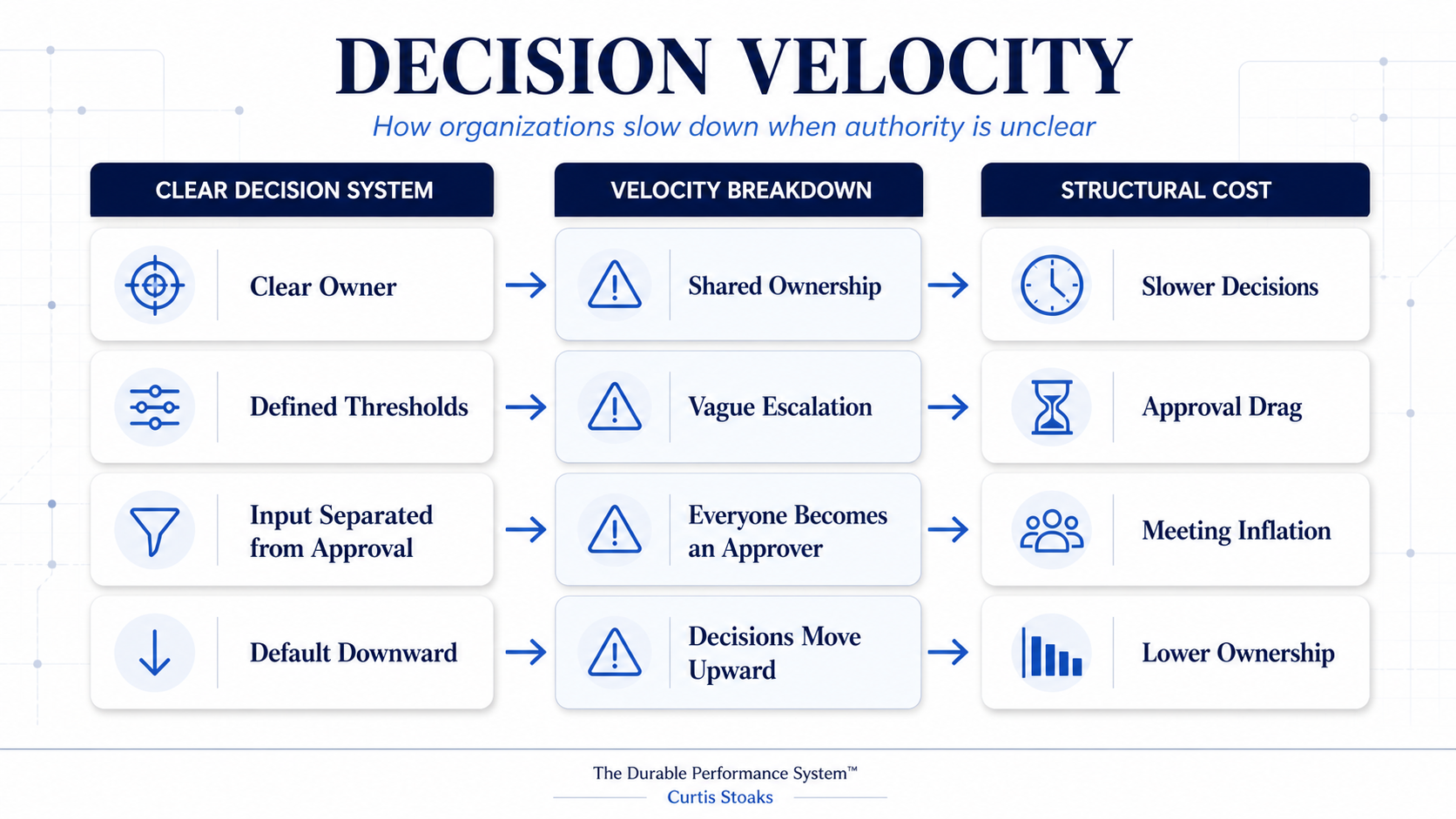
Durable organizations keep routine decisions close to the work, make escalation thresholds explicit, and separate visibility from permission.
Speed is an outcome of design.
Clear authority, usable information, defined risk thresholds, and predictable accountability allow people to act without repeatedly seeking protection from the center.
Six structural causes of weak decision velocity.
When decisions repeatedly slow, examine the conditions around the decision before blaming urgency, communication, or effort.
Unclear Authority
People cannot move quickly when ownership, decision rights, input roles, and escalation boundaries are ambiguous.
Explore authority design →Excessive Approvals
Every added approval layer teaches the system that progress requires permission, even when the underlying risk has not changed.
Explore approval drag →Escalation Habits
Decisions rise because escalation has become safer, more familiar, or more politically protected than local judgment.
Weak Risk Thresholds
When teams do not know what truly requires senior review, they escalate broadly to protect themselves.
Incomplete or Distorted Information
Decisions slow when leaders receive compressed, delayed, or overly packaged versions of operating reality.
Explore signal integrity →Fear of Reversal or Consequence
When acting creates more personal exposure than waiting, delay becomes rational behavior.
Weak decision velocity appears before execution fails.
The organization still looks active, but more effort goes into aligning, escalating, updating, and protecting decisions than making them.
Ownership Is Unclear
No one can explain who makes the final call, who contributes input, and who only needs to be informed.
Alignment Becomes Approval
A useful coordination practice quietly becomes a requirement for broad permission.
Leaders Over-Enter Routine Decisions
Senior involvement expands until the organization depends on the center for work that should move locally.
Decision Meetings Multiply
More meetings are required to prepare, socialize, review, revisit, and validate the same decision.
Reversal Risk Shapes Behavior
People avoid deciding because prior judgments were overturned without clear learning or protection.
Waiting Feels Safer Than Acting
The penalty for delay is lower than the personal risk of making the call.
Slow execution is often treated as a people problem.
Leaders may ask for more urgency, follow-through, communication, or accountability.
But when the same decision types keep rising, the same review steps keep expanding, and the same teams keep waiting for permission, the issue is usually structural.
The system has taught people that a decision is safer when packaged, aligned, escalated, and approved by someone higher.
Decision drag follows a predictable pattern.
- 1 Pressure rises. A miss, customer escalation, quality issue, or leadership concern increases fear of another mistake.
- 2 Visibility gets added. Reviews, approvals, check-ins, and alignment steps expand.
- 3 Authority moves upward. Teams learn that routine decisions should be escalated before they create exposure.
- 4 Ownership weakens. People manage the approval path instead of the decision itself.
- 5 Execution slows. Delay becomes visible, but dependency is the deeper cost.
Delay compounds beyond the decision itself.
Weak decision velocity changes how work is coordinated, how ownership is experienced, and how dependent the organization becomes on senior leadership.
Execution Drag
Work waits for decisions, handoffs expand, priorities age, and rework grows around unresolved judgment.
Explore execution drag →Coordination Cost
More people spend more time preparing, updating, attending, and interpreting instead of completing useful work.
Lost Ownership
People stop treating outcomes as theirs when the real decision is repeatedly made somewhere else.
Leadership Dependence
Senior leaders become the operating bottleneck while local capability contracts from disuse.
Accountability Distortion
People remain responsible for outcomes without controlling the decisions, timing, or conditions that shape them.
Explore accountability design →Organizational Drift
Temporary controls survive, escalation becomes normal, and the organization adapts to slower operating conditions.
Explore organizational drift →Questions that reveal weak decision velocity.
If the same decision types keep appearing in these answers, the problem is not isolated delay. It is decision design.
Restore movement without lowering discipline.
Improving decision velocity does not mean eliminating judgment, review, or accountability. It means placing each at the level where it adds real value.
Define the owner. Clarify who provides input. Set the risk threshold. Distinguish visibility from permission. Protect sound local judgment. Review the decision rule, not every decision.
About decision velocity.
Is decision velocity the same as making decisions quickly?
What is the most common cause of slow decisions?
How does approval drag affect decision velocity?
Can greater visibility improve decision velocity?
How should leaders improve decision velocity?
Slow decisions usually reveal a design problem.
The earlier leaders can identify unclear authority, unnecessary approvals, escalation habits, weak thresholds, distorted information, and fear of reversal, the easier it becomes to restore decision velocity before dependency hardens.