What Is Approval Drag?
Approval drag happens when decision-making slows because too many people, layers, or visibility steps are required before action. What begins as caution often becomes dependency.
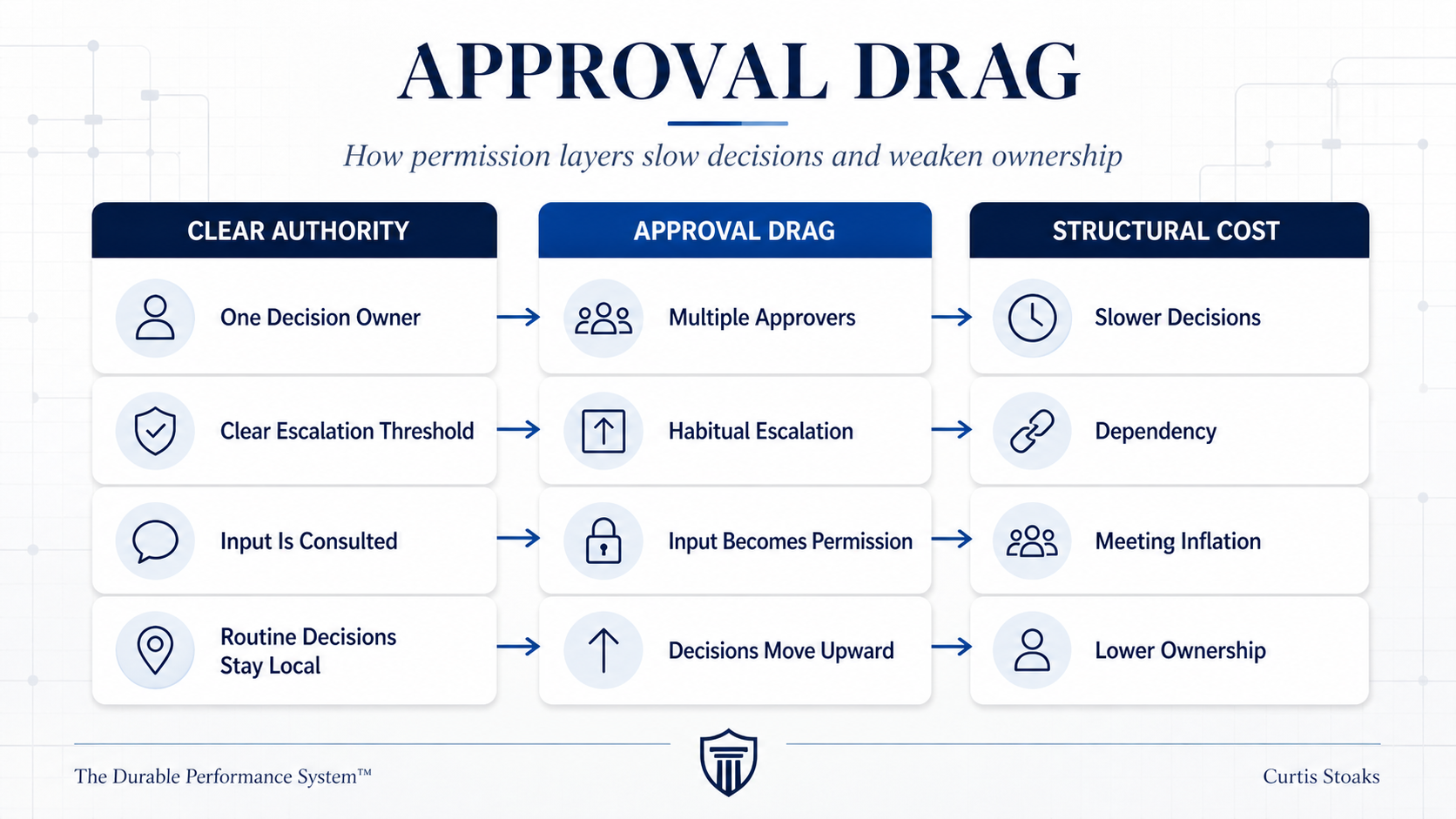
Approval drag is friction disguised as discipline.
Healthy oversight protects the system from real risk. The problem starts when routine decisions move through unnecessary permission loops, slowing execution while making leaders feel more informed.
Delay is visible. Dependency is the real cost.
The obvious cost is slower decision-making. The deeper cost is that people stop practicing judgment. They learn to package decisions for approval instead of owning them within clear guardrails.
Early signs of approval drag
The pattern often appears while the organization still believes it is being careful. The language sounds responsible, but the system becomes slower and more dependent.
Decisions move upward
Decisions that used to be local now require leader, director, or executive approval.
Input turns into permission
People who should be consulted begin behaving like approvers, creating unnecessary veto points.
Meeting load increases
Meetings multiply because unclear authority requires more discussion before anyone feels safe acting.
Ownership weakens
When people expect decisions to be reviewed or overridden, they stop fully owning judgment.
Truth gets compressed
Teams package updates carefully because the approval path rewards narrative control.
Delay becomes defensible
Waiting becomes rational because the system treats caution as maturity even when risk is routine.
Good intent can still create structural drag.
A mistake happens. A customer escalation becomes visible. A leader loses confidence in a local decision. The response is to add more visibility or approval.
That response may be reasonable in the moment. The problem starts when the added layer survives after the moment that justified it has passed.
Leaders feel safer because more decisions touch the center. Teams feel slower because more decisions require permission. Only one of those experiences reveals the structural cost.
The approval drag sequence is predictable
- 1 A visible mistake creates pressure. Leadership wants to prevent recurrence and reduce exposure.
- 2 An approval layer gets added. The new step feels temporary, prudent, and responsible.
- 3 The layer becomes normal. Removing it feels riskier than keeping it, so it stays.
- 4 Teams adapt to permission. People escalate earlier, package decisions carefully, and wait longer.
- 5 Ownership weakens. The organization appears safer, but capability narrows beneath the approval structure.
How approval drag weakens the operating system
The slowdown is rarely caused by a single bad process. It is usually produced by unclear authority, vague thresholds, too many approvers, and leadership reentry.
Authority Design
When no one knows who owns the final call, decisions drift into shared approval.
Read more →Decision Velocity
Every extra approval layer adds coordination cost and slows judgment moving into action.
Read more →Execution Drag
Meetings, reviews, and handoffs accumulate until friction becomes part of the operating model.
Read more →Signal Integrity
Approval paths often reward safer narratives instead of cleaner operating reality.
Read more →Leadership Systems
When leaders repeatedly reenter routine decisions, the system learns to wait for them.
Read more →Questions that reveal approval drag
If the same approval points appear repeatedly, the problem is not isolated delay. It is a decision-design problem.
Choose the next step that fits the problem.
Approval drag improves when decision rights are explicit, escalation thresholds are narrow, and leaders stop treating visibility as the same thing as control.
Take the Drift Diagnostic
Identify whether slow approvals are coming from authority, signal, incentives, accountability, or complexity.
Start the diagnostic →Read the books
Go deeper into organizational drift, structural performance, leadership, companies, and careers.
Explore the books →Use the resources
Access practical tools, doctrine overviews, and applied materials.
View resources →Read the Brief
Follow concise essays on authority, incentives, accountability, execution, and organizational design.
Browse the Brief Archive →Approval drag is accumulated permission.
The earlier you can identify which approvals protect real risk and which merely preserve habit, the easier it becomes to restore ownership, decision velocity, and structural clarity.