What Is Execution Drag?
Execution drag is the accumulated friction that slows work after priorities are set and decisions are made. Handoffs, meetings, rework, unclear ownership, competing commitments, and approval dependencies consume capacity without creating proportional progress. These conditions reflect organizational design and directly reduce organizational effectiveness.
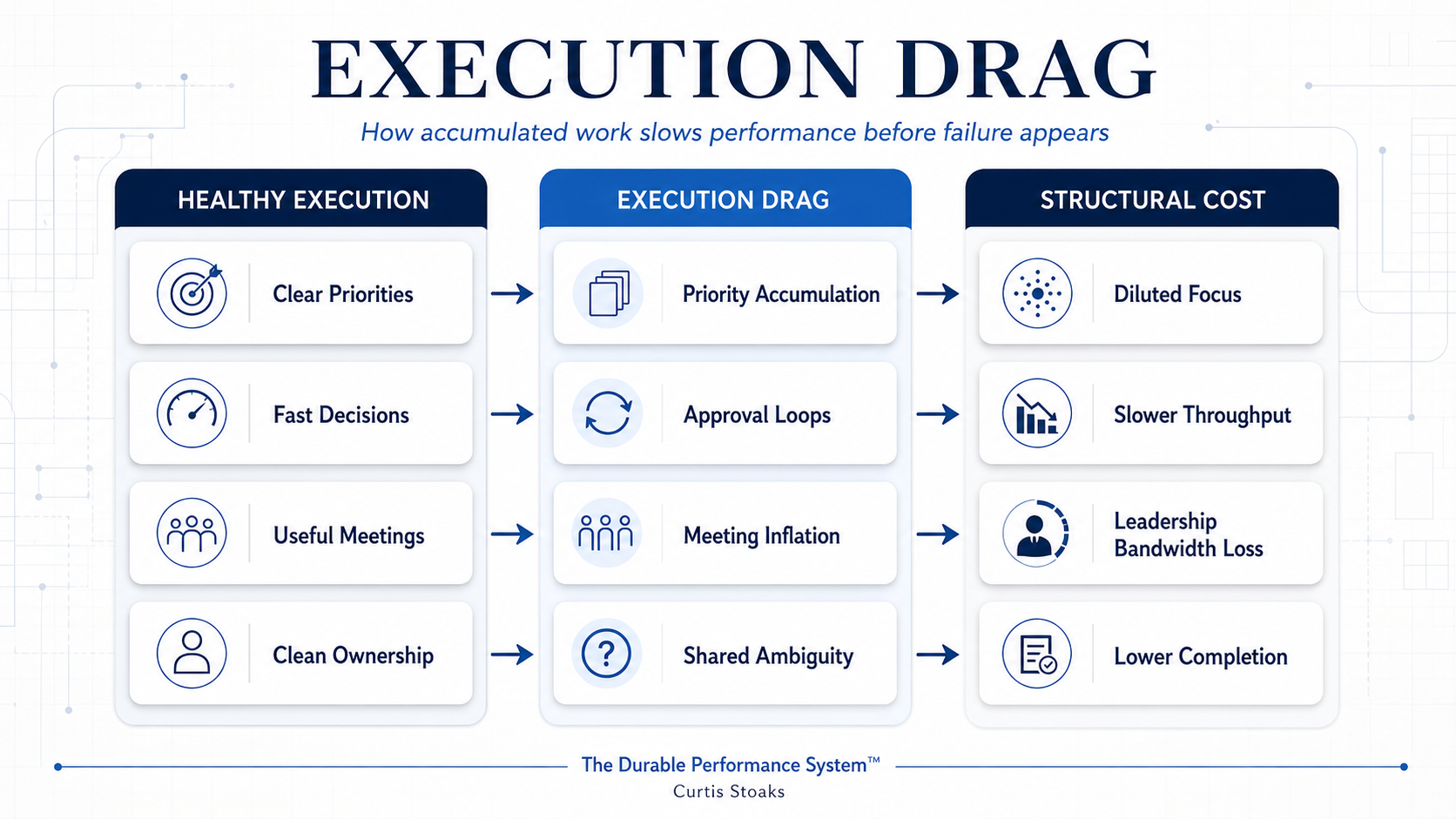
Overload is structural drag.
Execution slows when leaders keep adding priorities, meetings, projects, approvals, and reporting without removing anything. Subtraction is often the strongest performance intervention.
Prefer to read? Continue below for the definition, causes, early signals, effects, and diagnostic questions.
Execution drag is friction hidden inside activity.
It appears when the operating system requires more coordination, waiting, switching, clarification, approval, and rework than the work itself should demand.
The organization remains busy. Calendars stay full. Updates continue. Yet completion, throughput, focus, and ownership weaken.
As part of organizational design , execution drag reveals how work, priorities, authority, information, coordination, and capacity have been arranged.
Execution drag is not low effort.
It is also not the same as ordinary workload. A demanding workload can still move cleanly when priorities, ownership, information, and decision rights are clear.
Motion is not throughput.
More projects, meetings, messages, and effort can create the appearance of productivity while fewer important outcomes reach a clean finish.
Execution drag reveals how the system is arranged and what it produces.
Recurring friction is not only an execution problem. It is evidence that the operating structure is consuming too much capacity before effort can become completed work.
Organizational Design
Organizational design includes how work, authority, information, incentives, accountability, coordination, priorities, and operating mechanisms are arranged.
Execution drag appears when that design creates too many handoffs, unresolved dependencies, competing priorities, delayed decisions, recurring meetings, unclear ownership, and approval requirements.
Organizational Effectiveness
Organizational effectiveness reveals whether the system converts available effort, information, decisions, and resources into intended outcomes without excessive friction or dependence.
Execution drag reduces effectiveness by increasing work in progress, coordination cost, rework, waiting, employee overload, leadership intervention, and the effort required to complete each result.
Seven structural sources of friction.
When the same execution problems appear across capable teams, examine the operating conditions before demanding more urgency.
Too Many Handoffs
Work crosses unnecessary roles, functions, systems, or approval points before anyone can complete it.
Unclear Ownership
People coordinate around the work because no one has clean authority over the outcome, tradeoffs, or next decision.
Explore authority design →Conflicting Priorities
Multiple commitments compete for the same capacity without explicit sequencing, tradeoffs, or removal.
Repeated Rework
Late input, unclear standards, changing direction, and weak decisions force teams to redo work that appeared complete.
Excessive Meetings and Reporting
Coordination expands because leaders lack confidence in ownership, information, or progress.
Approval Dependencies
Work pauses while people seek visibility, alignment, review, or permission that does not materially change the risk.
Explore approval drag →Weak Information Flow
Teams move with incomplete, delayed, filtered, or conflicting information and discover problems after execution is underway.
Explore signal integrity →Execution drag appears while the organization still looks productive.
The team continues working hard, but progress becomes heavier, more fragmented, and increasingly dependent on coordination.
Priorities Compete
Teams cannot identify which commitment should win when time, people, or attention become constrained.
Meetings Inflate
More coordination is required because ownership, tradeoffs, standards, and decisions remain unclear.
Decisions Slow
Dependencies, stakeholders, review loops, and incomplete information delay work before it can move.
Completion Weakens
New work launches continuously while fewer initiatives reach a clear finish with measurable outcomes.
Rework Becomes Normal
Teams repeatedly revise completed work because expectations, input, or authority arrived too late.
High Performers Absorb the Load
The strongest employees compensate until their effort becomes an invisible operating dependency.
Slow execution is often treated as weak urgency.
Leaders may ask for more discipline, follow-through, communication, or accountability.
But when the pattern repeats across teams, people may be carrying too many priorities, navigating too many handoffs, attending too many meetings, waiting through too many approvals, and absorbing too many unresolved tradeoffs.
The team is not necessarily failing to execute. It may be executing inside a system that has become too heavy.
The breakdown is predictable.
- 1 New work gets added. Initiatives, priorities, controls, and reporting expand without retiring older commitments.
- 2 Capacity becomes fictional. The organization accepts work based on optimism instead of explicit tradeoffs.
- 3 Coordination expands. Meetings, updates, handoffs, and alignment steps increase to manage the load.
- 4 The operating design changes. Additional meetings, roles, handoffs, reports, and workarounds become permanent parts of how work moves.
- 5 Throughput declines. Work remains active, but decisions slow, rework grows, and fewer outcomes close cleanly.
- 6 Compensation rises. High performers, experienced managers, and senior leaders absorb unresolved load through extra effort.
- 7 Effectiveness narrows. The organization consumes more effort, time, and coordination to produce the same or weaker result.
- 8 Drag becomes normal. The organization stays busy while capacity, clarity, ownership, and momentum continue to degrade.
Friction compounds across the operating system.
Execution drag changes organizational design, reduces organizational effectiveness, consumes usable capacity, weakens accountability, and increases dependence on employees and leaders who compensate for the system.
Organizational Design
Temporary handoffs, meetings, workarounds, reporting, and coordination roles become permanent parts of the operating structure.
Explore organizational design →Organizational Effectiveness
More effort is consumed by coordination, waiting, rework, and switching before it becomes useful output.
Explore organizational effectiveness →Decision Velocity
More handoffs, dependencies, stakeholders, and review steps increase the time between judgment and action.
Explore decision velocity →Accountability
Ownership becomes less credible when outcomes depend on decisions, resources, or handoffs controlled elsewhere.
Explore accountability design →Usable Capacity
Coordination, switching, waiting, reporting, and rework consume time that appears available on paper.
Employee Overload
People carry more open loops, competing commitments, emotional pressure, and unfinished work than the system acknowledges.
Leadership Dependence
Leaders become the clearinghouse for priorities, tradeoffs, decisions, and conflict the structure should resolve.
Organizational Drift
Accumulated friction becomes normal when leaders explain recurring drag instead of removing the conditions producing it.
Explore organizational drift →Subtraction is an execution discipline.
Every recurring meeting, report, approval, handoff, project, metric, and priority places weight on execution. That weight should remain only when it improves a decision, protects meaningful risk, or produces a necessary outcome.
Structural simplicity does not mean removing rigor. It means removing work and complexity that no longer earn continuation.
Questions that reveal execution drag.
If these questions produce immediate examples, the organization does not only have a speed problem. It has accumulated structural load.
Use the Drift Diagnostic →Remove load before demanding more effort.
Clarify the few priorities that must win. Stop or defer work without sufficient capacity. Reduce handoffs. Name the outcome owner. Remove approvals that do not change risk. Eliminate reporting that does not change a decision. Correct information flow before rework begins.
The goal is not to make people busier or faster. It is to increase the percentage of effort that becomes completed, useful work.
Execution drag rarely operates alone.
Organizational Design
Execution drag reflects how work, authority, priorities, information, accountability, and coordination are arranged.
Explore organizational design →Organizational Effectiveness
The cost of execution drag becomes visible through declining throughput, completion, adaptability, usable capacity, and outcome durability.
Explore organizational effectiveness →Approval Drag
Permission loops add waiting and coordination before work can proceed.
Explore approval drag →Authority Design
Clear ownership reduces escalation, meeting inflation, and unresolved tradeoffs.
Explore authority design →Signal Integrity
Timely operating truth reduces late correction and repeated rework.
Explore signal integrity →Accountability Design
Standards, ownership, authority, follow-up, and consequence must remain aligned.
Explore accountability design →Choose the next structural path.
Execution drag becomes actionable when leaders examine how work is arranged, what that arrangement produces, and which accumulated sources of friction should be removed.
Organizational Design
Examine how priorities, work, authority, information, handoffs, capacity, and coordination are arranged.
Explore Organizational Design →Organizational Effectiveness
Evaluate whether the operating system converts effort into useful, timely, durable outcomes without excessive friction.
Explore Organizational Effectiveness →Structural Simplicity
Remove meetings, reports, approvals, priorities, processes, and commitments that no longer earn continuation.
Explore Structural Simplicity →Approval Drag
Identify permission loops and review layers that delay execution without meaningfully changing risk.
Explore Approval Drag →The Drift Diagnostic
Identify where accumulated priorities, weak ownership, approval dependencies, filtered information, or structural overload may already be changing the system.
Take the Drift Diagnostic →The Durable Performance System™
See how execution drag connects with design, effectiveness, authority, incentives, signal, accountability, consequence, and simplicity.
See the Complete System →About execution drag.
Is execution drag the same as having too much work?
How is execution drag different from low productivity?
How does execution drag relate to organizational design?
How does execution drag affect organizational effectiveness?
What is the clearest sign of execution drag?
Why do high performers hide execution drag?
How should leaders begin reducing execution drag?
Execution drag is not solved by asking people to push harder.
The earlier leaders identify where priorities accumulated, ownership blurred, decisions slowed, handoffs expanded, and rework became normal, the easier it becomes to improve organizational design, remove structural load, and strengthen organizational effectiveness.